What Changes
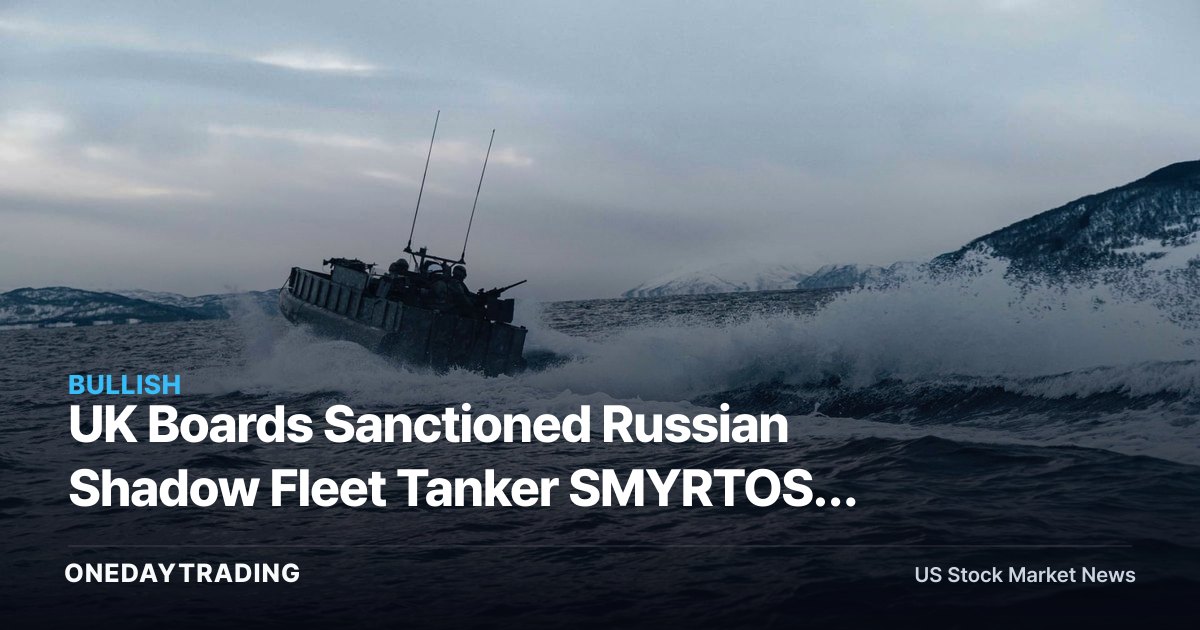
For most of the post-2022 sanctions period, enforcement against Russian oil exports has been largely financial — price caps, insurance restrictions and entity listings. The boarding of the SMYRTOS marks a shift toward direct physical interdiction at sea, in one of the world's busiest shipping lanes. That sends a signal to operators of aging, opaquely owned tankers that the shadow fleet's freedom of movement through European waters is no longer guaranteed.
If interdictions become more routine, the effective transport cost of sanctioned crude rises. Shadow-fleet vessels already command premium charter rates because of their legal and insurance exposure; detentions add the risk of cargo and asset seizure. At the margin, that can pull some barrels off the water or force deeper discounts on Russian grades, tightening the supply available to global buyers and supporting benchmark prices.
By the Numbers
No financial figures were disclosed in the report — the core facts are the vessel name (SMYRTOS), the location (English Channel), and the action (boarded and held off the south coast for investigation). The market read is therefore qualitative: a single detention does not move global balances, but it establishes a precedent that traders will price into Russian crude discounts and freight risk if repeated.
Winners & Losers
- XOM, CVX — Western oil majors benefit if Russian barrels face higher friction and prices firm.
- Energy sector (XLE) — broad upstream exposure gains from any supply-side risk premium.
- Refiners (VLO, MPC) — mixed; tighter discounted crude supply can pressure feedstock margins.
- Shipping/tanker names (FRO) — compliant tanker operators may gain pricing power as shadow capacity is constrained.
Risk Check
- A single boarding is symbolic; without sustained enforcement the supply impact is negligible.
- Russia and buyers can reroute via non-European waters, blunting the chokepoint effect.
- Demand-side weakness or OPEC+ output decisions could overwhelm any modest supply tightening.
- Escalation carries geopolitical headline risk that cuts both ways for energy equities.
Bottom Line
The SMYRTOS detention is a measured but meaningful escalation in sanctions enforcement that tilts oil supply risk modestly to the upside, supporting Western producers like XOM and CVX — though one interdiction alone is far from a durable catalyst, and broader demand and OPEC+ dynamics still dominate the price path.
📊 Analysis
Signal Bullish
Why Physical interdiction of shadow-fleet tankers raises the cost of moving sanctioned Russian crude, a marginal supply-tightening positive for oil prices and Western producers.
Tickers$XOM$CVX$VLO$MPC$FRO
This article was independently written by OneDayTrading from public reporting. Read the original (CNBC)