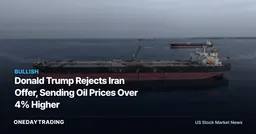
Donald Trump’s Denial Leaves Oil Investors With Two Conflicting Signals
Donald Trump’s rejection of reported sanctions relief leaves oil investors balancing an active diplomatic channel against unresolved terms. On the article date shown in CNBC’s source URL, 2026-09-30, Iran’s cabinet had received a U.S. proposal following talks with Qatari mediators in Doha. The immediate relevance for commodity markets is not evidence of an agreement, but the coexistence of negotiations and firm crude prices.
CNBC reported that Brent crude was up 1.16% at $103.78 per barrel at 5:34 a.m. E.T. The same report showed U.S. West Texas Intermediate futures up 1.13% at $90.39 per barrel at 5:34 a.m. E.T. Those moves establish the market snapshot; the supplied evidence does not establish that the diplomatic developments caused them.
For investors, the distinction matters. The tape confirms higher Brent crude and U.S. West Texas Intermediate futures at the stated time, while the political record confirms contact without revealing an agreed outcome. Reading the price move as proof that negotiations will fail would go beyond the evidence, just as treating the proposal’s delivery as proof of de-escalation would confuse process with result.
Iran Receives a U.S. Proposal, While Its Terms Stay Undisclosed
Iranian Foreign Minister Abbas Araqchi presented the Iranian cabinet with a U.S. proposal after meetings with Qatari mediators in Doha earlier in the week, according to a government spokesperson. In this context, the proposal is the formal subject placed before Iran’s cabinet; its contents, requested concessions and prospective relief were not disclosed in the available facts.
The diplomatic channel therefore has substance, but not yet a visible bargain. A proposal reached the cabinet after mediation, which is more concrete than a general statement of intent. No confirmed evidence says whether Iran accepted or rejected it, and the identity of the government spokesperson who disclosed the presentation was not provided.
Qatar was seeking to broker a lasting peace settlement between Washington and Tehran during a Middle East conflict described by CNBC as having lasted seven months. Qatari foreign ministry spokesperson Majed al-Ansari said, “We're working towards establishing a common ground in order to get into a deal that would save all of us from the repercussions of the conflict.” His wording describes an effort to create negotiating space, not a completed settlement.
That gap between delivery and decision is the central analytical constraint. Investors can verify that a U.S. proposal entered Iran’s cabinet process and that mediation continued. They cannot infer its economic scope, the specific nuclear steps under discussion or the probability of a final peace settlement from the disclosed record.
Axios Report Meets an Explicit Rebuttal From Donald Trump
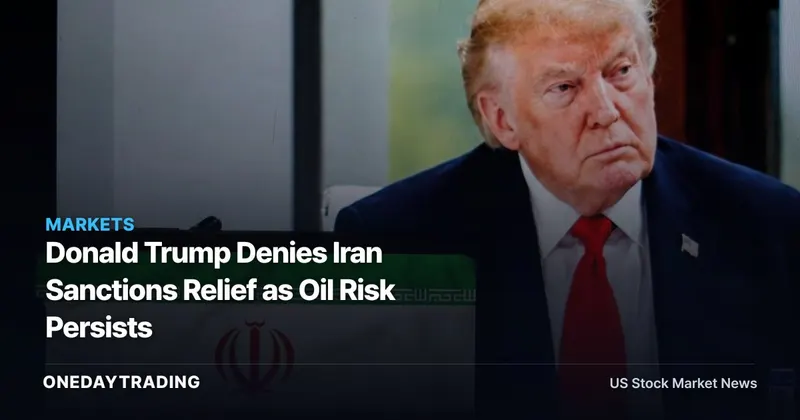
Donald Trump disputed an Axios account claiming that he was prepared to offer Tehran sanctions relief and release frozen Iranian funds in return for concrete steps on Iran’s nuclear program. He wrote, “This is untrue. I offered them NOTHING!” and separately called the report a “HOAX,” according to CNBC. The denial directly contests the reported terms rather than the confirmed fact that Iran’s cabinet received a U.S. proposal.
This creates two separate questions that should not be collapsed. One is whether Washington transmitted a proposal after the Doha meetings; the confirmed account says it did. The other is whether that proposal contains sanctions relief, access to frozen funds or specified nuclear concessions; those details remain unknown, and Trump explicitly denied the reported offer.
The distinction limits what can be priced with confidence. A continuing channel between Washington and Tehran could eventually produce information relevant to the conflict, sanctions and crude markets. At present, neither the denial nor the cabinet presentation establishes what Iran was asked to do, what Washington was prepared to provide or whether either side will proceed.
That is why the crude snapshot deserves precision. Brent crude at $103.78 per barrel and U.S. West Texas Intermediate futures at $90.39 per barrel show where the contracts stood at 5:34 a.m. E.T.; they do not reveal which diplomatic account traders accepted. The market data and the political statements are simultaneous evidence, not proof of a single causal chain.
Oil-Market Scenarios and the Next Verifiable Checkpoints
The constructive scenario is conditional on the diplomatic process advancing beyond proposal delivery. Evidence that Iran accepted the U.S. proposal, or that Washington and Tehran established common ground through Qatar, would turn a procedural development into a clearer negotiating outcome. The current record confirms none of those steps.
The adverse scenario is that the parties fail to agree or that the undisclosed proposal does not bridge their positions. Trump’s denial of the sanctions-relief report also leaves uncertainty over what economic terms, if any, accompany the U.S. approach. Without the text or an official description, investors cannot reliably map the proposal to sanctions policy or oil-market consequences.
- Check Iran’s formal response: acceptance, rejection or a counterproposal would provide the next concrete signal from Tehran.
- Check the proposal’s disclosed terms: investors need confirmation of any sanctions provisions, frozen-fund provisions and nuclear steps before assigning an economic effect.
- Check Qatar’s mediation: the relevant milestone is evidence that Washington and Tehran have established the common ground Qatar is seeking, not another broad expression of intent.
- Check crude with full timing: compare subsequent moves with CNBC’s stated baseline of Brent crude at $103.78 per barrel and U.S. West Texas Intermediate futures at $90.39 per barrel, both recorded at 5:34 a.m. E.T.
The disciplined read is neutral rather than complacent. Diplomacy remains active, crude prices were higher in the reported snapshot, and the decisive terms are still unavailable. The next investable change comes when one of those unknowns becomes a confirmed decision.
📊 Analysis
Signal Neutral
Why Oil prices were higher while diplomatic engagement continued, but the proposal’s undisclosed terms and Iran’s unanswered response prevent a directional sector call.
This article was independently written by OneDayTrading from public reporting. Read the original (CNBC)