What Changes
The headline number that grabs attention is the salary, but the substance is governance. When the person nominally running a top-tier gold exporter is compensated at a level that does not match the role, it signals that the official books may not reflect how value and control actually flow through the company. For a business whose product is fungible, high-value, and easy to move across borders, weak internal controls are not a cosmetic issue.
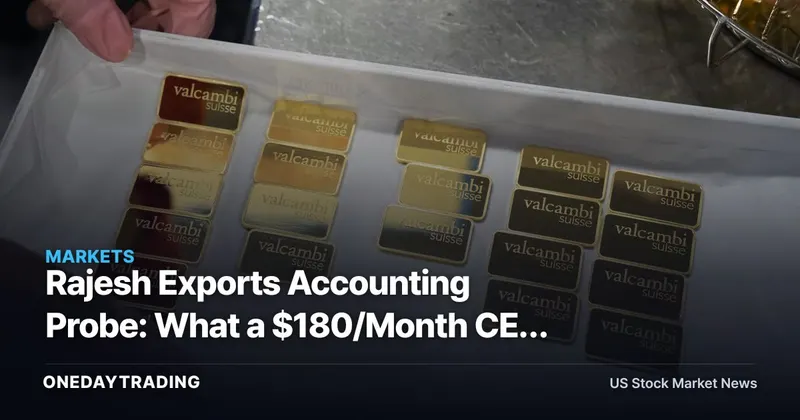
Valcambi sits at the heart of why this travels beyond India. As one of the world's larger precious-metals refiners, its bars circulate through vaults, ETFs, and bullion dealers globally. An accounting probe at the parent does not automatically taint refined metal, but it does push institutional buyers to lean harder on accreditation, chain-of-custody documentation, and counterparty due diligence rather than brand reputation alone.
By the Numbers
The single hard figure from the investigation is the reported 180 dollars per month in managing-director pay. That is the kind of disclosure that tends to trigger deeper forensic review of inter-company transactions, related-party dealings, and reported margins. Until Indian authorities quantify the discrepancies, the scale of any restatement or penalty remains undefined, which is itself the central uncertainty.
Winners & Losers
- Transparent, accredited refiners and miners: Buyers paying a premium for documented provenance gain relative appeal when a large peer faces a governance cloud.
- Rajesh Exports and Valcambi counterparties: Banks, dealers, and ETF custodians sourcing from the group face reputational and operational review costs.
- Physical gold demand broadly: Largely insulated, since the probe concerns one company's books, not the metal's value.
- Compliance and assurance providers: Auditors and supply-chain verification services see demand reinforced by cases like this.
Risk Check
- The investigation is early; allegations are not findings, and the financial impact is not yet sized.
- This is an India-listed company with no direct US equity exposure, so read-through to American stocks is indirect.
- Gold prices respond to rates, the dollar, and central-bank buying far more than to a single firm's audit.
- Cross-border refining relationships are opaque, making second-order exposure hard to map.
Bottom Line
For US investors the practical signal is not a trade but a reminder: the value of physical gold rests on a supply chain whose weakest governance links rarely surface until an investigation forces them into view. The probe is a credibility test for one major exporter, not a verdict on bullion itself, and the metric that matters next is whatever number Indian authorities ultimately attach to the discrepancies.
📊 Analysis
Signal Neutral
Why The probe targets an India-listed company with no direct US equity exposure, and gold prices are driven by macro factors rather than one firm's accounting issues.
This article was independently written by OneDayTrading from public reporting. Read the original (CNBC)