Why Pennsylvania’s 1st District Matters to Investors
Brian Fitzpatrick’s reelection contest is primarily a political-risk event rather than a stock-specific catalyst. He is seeking a sixth House term against Bob Harvie, a former high school social studies teacher and county commissioner, in an election whose outcome could contribute to control of Congress. The available facts do not establish a direct beneficiary or victim among U.S.-listed companies, so the investable signal lies in the balance of power rather than in an immediate sector call.
Pennsylvania’s 1st Congressional District election is a House race between a Republican incumbent and a Democratic challenger. Its significance comes from the competitiveness of the seat and the Nov. 3 decision over congressional control, not from any confirmed change in tax, spending or industry policy.
Fitzpatrick’s record complicates a simple party-line interpretation. He voted against the final version of Republicans’ 2025 tax and spending package after supporting an earlier House iteration. That sequence shows why investors cannot infer his future vote from either his party label or one isolated roll call.
The Fitzpatrick-Harvie Polling Picture
The polling evidence points in different directions. A Global Strategy Group internal survey for the Harvie campaign showed Bob Harvie and Brian Fitzpatrick tied. A September poll by Public Opinion Strategies for the National Republican Congressional Committee and Fitzpatrick’s campaign placed Brian Fitzpatrick ahead by nine percentage points.
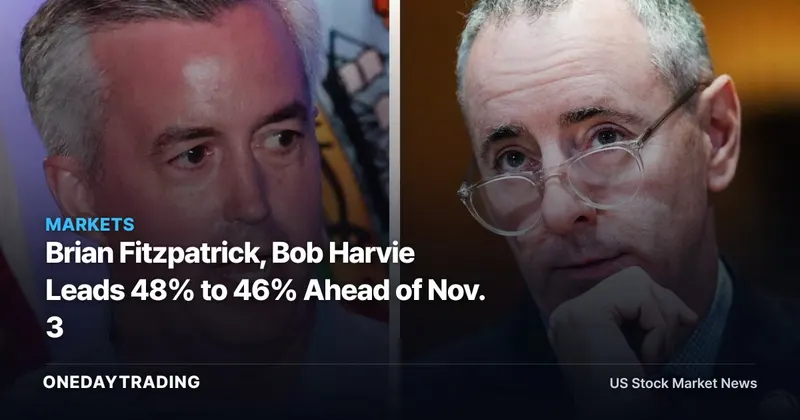
The poll released Sunday produced the opposite ordering: Bob Harvie received 48% and Brian Fitzpatrick received 46%, CNBC reported, with the result inside the margin of error. The precise margin of error and complete methodologies for the cited surveys are not supplied. Independent public polling is also sparse, limiting confidence in any single estimate.
The clean analytical conclusion is that the race is competitive, not that momentum guarantees an outcome. Campaign-sponsored surveys require careful attribution, and a narrow public-poll lead inside the margin of error does not establish who will win. The next decisive checkpoint is the Nov. 3 election itself.
Ticket Splitting Is Fitzpatrick’s Core Defense
Brian Fitzpatrick won 55% of voters in the district in 2022, while Josh Shapiro won 59% of the vote there during the same period, according to CNBC. Those results demonstrate that district voters have previously supported candidates from different parties on the same ballot. They do not prove that the pattern will repeat.
The district also opted for Joe Biden in 2020 and Kamala Harris in 2024. Fitzpatrick’s case therefore depends on maintaining an identity distinct from the broader Republican label. He summarized that argument directly to CNBC: “Brian Fitzpatrick is Brian Fitzpatrick. I’m not Donald Trump. I’m not anybody else.”
That distinction is the central test of the election. A Fitzpatrick victory would show that his personal electoral record remained sufficient in a district that backed Democratic presidential candidates in the cited elections. A Harvie victory would show that the challenger overcame both incumbency and the district’s demonstrated willingness to split its votes. Neither scenario is known in advance.
Campaign Spending Signals a Contested Seat
Outside spending confirms that both parties are treating the district as consequential. The Democratic Congressional Campaign Committee committed more than $1.5 million to TV ads since the start of October, and House Democrats’ main super PAC committed more than $7.5 million to TV ads over the same period, CNBC reported.
Republican support is also substantial. The Congressional Leadership Fund committed just under $5 million to ads this election, while the NRCC committed just over $1 million. MAGA Inc. recently purchased $100,000 in ads opposing Harvie, according to an Oct. 12 FEC filing.
These commitments measure campaign attention, not voter conversion. They show that political organizations see value in contesting the seat, though the facts do not reveal the effectiveness, audience reach or persuasion rate of the advertisements. Spending totals therefore strengthen the case that the race matters without resolving which candidate has the advantage.
Cash Advantages and Their Limits
Brian Fitzpatrick reported more than $709,000 in cash on hand as of Oct. 14, compared with Bob Harvie’s just over $409,000, according to CNBC. The incumbent entered the closing stage with the larger campaign reserve on that reporting date.
Cash on hand can indicate available resources, though it is not an election forecast. The outside advertising commitments are larger than either candidate’s reported reserve, making the full competitive picture broader than the two campaign accounts alone. Reilly Richardson pointed to Harvie’s cash disadvantage, while the movement of the race rating and conflicting polls show why funding cannot be read in isolation.
Who Gains From the Pennsylvania Result
- Brian Fitzpatrick: A win would secure the sixth House term he is seeking and preserve a Republican-held seat. His strongest evidence is his 2022 result and the district’s demonstrated ticket splitting.
- Bob Harvie: A win would give Democrats a seat that the Cook Political Report with Amy Walter moved from “Likely R” to “Lean R.” His strongest polling evidence is the Sunday result placing him at 48% against Fitzpatrick’s 46%, within the margin of error.
- Democrats: Erin Covey told CNBC, “If they are able to beat him this cycle, it is definitely going to be a great night for Democrats.” Hakeem Jeffries separately described the state as “incredibly important.”
- Public-market investors: No U.S.-listed company, industry or security is directly connected to the contest in the supplied evidence. Any sector positioning based solely on this district would run ahead of the confirmed facts.
Risks to Any Confident Election Thesis
- Poll disagreement: The available surveys range from a tie to a Brian Fitzpatrick lead of nine percentage points and a Bob Harvie lead of 48% to 46%.
- Limited independent evidence: Sparse public polling and unavailable full methodologies restrict comparison across surveys.
- Candidate-versus-party uncertainty: The district backed Joe Biden in 2020 and Kamala Harris in 2024, while Fitzpatrick captured 55% of voters in 2022.
- Outcome uncertainty: Neither the winner of Pennsylvania’s 1st Congressional District nor the party that will control Congress is known.
The Nov. 3 Bottom Line for Fitzpatrick and Harvie
Brian Fitzpatrick retains evidence of cross-party durability, a larger cash position as of Oct. 14 and a September poll showing a nine-percentage-point lead. Bob Harvie has a competitive race rating, substantial Democratic outside support and a Sunday poll placing him narrowly ahead. For investors, the disciplined stance is neutral: treat Nov. 3 as the point when electoral uncertainty becomes an observable result, then assess congressional control before assigning implications to taxes, spending or individual sectors.
📊 Analysis
Signal Neutral
Why The competitive race could affect control of Congress, though the supplied evidence supports no directional conclusion for U.S.-listed stocks or sectors.
This article was independently written by OneDayTrading from public reporting. Read the original (CNBC)