Luiz Inácio Lula da Silva’s Victory Reprices Brazil Risk
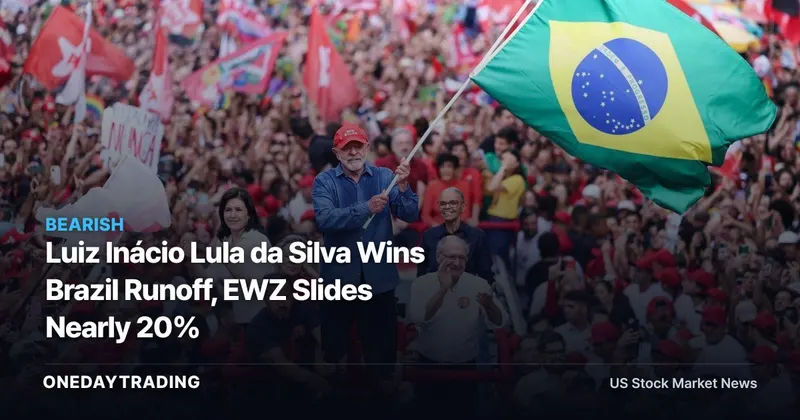
Luiz Inácio Lula da Silva won Brazil’s presidential runoff with 51.8% of valid votes, CNBC reported, securing an unprecedented fourth term after losing the first round. Flávio Bolsonaro received 48.2% of valid runoff votes, according to the same report, leaving a narrow result and an unresolved challenge to the outcome. For investors, the immediate message came from the iShares MSCI Brazil ETF: EWZ fell nearly 20% in overnight trading following the election results.
The election shifts the market’s focus from voting arithmetic to governability and debt stabilization. Lula is expected to govern from 2027 to 2030, while Brazil’s gross debt already stood at 82.9% of GDP in August, its highest level since March 2021. That combination makes fiscal credibility the central variable for Brazilian assets.
What EWZ’s Nearly 20% Fall Says
EWZ is the iShares MSCI Brazil ETF cited in CNBC’s report and the clearest listed instrument in the supplied evidence. Its nearly 20% overnight decline is a direct market move, not proof that any specific fiscal policy has been adopted or that Brazil’s economic outcome is settled.
The size of the move suggests that the result diverged from positioning ahead of the runoff. Chris Turner of ING had forecast that Brazil’s currency and bond markets would rally if Bolsonaro won. Lula’s victory removed that scenario and forced investors to reassess the price they require for fiscal and political uncertainty.
The transmission mechanism is straightforward. When investors question whether government debt can be stabilized, they may demand higher expected returns from exposed assets. Higher required returns compress the valuations investors are willing to assign, even before changes in spending, taxation or public investment become measurable.
The tape has therefore priced an immediate increase in perceived risk. It has not priced a confirmed Lula fiscal program because the fact set provides no settled future policies. That distinction matters: a sharp ETF decline can reflect uncertainty and prior positioning without establishing the eventual direction of earnings, growth or public finances.
Brazil’s 82.9%-of-GDP Fiscal Test
Brazil’s gross debt reached 82.9% of GDP in August, according to the Central Bank of Brazil as cited by CNBC. The level was the highest since March 2021, making debt stabilization more than an abstract campaign debate. It is the balance-sheet constraint through which the election result reaches asset valuations.
A credible fiscal path could reduce the risk premium embedded after the vote. A path that leaves spending growth and the debt trajectory unclear could keep pressure on Brazilian-market pricing. The sheet does not provide the exact amount of gross debt, so the relevant benchmark is the reported ratio to GDP rather than an unsupported currency figure.
Alejo Czerwonko described the likely direction as a “gradual approach” that would build on the existing fiscal framework while preserving public investment and social spending. Goldman Sachs analysts expected “modest measures” to contain spending growth, accompanied by further increases in an already high tax burden, with major structural reforms unlikely.
Those assessments describe expectations, not enacted outcomes. Investors need to separate the appeal of gradual adjustment from its capacity to alter the debt trajectory. The decisive evidence will be whether announced measures provide a visible route from fiscal intent to debt stabilization.
Flávio Bolsonaro’s Challenge Extends the Political Risk Window
Flávio Bolsonaro refused to concede and said he would seek annulment of the result, according to Reuters as reported by CNBC. The final resolution of that proposed request is not provided. Until its status is known, the election carries a political-process uncertainty alongside the fiscal question.
Voting was extended by 2 hours after voter-suppression allegations and requests from the campaigns. Supreme Court Justice Cristiano Zanin’s extension was called “unacceptable” by Bolsonaro. The available evidence does not establish the outcome of the allegations, so they should not be treated as proven misconduct.
The runoff was also historically unusual. It was the first time since Brazil returned to direct elections in 1989 that a candidate won the final runoff after losing the first round. The exact ballot count is unavailable, though the Superior Electoral Court reported the 51.8%-to-48.2% division with nearly all ballots counted on Sunday.
The Wider Political Signal
Lula’s victory also carries an international-policy dimension. Donald Trump had characterized Bolsonaro’s first-round lead as “a very, very big victory.” Daniela Portella Sampaio said Trump would have preferred a Brazilian leader more closely aligned with U.S. foreign policy as Washington sought to project power across the Americas.
Regional leaders recognized the result. Keiko Fujimori called the outcome a “democratic day,” while Orsi Yamandu congratulated Lula and called him a “friend.” These responses confirm diplomatic acceptance from the leaders identified in the report; they do not establish an economic or market outcome.
A separate political reversal occurred in Serbia on the same day. Aleksandar Vucic conceded defeat in a parliamentary election to a student-led opposition movement, ending 14 years of leadership. No relationship between Serbia’s result and the Brazilian market move is established in the supplied evidence.
Brazil Assets: The Bull Case and the Risk Case
- Constructive case: Lula could convert the expected gradual approach into measures that convince investors Brazil can stabilize debt while preserving stated spending priorities. If the fiscal path becomes more credible, part of the risk premium reflected in EWZ could unwind.
- Risk case: Modest measures may prove insufficient to change investor perceptions when gross debt is already 82.9% of GDP. Further uncertainty over spending growth, taxation or structural reform could keep required returns elevated.
- Political condition: A clear resolution of Bolsonaro’s proposed annulment request could narrow the uncertainty surrounding the electoral process. An unresolved challenge could prolong it.
- Positioning condition: EWZ’s nearly 20% overnight fall shows that the initial repricing was severe. The move alone cannot reveal how much reflects fiscal concerns, political uncertainty or the reversal of pre-election expectations.
What Investors Should Check Next
- Fiscal detail: Look for measures that specify how spending growth and the debt trajectory would be contained, rather than relying on broad descriptions of gradualism.
- Debt direction: Compare subsequent gross-debt readings with the August level of 82.9% of GDP and the March 2021 reference point.
- Electoral resolution: Track the formal status of Flávio Bolsonaro’s proposed annulment request and any authoritative finding concerning the voter-suppression allegations.
- Market confirmation: Watch whether EWZ extends or reverses its nearly 20% overnight decline once investors can assess fiscal decisions rather than election expectations.
The Next Trigger for Lula and EWZ
The election delivered a winner, not a complete market roadmap. Lula’s 51.8% runoff victory established political control for the expected 2027-to-2030 term, while the EWZ decline registered immediate skepticism about the investment backdrop.
The next decisive trigger is fiscal evidence. A policy path capable of addressing gross debt at 82.9% of GDP could challenge the bearish first reaction; vague or insufficient measures could validate it. Until those details arrive, EWZ reflects a repricing of probabilities rather than a final judgment on Lula’s presidency.
Market data check: iShares MSCI Brazil ETF
iShares MSCI Brazil ETF last traded near $31.69 (-25.59%). Our composite signal — blending price momentum and news flow — reads 🟡 neutral. Price momentum scores 5/100 (soft).
Data as of publication. Price via market feeds; for reference only, not investment advice.
📊 Analysis
Signal Bearish
Why EWZ’s nearly 20% overnight decline shows investors assigning a heavier risk premium to unresolved fiscal and political questions after the runoff.
This article was independently written by OneDayTrading from public reporting. Read the original (CNBC)