Key Takeaways
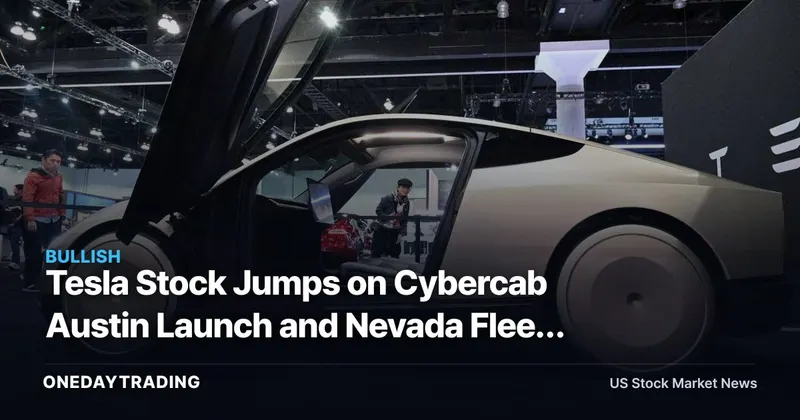
Tesla (TSLA) stock jumped after MarketWatch reported that Tesla is preparing a robotaxi push, with Cybercab planned for launch in Austin, Texas, and regulatory approval to deploy thousands of vehicles in Nevada.
The investor read-through is straightforward: Tesla (TSLA) is trying to shift the equity story from electric-vehicle unit economics toward autonomous mobility capacity, but the market still needs proof that permission becomes revenue.
What Happened
Tesla (TSLA) moved higher after MarketWatch reported that Tesla is getting ready to launch Cybercab in Austin, Texas, and received clearance to deploy thousands of vehicles in Nevada. The report gives Tesla (TSLA) two near-term geography markers for its robotaxi strategy rather than a broad, undated autonomy claim.
A robotaxi push means Tesla (TSLA) is attempting to turn autonomous vehicles into a paid transport service, where fleet deployment, vehicle utilization and regulatory clearance matter as much as vehicle sales. For investors, the key mechanism is mix: successful robotaxi operations would attach software-like economics to an automaker still judged heavily on delivery volumes and pricing.
The stock reaction matters because Tesla (TSLA) has been valued partly on autonomy optionality for years. MarketWatch's report adds a concrete operating path, but Tesla (TSLA) still has to show that Austin Cybercab activity and Nevada vehicle deployment can translate into usage, safety performance and financial contribution.
Background & Context
Tesla (TSLA) sits at the intersection of EV manufacturing, autonomous driving and mobility services. In a capital-cycle business, the difference between a demonstration and a fleet is critical because vehicles consume cash before they produce service revenue.
The Nevada approval to deploy thousands of vehicles is the more scalable fact in the report because capacity, not presentation, determines the size of the opportunity. The Austin Cybercab launch is the customer-facing test because service quality, route density and operational reliability determine whether autonomy becomes a transport product.
Market & Stock Impact
- Tesla (TSLA): Tesla (TSLA) benefits if Cybercab in Austin and thousands of Nevada vehicles raise the probability that autonomous mobility becomes a revenue line beyond EV sales.
- EV sector: The EV sector gains a narrative tailwind if Tesla (TSLA) reframes competition around autonomous service capacity instead of only vehicle pricing and delivery growth.
- Autos sector: Legacy automakers face a sharper technology benchmark if Tesla (TSLA) converts approved robotaxi deployment into repeatable operations.
- Autonomous mobility: The autonomous mobility theme gets a concrete catalyst because MarketWatch reported both an Austin launch plan and a Nevada deployment approval.
Investor Checkpoints
- Tesla (TSLA) investors should track when Cybercab service begins in Austin, Texas, per MarketWatch's reported launch plan.
- Tesla (TSLA) investors should measure whether Nevada's approval for thousands of vehicles becomes actual deployed fleet capacity.
- Tesla (TSLA) investors should watch next earnings commentary for robotaxi revenue timing, capital spending and service margins.
- Tesla (TSLA) investors should separate stock reaction from operating proof until utilization data or financial contribution is disclosed.
Outlook
The bull case is that Tesla (TSLA) can use Austin Cybercab and Nevada fleet approval to make autonomy feel less like an option value story and more like a staged commercial rollout. The risk is that deployment approvals and launch plans lift expectations faster than Tesla (TSLA) can prove safety, utilization and unit economics.
The next catalyst is not another slogan about autonomy. The next catalyst is evidence that Tesla (TSLA) can turn thousands of approved vehicles and an Austin Cybercab launch into measured service activity that investors can underwrite.
FAQ
Why did Tesla stock jump today?
Tesla (TSLA) stock jumped after MarketWatch reported that Tesla is preparing a robotaxi push. MarketWatch reported that Tesla plans to launch Cybercab in Austin, Texas, and received approval to deploy thousands of vehicles in Nevada.
What is Tesla Cybercab?
Tesla (TSLA) Cybercab is the vehicle named in MarketWatch's report on Tesla's robotaxi push. In the reported setup, Tesla (TSLA) Cybercab is tied to an Austin, Texas launch plan for autonomous ride service.
How does Nevada approval affect Tesla robotaxi plans?
Nevada approval matters because MarketWatch reported that Tesla (TSLA) received the nod to deploy thousands of vehicles in the state. For Tesla (TSLA), the investor checkpoint is whether that approved capacity becomes active robotaxi operations with disclosed usage and economics.
Market data check: TSLA
TSLA last traded near $365.13 (+5.79%). Our composite signal — blending price momentum and news flow — reads 🟡 neutral. Price momentum scores 95/100 (firm).
Data as of publication. Price via market feeds; for reference only, not investment advice.
📊 Analysis
Signal Bullish
Why Tesla's robotaxi catalyst is positive because the report links Cybercab launch plans with approval to deploy thousands of vehicles, raising perceived autonomy optionality while execution risk remains.
This article was independently written by OneDayTrading from public reporting. Read the original (MarketWatch)