At a Glance
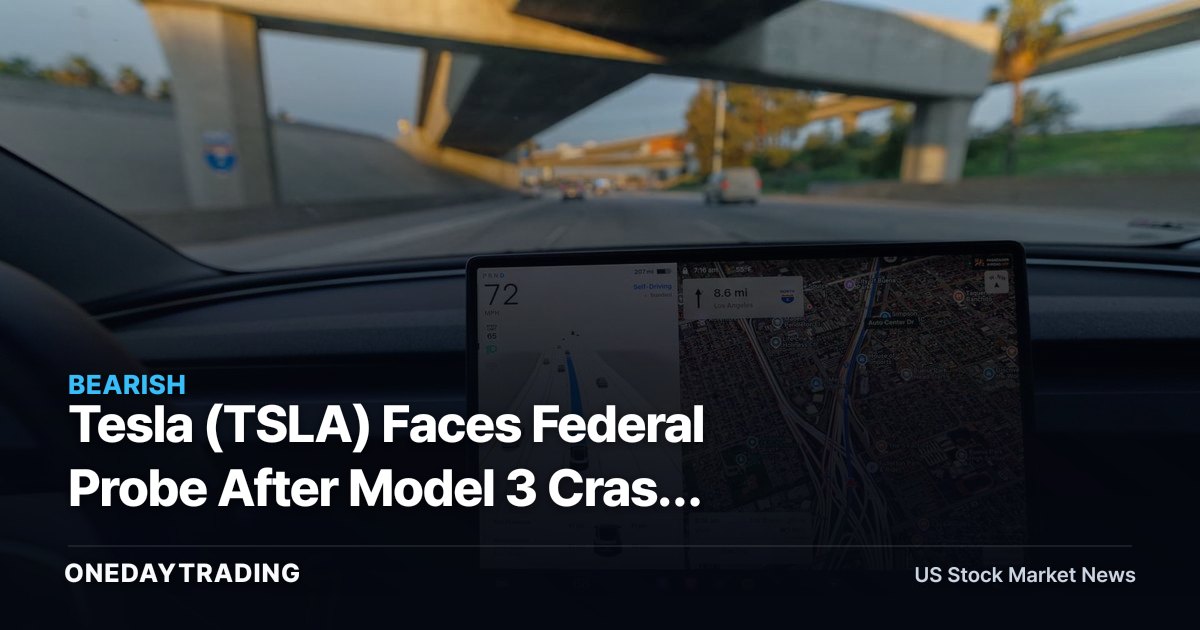
U.S. regulators have opened a federal probe after a Tesla Model 3 crashed into a Texas home and killed a 76-year-old, with the driver, Michael Butler, telling Harris County authorities he was using Tesla's partially automated driving systems. For investors, the headline risk is not the single accident but the regulatory and legal channel it reopens around Tesla's self-driving narrative.
Why It Matters Now
Tesla's valuation increasingly leans on software and autonomy — Full Self-Driving (FSD) subscriptions, future robotaxi revenue, and the premium multiple that comes with being treated as an AI company rather than a carmaker. A federal investigation that explicitly ties a fatality to driver-assist use strikes directly at that thesis, because each probe raises the odds of mandated software limits, recalls, or stricter human-monitoring requirements that slow the path to unsupervised driving.
The financial mechanism matters. Tesla recognizes deferred FSD revenue as capabilities are delivered; anything that delays regulatory clearance for higher autonomy can push out that revenue and pressure the credibility of robotaxi timelines management has promoted. Heightened scrutiny also feeds product-liability exposure, since plaintiffs increasingly cite driver-assist marketing in litigation.
Context cuts both ways: drivers are instructed to stay attentive and Tesla's systems are classified as partially automated, so legal responsibility is contested rather than settled. But repeated federal attention compounds reputational risk in a period when competition in driver assistance and autonomy is intensifying.
FAQ
- What triggered the probe? A fatal crash where a Model 3 hit a Texas home, killing a 76-year-old, with the driver saying he used partially automated driving.
- Does this prove the software failed? No — the cause is under investigation, and driver attentiveness and misuse are open questions.
- Why does it move TSLA? Tesla's premium rests on autonomy and robotaxi optionality, which regulation can directly constrain.
- Is this a one-off? It adds to a pattern of federal interest in Tesla driver-assist incidents, raising cumulative scrutiny.
Related Stocks & Sectors
- Tesla (TSLA) — direct subject; FSD/robotaxi valuation and liability exposure are the core risk.
- EV and autos sector — peers face read-through on how aggressively driver-assist features are regulated.
- Mobileye (MBLY) — rival autonomy supplier that benefits from a more cautious, validation-heavy approach.
- Alphabet (GOOGL) — Waymo's measured rollout contrasts with Tesla's vision-only strategy in the robotaxi race.
What to Watch
- Whether the probe escalates into a formal recall or software restriction order.
- Tesla's next earnings call for updated robotaxi and FSD-take-rate commentary.
- Any change in how regulators classify and label partially automated systems.
- Litigation filings that cite driver-assist marketing as a liability theory.
Overall Outlook
The bull case argues that responsibility may rest with driver misuse and that Tesla's autonomy lead and data advantage remain intact. The bear case is that stacking federal probes erodes the regulatory runway and legal protection underpinning a software-driven multiple. The decisive variable is whether scrutiny stays investigative or converts into binding restrictions that move FSD timelines.
Market data check: TSLA
TSLA last traded near $403.54 (+0.76%). Our composite signal — blending price momentum and news flow — reads 🟡 neutral. Price momentum scores 56/100.
Data as of publication. Price via market feeds; for reference only, not investment advice.
📊 Analysis
Signal Bearish
Why A new federal probe tying a fatality to Tesla's partially automated driving raises regulatory and liability risk against the FSD/robotaxi valuation thesis.
This article was independently written by OneDayTrading from public reporting. Read the original (CNBC)