At a Glance
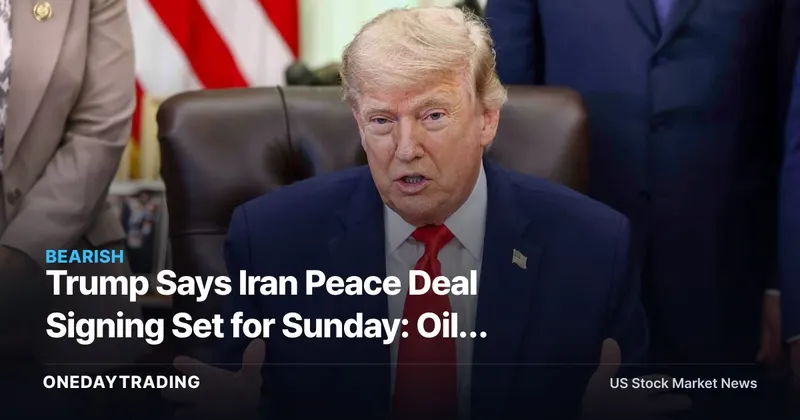
President Donald Trump said on Truth Social that an agreement to end the war with Iran will be signed on Sunday. Iran, however, has signaled it remains cautious on the timing, leaving room for slippage between the announcement and any final signature.
For markets, the headline matters less for the politics than for what it implies: a potential de-escalation of Middle East conflict risk that has been embedded in oil prices, defense demand and broad risk appetite.
Why It Matters Now
Middle East tension is one of the most direct channels through which geopolitics reaches U.S. equity portfolios. When conflict risk rises, crude oil typically carries a war premium and defense names attract a bid; when a credible peace path appears, that premium can unwind. A signed deal would point toward the second scenario.
The key caveat is execution. Trump has named a date, but Iran has not fully confirmed the timing, so traders face headline risk in both directions. A confirmed signing could pressure oil and lift cyclical, risk-on assets, while any delay or breakdown could quickly reverse those moves and restore a geopolitical premium.
Because the catalyst is a political event rather than a corporate result, the cleanest read-through is through commodity-sensitive and risk-sensitive sectors rather than a single company. That makes energy, defense and broad index exposure the natural places to watch.
FAQ
- What did Trump actually say? That a deal to end the war with Iran will be signed on Sunday, posted via Truth Social.
- Is the deal confirmed? Not fully. Iran has indicated it remains cautious about the timing, so the signature is not guaranteed.
- Why would peace pressure oil? Conflict risk often adds a premium to crude prices; easing tensions can let that premium fade, weighing on oil and energy shares.
- Who could be hurt by de-escalation? Sectors that benefit from elevated geopolitical risk, such as oil producers and defense contractors.
Related Stocks & Sectors
- Energy (XOM, CVX): Lower geopolitical risk can ease crude prices, pressuring oil major margins and sentiment.
- Defense (LMT, RTX): A peace narrative can soften the demand story that supports defense contractors.
- Airlines and transports (DAL): Cheaper fuel and calmer macro tone are typically supportive.
- Broad market (SPY): Reduced conflict risk can improve overall risk appetite.
What to Watch
- Whether the signing actually occurs on Sunday or slips amid Iranian caution.
- Crude oil price reaction and any unwind of the war premium.
- Defense sector moves as the conflict-demand thesis is repriced.
- Follow-up statements from both sides confirming or contradicting the timeline.
Overall Outlook
The bull case for risk assets is straightforward: a genuine end to the war removes an overhang, can lower oil-driven inflation pressure and supports cyclical sentiment. The risk is that the announcement runs ahead of reality. With Iran cautious on timing, a delay or collapse would restore the geopolitical premium and reverse any peace-trade moves. Investors should treat this as a headline-driven, two-sided event rather than a settled outcome.
📊 Analysis
Signal Bearish
Why A signed Iran peace deal would ease Middle East risk, unwinding the geopolitical premium in oil and softening the demand narrative for energy and defense names.
Tickers$XOM$CVX$LMT$RTX$SPY
This article was independently written by OneDayTrading from public reporting. Read the original (CNBC)