Federal Reserve Findings Change the Risk, Not the Cost Record
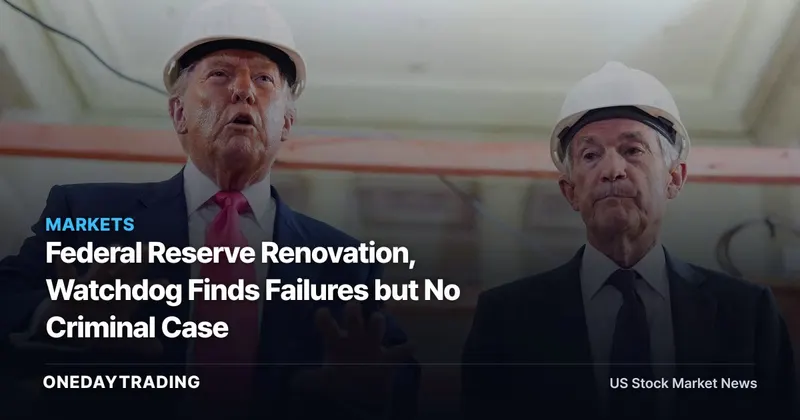
The Federal Reserve received a split verdict on 2026-09-30: its inspector general identified management and oversight failures in the headquarters renovation, while finding no reasonable grounds for a federal criminal referral. For investors, the report narrows one institutional risk around the central bank without resolving the governance problem exposed by the project’s large cost overruns.
CNBC reported that the Federal Reserve renovation rose by roughly a billion dollars from initial estimates as design changes and other problems accumulated. That figure matters less as a direct market expense than as evidence of weak project controls inside an institution whose credibility depends on disciplined decision-making and clear accountability.
The report does not establish a change in monetary policy, interest rates or any listed company’s earnings. The investable reading is therefore neutral: a legal threat involving Jerome Powell has lost support in the watchdog’s findings, while unresolved cost, audit and enforcement questions prevent investors from treating the matter as fully closed.
What the Federal Reserve Inspector General Established
The inspector general’s evaluation is an internal oversight review assessing whether management, controls and conduct warrant corrective action or referral. It concluded that failures in management and oversight contributed to major overruns, and it found no reasonable basis to believe a federal criminal-law violation requiring referral to the U.S. Attorney General had occurred.
The distinction is important. Poor project administration can justify stronger controls, audits and management changes without satisfying the threshold for a criminal case. The report assigns institutional responsibility for execution failures while drawing a boundary between mismanagement and evidence of a federal crime.
The review also made no claim of misconduct connected to Jerome Powell’s Senate testimony in June 2025. It noted that the Federal Reserve’s board did not handle day-to-day project decisions, preserving a separation between board-level oversight and operational management without erasing the organization’s responsibility for the outcome.
Michael Horowitz led the investigation after Jerome Powell appointed him in June 2025. Powell requested the investigation in July 2025, the same month the inspector general’s review began.
The Cost Overrun and Its Operating Causes
According to CNBC, the Federal Reserve’s 2025 budget allocated 2.5 billion dollars to the renovation. CNBC also reported that the Federal Reserve allocation was 700 million dollars above earlier estimates, giving investors a clear comparison baseline even though the project’s final total cost remains unknown.
The Federal Reserve attributed higher costs to design updates, gaps between estimated and actual material and labor costs, and unexpectedly poor environmental conditions at the site. Those explanations divide the overrun into changing scope, inaccurate cost assumptions and physical conditions that were worse than anticipated.
Each category points to a different control test. Design updates raise questions about approval discipline; material and labor gaps test the quality of estimates; environmental conditions test early site assessment and contingency planning. The inspector general’s finding that management and oversight failures contributed to the overruns indicates that external cost pressures alone do not explain the result.
The missing final cost limits any stronger financial conclusion. The reported figures establish the scale of the budget expansion and the comparison with earlier estimates, not the eventual amount the project will consume.
Jerome Powell, Criminal Referral and Institutional Independence
The strongest finding for Jerome Powell is the absence of grounds for a criminal referral. The watchdog stated, “At no point during our evaluation did we find reasonable grounds to believe that a violation of federal criminal law had occurred,” according to CNBC.
Tim Scott separately said, “I do not believe that he committed a crime during the hearing.” James E. Boasberg had also quashed subpoenas issued to the Federal Reserve and found no evidence of wrongdoing by Powell.
Jeanine Pirro agreed to drop the criminal investigation before Kevin Warsh’s confirmation, though she left open a conditional path back to it: “I will not hesitate to restart a criminal investigation should the facts warrant doing so,” CNBC reported. Whether the Department of Justice will reopen an investigation remains unknown, so the inspector general’s conclusion reduces the evidentiary basis for escalation without making future action impossible.
Powell completed his term as chair and remains a Federal Reserve governor, with that term ending in January 2028. It is also unknown whether Warsh will ask him to resign. Those questions concern leadership and institutional continuity; the report itself supplies no basis for projecting a policy decision or market outcome from either one.
Market Interpretation for Rates and U.S. Equities
- Rates: The findings contain no monetary-policy decision, interest-rate signal or timetable. Any rates reaction based solely on this report would therefore reflect perceptions of Federal Reserve governance and independence, not a newly reported policy change.
- U.S. equities: The fact sheet identifies no listed company with revenue, costs or contracts directly affected by the renovation. Assigning a company-specific earnings impact would exceed the available evidence.
- Institutional risk: The no-referral conclusion removes one source of immediate legal escalation around Powell. The documented oversight failures keep governance risk alive because remediation, project execution and final spending are not settled.
- Political risk: Donald Trump’s involvement places the dispute around the Federal Reserve in a broader leadership context, though the report does not establish a resulting change in policy, rates or asset prices.
Kevin Warsh’s Audit Becomes the Next Evidence Test
Kevin Warsh welcomed the findings and said the Federal Reserve would take steps to adopt the inspector general’s recommendations. That response signals an intended remediation process, not proof that every recommendation has been implemented.
Warsh also plans a full audit of the renovation and asked the General Services Administration to act as project executive. This creates the clearest next checkpoint: whether the audit establishes tighter project authority, clarifies remaining costs and converts the inspector general’s recommendations into verifiable controls.
- Final project cost: Compare the eventual total with the 2.5 billion dollars allocated in the Federal Reserve’s 2025 budget and with the 700 million dollars above earlier estimates.
- Recommendation adoption: Check which inspector general measures the Federal Reserve formally accepts and whether implementation can be documented.
- Project governance: Assess how the General Services Administration’s role changes responsibility for approvals, estimates and execution.
- Legal status: Monitor whether the Department of Justice reopens the matter and whether any new facts alter the inspector general’s no-referral assessment.
The Balanced Read on Federal Reserve Governance
The constructive case is narrow but meaningful: an inspector general led by Michael Horowitz found serious administrative failures without finding reasonable grounds for a criminal referral. Warsh’s proposed audit and the General Services Administration’s planned executive role could strengthen accountability if the Federal Reserve adopts and verifies the recommendations.
The risk case rests on unfinished work. The final renovation cost is unknown, complete adoption of the recommendations is not assured, and possible action by the Department of Justice has not been resolved. The Federal Reserve’s Board of Governors declined to comment, leaving Warsh’s audit as the next substantive source of evidence.
Investors should keep the report in its proper lane. It is a governance finding with potential implications for institutional confidence, not a new rates signal or a quantified earnings event. The next meaningful change in the analysis will come from documented remediation, a final cost, or a new legal decision—not from extrapolating beyond what the watchdog found.
📊 Analysis
Signal Neutral
Why The report reduces immediate legal uncertainty around Jerome Powell while documenting serious project-control failures and leaving future enforcement and final costs unresolved.
This article was independently written by OneDayTrading from public reporting. Read the original (CNBC)