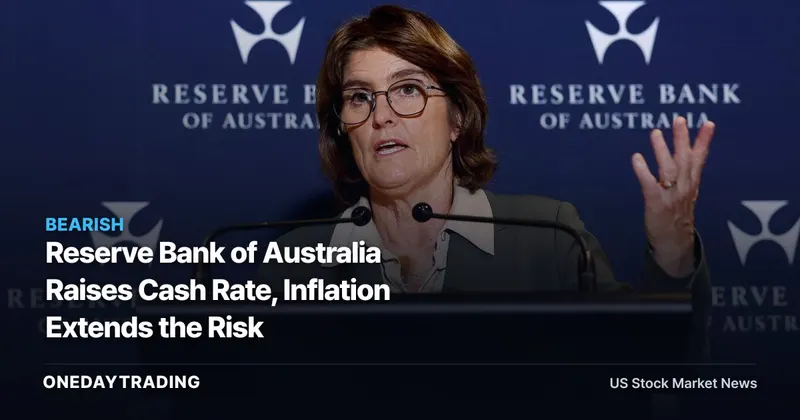
Reserve Bank of Australia Extends the Restrictive Rate Backdrop
The Reserve Bank of Australia raised its benchmark cash rate by 25 basis points to 4.85% on 2026-11-03, tightening the backdrop for rate-sensitive Australian equities. For investors, the important signal is not simply the size of the increase. It is the combination of an 18-year rate high, persistent inflation and slower year-over-year economic growth.
CNBC Markets reported that the cash rate reached its highest level since November 2008. The decision matched expectations from economists polled by Reuters, so the increase itself did not represent a surprise relative to that forecast. What remains unresolved is how long the higher-rate setting will be required.
The benchmark cash rate is the Reserve Bank of Australia’s principal policy rate, influencing the price of borrowing across the economy. A higher rate can restrain demand and inflation through financing conditions; it can also pressure equity valuations and business activity when those conditions persist. Those are transmission mechanisms, not reported market outcomes, and the supplied evidence provides no stock prices, index moves or company-level exposure.
Inflation, Not the Vote Alone, Defines the Policy Message
Australia’s consumer price index rose 4.3% in September 2026, according to CNBC Markets, accelerating from 4% in August 2026. That direction matters because the Reserve Bank of Australia expects inflation to “remain elevated through much of 2027” and return to its 2%-3% target range only in late 2027.
The November increase was the Reserve Bank of Australia’s fifth rate rise in 2026. Six members supported the increase while three preferred to hold, a split that shows the decision was contested even as the majority chose tighter policy. The division does not establish the next move: the exact date of the next decision and whether another increase will occur are both unknown.
Michelle Bullock described inflation as “too high” and said, “We’re seeing signs that upside risks to inflation are materializing.” She also left additional tightening conditional on “if that’s what’s needed to get inflation down.” For investors, that language keeps inflation outcomes at the center of the reaction function without confirming any future cash-rate path.
The late-2027 inflation forecast is especially significant because the expected return to the target range was pushed back by three quarters. A longer inflation horizon can keep the discount-rate question active for longer, even when a single policy decision has already been anticipated. The counterweight is the split vote, which prevents the latest increase from being read as an automatic sequence of further moves.
Slower Growth Complicates the Equity Read-Through
Australia’s GDP increased 2.1% year over year in the June quarter of 2026, down from 2.5% in the March quarter, CNBC Markets reported. The Reserve Bank of Australia is therefore confronting firmer inflation alongside slower year-over-year growth. That tension narrows the policy margin: tighter financial conditions may help restrain inflation, while sustained restraint may also weigh on activity.
For equity analysis, the mechanism runs from the cash rate into financing conditions, then into required returns and valuation multiples. Businesses or sectors that depend more heavily on borrowing may face greater sensitivity to that channel; the fact sheet does not identify individual companies, funding structures or revenue exposures, so no U.S.-listed ticker can be responsibly ranked as a direct beneficiary or victim.
The bearish interpretation rests on duration, not on a forecast of recession. If inflation remains above the Reserve Bank of Australia’s 2%-3% target range through much of 2027, investors may continue to demand compensation for policy uncertainty. If inflation moves back toward the range sooner than expected, that pressure could ease without requiring the future rate path assumed by the more restrictive scenario.
Michelle Bullock said recession was “not our base case at the moment.” That statement supplies a counter-scenario to the negative growth risk, though it is not a guarantee that Australia will avoid recession. The evidence supports a restrictive and uncertain macro setting, not a definitive economic or market outcome.
What Investors Need From the Next Reserve Bank of Australia Decision
- Inflation direction: Compare the next available consumer price reading with the 4.3% rate recorded in September 2026 and the 4% rate recorded in August 2026. The direction will help test whether the upside inflation risk identified by Michelle Bullock is persisting.
- Target timing: Watch whether the Reserve Bank of Australia retains its expectation that inflation will stay elevated through much of 2027 and return to the 2%-3% target range in late 2027. A change in that horizon would alter the duration of the policy constraint.
- Decision balance: Examine whether the next vote preserves the six-to-three division between an increase and a hold, or shifts toward either position. The next decision date is not provided, so the vote should be assessed when the central bank releases it.
- Growth trajectory: Compare subsequent GDP evidence with the 2.1% year-over-year increase in the June quarter of 2026 and the 2.5% increase in the March quarter. Further moderation would sharpen the tension between inflation control and economic activity.
The central investment question is whether inflation data validate a prolonged restrictive stance or weaken the case for additional tightening. The latest increase established a 4.85% cash rate; it did not establish another increase, a future peak or a recession. The next policy decision must therefore be judged through fresh inflation data, the updated target timetable, the vote split and the direction of growth.
📊 Analysis
Signal Bearish
Why A higher cash rate and a later expected return to the inflation target create a restrictive backdrop for rate-sensitive Australian equities, although the future rate path remains unknown.
This article was independently written by OneDayTrading from public reporting. Read the original (CNBC Markets)