What Changes
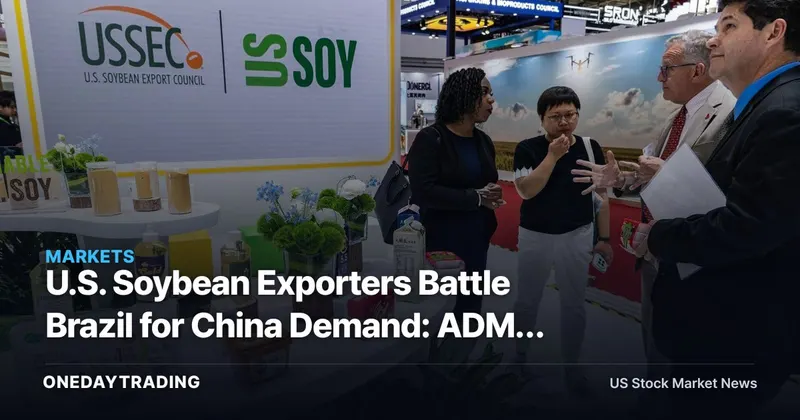
This is less a single deal and more a competitive repositioning. By leaning on quality, the U.S. side is implicitly conceding that on raw availability and freight timing Brazil has been winning the Chinese order book. The interesting question for investors is whether quality differentiation is durable, or whether Chinese crushers treat soybeans as a near-commodity where landed cost and supply reliability dominate the purchasing decision.
For the U.S. agribusiness complex, China demand is the swing variable. The companies that originate, store, transport and crush beans capture the volume regardless of which farm-belt region supplies them, so a rebound in Chinese purchasing matters more to throughput-driven processors than to any single grower. A sustained share recovery would also stabilize cash crop prices and, by extension, U.S. farm balance sheets that drive equipment and input spending.
The counterweight is structural: Brazil has expanded planted area and harvest capacity for years, and a quality-led campaign does not reverse that overnight. Quality claims must convert into repeat contracts to move volumes.
By the Numbers
The source frames China as the single largest importer of soybeans globally, which is why both exporting nations are fighting over the same buyer. No specific tonnage, price or market-share figures are provided, so the read here is directional rather than quantified — the signal is a contested share battle, not a confirmed swing in volumes.
Winners and Losers
- ADM (Archer-Daniels-Midland) — A China origination rebound lifts U.S. crush and export throughput; ADM monetizes volume and processing margins more than the underlying bean price.
- BG (Bunge) — As a global grain trader with both U.S. and South American footprints, Bunge is naturally hedged, but stronger U.S.-to-China flow supports its North American originations.
- DE (Deere) — Farm equipment demand tracks farm income; recovered export sales would firm the cash-crop cycle that underpins machinery orders.
- CTVA (Corteva), NTR (Nutrien) — Seed and fertilizer demand is downstream of grower profitability and planting confidence.
- Brazil-exposed supply chains — Any U.S. share recapture comes at the margin from Brazilian export volume, the natural loser if the quality pitch lands.
Risk Check
- Buyers may prioritize landed cost and supply timing over quality, blunting the U.S. pitch.
- Brazil's expanded capacity and harvest timing give it a persistent structural edge.
- China demand is policy- and trade-sensitive; the order book can shift on factors outside crop quality.
- For traders like ADM and BG, dual-region exposure means a U.S. gain can be partly offset by softer South American volumes.
Bottom Line
A U.S. quality offensive aimed at the world's biggest soybean buyer is a credible volume catalyst for processors and the farm-input chain, but it is a campaign, not a closed sale — the metric that matters is whether marketing claims convert into repeat Chinese contracts large enough to move U.S. export volumes against Brazil's scale advantage.
Market data check: ADM
ADM last traded near $76.45 (+0.21%). Our composite signal — blending price momentum and news flow — reads 🟡 neutral. Price momentum scores 52/100. Recent coverage skews bullish (1 vs 0).
Data as of publication. Price via market feeds; for reference only, not investment advice.
📊 Analysis
Signal Neutral
Why A competitive marketing push to reclaim Chinese demand is a potential upside catalyst for U.S. ag exporters, but the outcome is unconfirmed and offset by Brazil's structural capacity edge, leaving no clear directional read yet.
Tickers$ADM$BG$DE$CTVA$NTR
This article was independently written by OneDayTrading from public reporting. Read the original (CNBC)