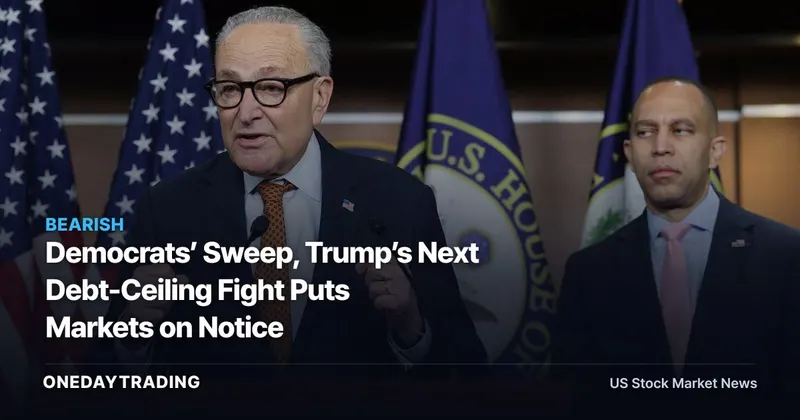
Democrats’ Sweep Changes the Debt-Ceiling Risk
Democrats’ electoral sweep on Tuesday night changed the balance of power around the next debt-ceiling confrontation with President Donald Trump and the Republican Party. For investors, the sharpest risk is not a known default date or an agreed policy outcome; it is the prospect that a must-pass borrowing decision becomes the incoming majority’s principal source of negotiating leverage.
CNBC Markets published the underlying analysis on 2026-11-04. Its central market implication is conditional: a prolonged confrontation could expose equity markets and U.S. sovereign credit to damage, even though the United States has never meaningfully breached the debt limit.
Why the Treasury Department’s $41.1 Trillion Authority Matters
The debt ceiling prevents the government from borrowing money that Congress has already directed federal agencies to spend. It is therefore a financing constraint on enacted obligations, not a fresh authorization of those obligations.
Congress last set the debt limit in 2025, when it authorized the Treasury Department to borrow $41.1 trillion, according to CNBC Markets. That figure defines the scale of the existing authority, while the timing of any exhaustion remains unresolved.
CNBC Markets also reported that Congress has run deficits for decades and that the deficit is $1.99 trillion this year. The connection is mechanical: continued deficits require borrowing authority, so the limit periodically becomes binding even though the spending instructions have already been issued.
The Treasury Department’s exact exhaustion date is unknown. The estimated X-date—the point when the United States could no longer meet all obligations—falls in the fourth quarter of 2027, according to the supplied reporting, but its precise date has not been established.
President Donald Trump Faces a Narrow Political Choice
President Donald Trump called for Republicans to settle the debt-limit issue before the incoming Democratic-majority Congress is seated. Whether Congress will do so is unknown, leaving two materially different paths for markets to assess.
An early increase would remove the incoming majority’s immediate debt-ceiling leverage. Failure to act would carry the dispute into a Congress where Democrats can seek concessions from the White House, changing the political roles surrounding a confrontation that has traditionally involved congressional Republicans pressing Democratic administrations.
The 2025 increase offers one limited point of context. It was linked to tax cuts and other policy changes and passed along party lines. That history does not establish what a new agreement would contain, and the available facts do not confirm that either party can complete another increase before the change in congressional control.
The 2028 presidential election adds a defined political horizon to the negotiations. It does not determine the outcome, but it gives both sides a reason to weigh the policy substance of an agreement against how the confrontation presents their governing priorities.
Aniket Shah Sees More Aggressive Democratic Leverage
Aniket Shah, who heads the Washington policy team at Jefferies, argues that market participants may underestimate how forcefully Democrats intend to approach 2027. “I don't think they realize how aggressively Democrats plan to take 2027,” Shah told CNBC Markets.
His second observation makes the negotiating logic explicit: “[Democrats] are going to want to embarrass the White House, and they're going to want to get leverage.” This is an analyst’s assessment, not a confirmed Democratic negotiating position. The specific concessions that might enter an agreement remain unknown.
That distinction matters for pricing political risk. The electoral result is confirmed, as is the incoming Democratic majority’s role in the next confrontation if the issue remains unresolved. The intensity, duration and policy content of that confrontation are not confirmed.
George Pollack, a senior U.S. analyst with Signum Global Advisors, is among the policy specialists associated with analysis of the confrontation. Goldman Sachs is also identified in the supplied material, although the fact sheet does not establish any final agreement or adopted concession linked to either institution’s analysis.
Technical Default Is a Tail Risk, Not the Base Case
Robert Sockin, chief U.S. economist at PGIM, describes the reversal of the parties’ traditional roles as a “very weird irony.” More important for portfolios, he separates the expected path from the severe scenario.
“It's not our base case, but we think the risk is higher than ever that you could get a technical default from the government,” Sockin told CNBC Markets. A technical default would mean the government misses an obligation even if the payment is subsequently made; whether such a default will occur is unknown.
Sockin also warned: “You'll get more downgrades to the U.S. sovereign, and those might bite more this time.” That remains a forecast rather than an observed result. No further sovereign-rating downgrade is confirmed in the available evidence.
For equities, Sockin projected a “very negative reaction in equity markets” if the confrontation crossed that line. Investors should treat this as a conditional stress scenario, not a reported market move: the fact sheet supplies no index level, stock price, sector return or evidence that such a reaction has already begun.
Market Channels Supported by the Evidence
- Equity markets: PGIM’s Robert Sockin identifies a technical default as a scenario that could trigger a severe negative reaction. The exposure is market-wide in the supplied evidence, so no individual U.S.-listed company can be ranked as a direct beneficiary or victim.
- U.S. sovereign credit: Additional downgrades are a stated risk if the government misses an obligation. They are not a confirmed outcome.
- Treasury financing: The Treasury Department operates under the borrowing authority Congress set in 2025. The exact point at which that capacity is exhausted remains unknown.
- Political negotiations: Democrats’ leverage depends on the issue surviving until the new majority is seated. An earlier congressional increase would change that setup.
What Investors Should Monitor Next
- Action before the new Congress is seated: The first checkpoint is whether Republicans act on President Donald Trump’s request to resolve the borrowing limit before Democrats take control.
- The Treasury Department’s capacity: Any authoritative update narrowing when borrowing authority will be exhausted would reduce the current timing uncertainty.
- The fourth quarter of 2027: This is the estimated window for the X-date, not an exact deadline. Investors should distinguish a revised estimate from a confirmed payment failure.
- Terms of an agreement: The market significance will depend on whether a deal is reached and what concessions, if any, it contains. Neither point is known.
The Market Outlook Before the X-Date
The constructive scenario is straightforward: Congress raises the limit before the United States misses an obligation, preserving the country’s record of never meaningfully breaching the ceiling. Resolution before the incoming majority is seated would also prevent this particular negotiating channel from becoming a prolonged confrontation between Democrats and President Donald Trump.
The adverse scenario runs through delay. If negotiations persist toward the X-date, the unresolved possibility of a technical default and further sovereign downgrades becomes more relevant to equity-market risk. The evidence does not justify assigning a probability, naming stock-level losers or treating the projected reaction as inevitable.
The next signal is political action, not rhetoric alone. Investors need confirmation of whether Congress changes the limit, clarity from the Treasury Department on remaining borrowing capacity, and the actual terms of any compromise. Until those checkpoints arrive, the electoral sweep has increased the importance of the confrontation without determining its outcome.
📊 Analysis
Signal Bearish
Why The confrontation creates a conditional downside risk for equity markets if negotiations approach the unresolved X-date or produce a technical default.
This article was independently written by OneDayTrading from public reporting. Read the original (CNBC Markets)