At a Glance
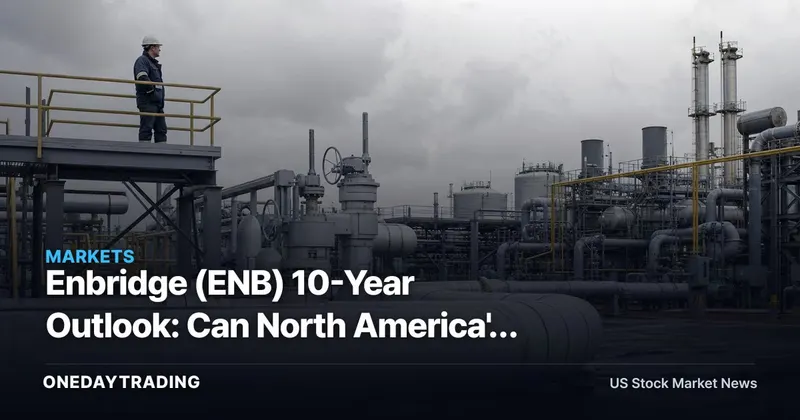
Enbridge runs one of the largest midstream networks in North America, and the investor question is no longer about the next quarter — it is whether the toll-road model that funds a high dividend yield can survive a decade of shifting energy demand. The setup favors income durability over capital appreciation, which is exactly how a pipeline operator should be underwritten.
Why It Matters Now
Midstream is the least glamorous link in the energy chain and, for income investors, often the most reliable. Enbridge does not bet on the price of oil or gas. It moves the molecules and collects a fee, with the bulk of cash flow tied to long-term, take-or-pay style contracts. That structure is what lets a mature, slow-growth business carry a yield well above the broader market without the payout being a red flag.
The ten-year frame changes the analysis. Over that horizon the swing factor is not throughput on legacy crude lines but where Enbridge redeploys capital — natural gas utilities, gas transmission feeding LNG export demand, and a growing renewables and infrastructure bucket. A pipeline operator's terminal value rests on whether its asset base stays full and contracted as the energy mix evolves, not on any single barrel.
The counterweight is the balance sheet. Scale at this level is built on debt, and a high payout leaves a thin margin for error. Rate moves hit valuation and refinancing cost directly, and a slower-than-assumed energy transition could leave newer green assets earning below the returns of the legacy network they are meant to replace.
FAQ
- Is the high yield safe? It is anchored by fee-based, contracted cash flow rather than commodity exposure, but a high payout ratio means investors should track distributable cash flow coverage, not just the headline yield.
- Does Enbridge depend on oil prices? Less than producers do — revenue is largely tied to volumes moved under contract, so the bigger risk is throughput and contract renewal, not the spot price.
- Where is future growth? Natural gas distribution, gas transmission linked to LNG exports, and renewable and infrastructure projects layered on top of the existing liquids network.
- What is the main long-term risk? Leverage in a higher-rate world and the pace of the energy transition stranding or underutilizing assets.
Related Stocks & Sectors
- Enbridge (ENB) — the subject; a scale midstream operator whose thesis is contracted cash flow funding a sustained dividend.
- Kinder Morgan (KMI), TC Energy (TRP) — peers with similar fee-based gas and pipeline exposure; useful read-throughs on contract trends and LNG-linked demand.
- Williams (WMB) — gas infrastructure leverage to North American export growth, a direct comparison for the gas-transmission thesis.
- Energy sector — midstream tends to track interest rates and energy-demand expectations more than crude prices.
What to Watch
- Distributable cash flow coverage of the dividend in upcoming results — the cleanest signal of payout durability.
- Leverage and refinancing terms as debt matures, and how rate levels move the cost of capital.
- Capital allocation between legacy liquids, gas transmission and renewables, and the contracted returns on new projects.
- LNG export build-out in North America, which underpins long-dated gas-transmission demand.
Overall Outlook
For income-focused investors, Enbridge offers a contracted, fee-based cash-flow engine and a yield that reflects scale rather than distress — a holding bought for the coupon, not the chart. The bear case is mechanical: heavy leverage meets a higher cost of capital, and a payout with little cushion leaves little room if throughput or transition economics disappoint. The next decade hinges on disciplined capital allocation, not on any rebound in commodity prices.
Market data check: ENB
ENB last traded near $56.24 (+0.09%). Our composite signal — blending price momentum and news flow — reads 🟡 neutral. Price momentum scores 51/100.
Data as of publication. Price via market feeds; for reference only, not investment advice.
📊 Analysis
Signal Neutral
Why A long-term thesis piece on a stable high-yield midstream operator with offsetting strengths (contracted cash flow) and risks (leverage, transition pace), with no near-term catalyst.
This article was independently written by OneDayTrading from public reporting. Read the original (NASDAQ)