What Changes
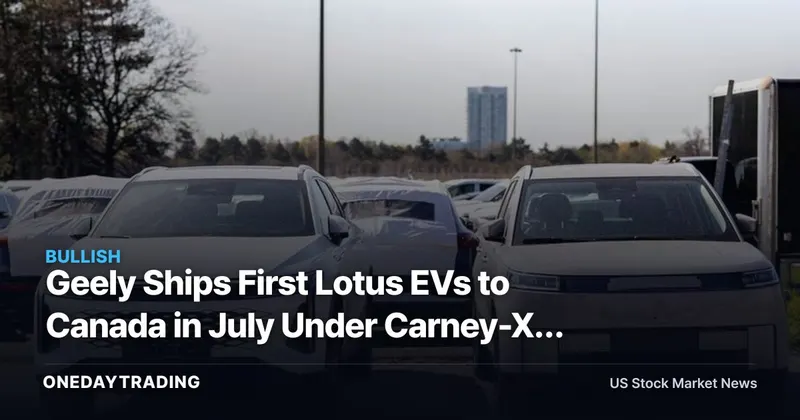
The story here is policy, not product. A single July shipment of Lotus EVs is small in unit terms, but it is the first physical test of whether the Carney-Xi understanding actually reopens a market that punitive tariffs had closed to Chinese-assembled cars. For Geely, Canada is a beachhead — proof that diplomatic channels, not just price, can move metal across a border that North American trade policy had sealed.
Geely is not a simple single-name bet. The group sits behind a web of listed and premium marques — Lotus, Polestar, Volvo — so the read-through runs through brand mix and assembly location rather than the Geely parent alone. Lotus plays at the high end, where buyers are less tariff-sensitive and volumes are thin; that makes the first cars more a statement of access than a revenue event.
The competitive channel matters for incumbents. Any normalization of Chinese EV imports into Canada pressures the pricing umbrella that legacy and Western EV makers have enjoyed there. The threat is gradual, not a flood, but the direction of travel — a reopening door rather than a closing one — is what the tape should weigh.
By the Numbers
The concrete facts are deliberately narrow: first Lotus EV shipments to Canada in July, framed as the product of a Carney-Xi deal and confirmed by the ambassador. No volumes, pricing or tariff schedule were disclosed in the account, which is itself the point — this is a signaling event whose financial weight depends on follow-on shipments and on whether the arrangement scales beyond one premium brand.
Winners & Losers
- Lotus Technology (LOT) — direct subject; Canadian market access adds a distribution lane for a low-volume premium EV maker that needs every channel it can open.
- Polestar (PSNY) — Geely-affiliated EV brand; a friendlier Canadian import posture is a tailwind for the broader Geely EV stable.
- Tesla (TSLA) — incumbent EV leader in Canada; faces incremental premium competition, though Lotus volumes are small near term.
- Legacy automakers (GM, F) — North American makers selling EVs in Canada lose a sliver of the tariff protection that kept Chinese-built rivals out.
Risk Check
- Volume risk: one premium shipment is symbolic; it may not scale into meaningful units.
- Policy reversibility: a bilateral understanding can stall or unwind if trade tensions flare again.
- Detail gap: no disclosed pricing, tariff terms or schedule means the financial impact is unquantified.
- Brand specificity: Lotus sits at the high end, so the precedent may not extend to mass-market Chinese EVs.
Bottom Line
This is an access story before it is a sales story: the upside is a reopened Canadian channel for Geely's EV brands and a precedent for Chinese imports, while the live risk is that one premium shipment proves more diplomatic gesture than durable volume. Watch whether July deliveries are followed by repeat orders and any published tariff terms — that is where symbolism becomes economics.
Market data check: LOT
LOT last traded near $1.1 (+1.85%). Our composite signal — blending price momentum and news flow — reads 🟡 neutral. Price momentum scores 65/100 (firm).
Data as of publication. Price via market feeds; for reference only, not investment advice.
📊 Analysis
Signal Bullish
Why A reopened Canadian market via the Carney-Xi deal is a positive access catalyst for Geely's EV brands Lotus and Polestar, even if near-term volumes are small.
Tickers$LOT$PSNY$TSLA$GM$F
This article was independently written by OneDayTrading from public reporting. Read the original (Investing.com)