Summary
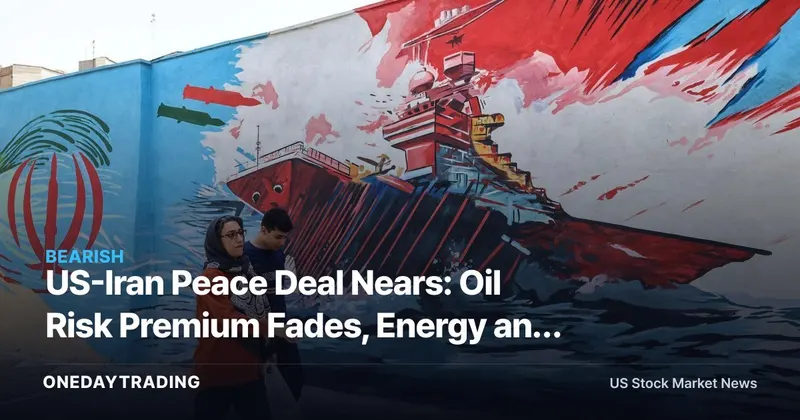
Pakistan's prime minister signaled that a US-Iran peace deal could be finalized within the next 24 hours, echoing a senior Trump administration official who said an agreement to end the Iran war could be signed soon. A genuine de-escalation would strip the war-risk premium out of crude prices, a bearish signal for oil producers but a potential tailwind for risk assets and fuel-sensitive industries.
The Full Story
The headline comes from CNBC, citing Pakistan's PM describing a 24-hour window for a finalized US-Iran agreement. Separately, a senior Trump administration official indicated that a deal to end the Iran war could be signed soon, lending credibility to a near-term resolution rather than a vague diplomatic gesture.
Markets price Middle East conflict primarily through the energy channel. When tensions in or around Iran escalate, traders embed a fear premium into crude because the region sits near critical shipping and production chokepoints. A confirmed peace deal works in the opposite direction, removing that insurance cost and letting prices drift back toward supply-and-demand fundamentals.
Structural Background
Oil is the transmission belt between geopolitics and the broader market. Lower crude feeds directly into gasoline, jet fuel, and shipping costs, easing headline inflation and giving central banks more room. That dynamic links a single diplomatic headline to bond yields, consumer spending, and the relative performance of energy versus the rest of the market.
Stock and Sector Ripple
- Oil majors (XOM, CVX): A fading war premium pressures crude prices, squeezing the upside that elevated oil had supported for integrated producers.
- Defense (LMT, RTX): De-escalation can cool the near-term urgency around munitions and missile-defense demand tied to active conflict.
- Airlines (DAL, UAL): Lower jet-fuel costs are a direct margin tailwind, making carriers a relative beneficiary of cheaper oil.
- Broad market (SPY): Reduced geopolitical uncertainty typically supports risk appetite and a steadier equity backdrop.
Bull vs Bear Scenarios
Bull case for equities: a signed deal removes a tail risk, cools oil-driven inflation, and supports a risk-on rotation favoring consumers, airlines, and growth names. Bear case: the 24-hour timeline is political signaling that slips or collapses, oil snaps back on disappointment, and any breakdown reintroduces volatility. Investors should treat an unsigned deal as a headline, not a fact.
Investor Action Points
- Watch WTI crude as the cleanest real-time gauge of whether the market believes the deal.
- Expect energy and defense to underperform if de-escalation is confirmed, while airlines and consumer-sensitive names may catch a bid.
- Avoid chasing on a single political headline; wait for an actual signed agreement before sizing positions.
- Use lower oil as a lens on the inflation and rates narrative, not just on energy tickers.
📊 Analysis
Signal Bearish
Why A US-Iran peace deal would remove the geopolitical risk premium from oil, pressuring crude prices and energy producers.
Tickers$XOM$CVX$LMT$RTX$DAL
This article was independently written by OneDayTrading from public reporting. Read the original (CNBC)