What Changes
Coca-Cola (KO) sits at the intersection of consumer habit and restaurant economics: if operators can sell more customized drinks without slowing service, Coca-Cola gains a stronger role inside the highest-frequency food channels.
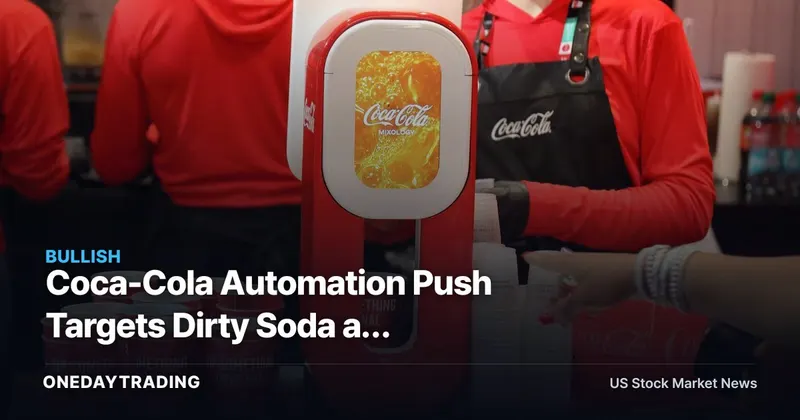
Dirty soda, a soft drink mixed with flavored syrups, creamers or other add-ins, and refreshers, fruit-forward cold beverages sold as premium drinks, turn fountain soda from a commodity pour into a higher-ticket menu item.
Automation matters because quick-service restaurants make money on repeatable speed. Coca-Cola (KO) benefits if restaurant customers can add customization while controlling labor friction, waste and order complexity.
By the Numbers
The provided CNBC source names 2 major restaurant customers, McDonald's (MCD) and Wendy's (WEN), as longtime Coca-Cola customers expanding beverage offerings to boost profit margins.
The provided CNBC source gives no dollar sales figure, margin percentage, capex amount or launch date for Coca-Cola's innovation labs. That absence matters: the story is strategically relevant, but investors cannot yet underwrite a measurable earnings contribution.
Winners & Losers
- Coca-Cola (KO): Coca-Cola gains if automated dirty soda and refreshers deepen restaurant dependence on Coca-Cola equipment, syrups and beverage know-how.
- McDonald's (MCD): McDonald's can use broader drink menus to lift profit mix, but execution depends on keeping service fast.
- Wendy's (WEN): Wendy's benefits if beverage expansion raises check economics without adding operational drag at the counter or drive-through.
- Traditional fountain soda: Plain carbonated soft drinks face internal competition if customized refreshers capture the consumer's incremental beverage spend.
Risk Check
- Coca-Cola (KO) has not disclosed financial targets in the provided CNBC source, so the market cannot size the revenue impact from automation.
- McDonald's (MCD) and Wendy's (WEN) can expand drinks, but complex beverage menus lose value if they slow throughput during peak service.
- Coca-Cola (KO) must prove that automation improves restaurant economics enough to justify installation, training and maintenance.
- Consumer interest in dirty soda and refreshers can be real without becoming large enough to move Coca-Cola's consolidated results.
Bottom Line
Coca-Cola (KO) has a credible strategic opening if automated dirty soda and refreshers help McDonald's (MCD), Wendy's (WEN) and other restaurant customers convert beverage customization into higher-margin traffic; the risk is that the story stays operationally interesting but financially too small to change Coca-Cola's earnings path.
FAQ
Why is Coca-Cola automating dirty soda and refreshers?
Coca-Cola (KO) is exploring automation for dirty soda and refreshers because quick-service restaurant customers want beverage expansion without sacrificing speed, per CNBC's reporting. Coca-Cola's payoff comes if automation makes customized drinks easier for operators to sell at scale.
How does Coca-Cola benefit from McDonald's and Wendy's beverage expansion?
Coca-Cola (KO) benefits when McDonald's (MCD) and Wendy's (WEN) make beverages a larger part of restaurant profit strategy. More beverage occasions can reinforce Coca-Cola's fountain system, syrup demand and customer relationships.
Is Coca-Cola stock affected by dirty soda and refresher automation?
Coca-Cola (KO) stock gets a modest strategic tailwind from the CNBC-reported innovation-lab push, but the provided source includes no sales or margin target. Investors should watch whether Coca-Cola discloses customer deployments, menu adoption or financial impact in future earnings commentary.
Market data check: KO
KO last traded near $91.1 (+0.66%). Our composite signal — blending price momentum and news flow — reads 🟡 neutral. Price momentum scores 63/100 (firm).
Data as of publication. Price via market feeds; for reference only, not investment advice.
📊 Analysis
Signal Bullish
Why Coca-Cola's automation work supports higher-margin beverage expansion for major restaurant customers, though the source provides no financial scale yet.
This article was independently written by OneDayTrading from public reporting. Read the original (CNBC)