
At a Glance
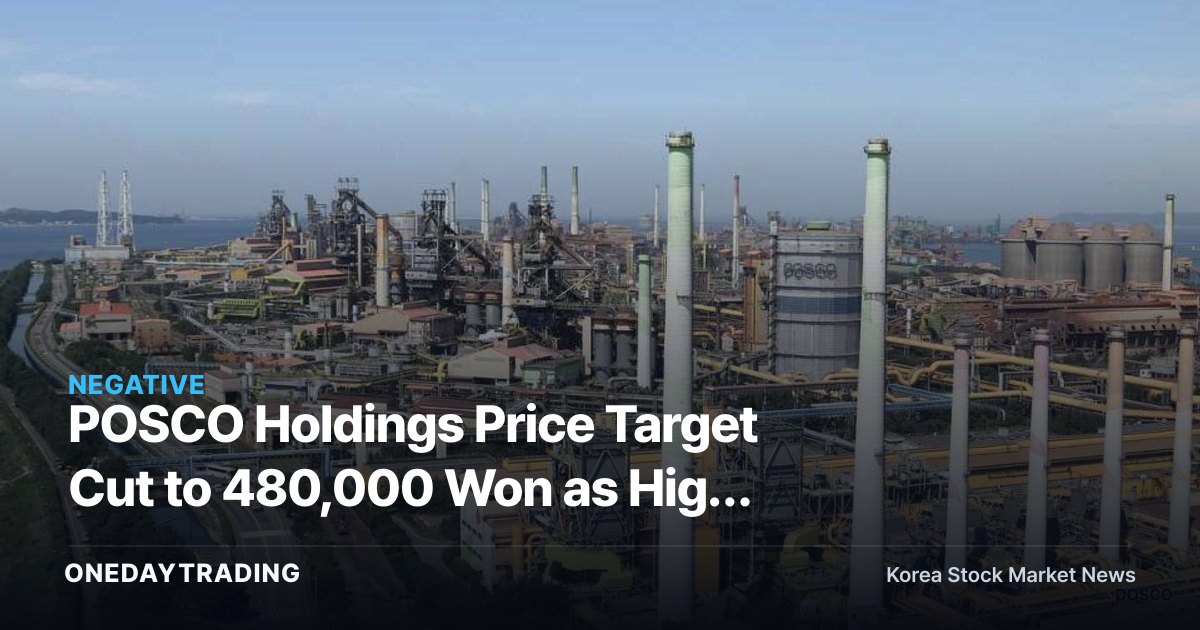
iM Securities has cut its price target for POSCO Holdings to 480,000 won. The downgrade reflects a combination of slowing steel demand amid high interest rates and tight monetary policy, a global supply glut, and falling iron ore prices. That said, the lithium business — a key battery material — and subsidiary earnings are seen as supports cushioning the share price on the downside.
Why It Matters Now
As the sector bellwether of Korea's steel industry and a top stock (ticker) by KOSPI market capitalization, a price-target cut for POSCO Holdings goes beyond a single-name issue and weighs on investor sentiment across the entire steel sector. In a global tightening phase, when investment pulls back across steel's downstream industries — construction, autos, and shipbuilding — demand for core products such as plate and hot-rolled coil declines, which in turn pressures product prices and margins.
On top of this, steel overproduction centered on China acts as a structural variable. When cheap steel floods the global market, domestic producers lose pricing power and profitability erodes. Falling iron ore prices help somewhat on the cost side, but they are also read as a signal that the broader steel cycle is slowing, so they cut both ways for the share price.
By contrast, POSCO Holdings has a business structure that does not depend on steel alone. The core of this analysis is that its eco-friendly future-materials division — including lithium, a key battery material — together with subsidiary earnings, partly offsets the steel weakness and serves as a safety net for the valuation.
Frequently Asked Questions
- Why was the price target lowered? Because slowing steel demand amid high rates and tight policy, a global supply glut, and falling iron ore prices have converged, weakening the profitability outlook for the core steel business.
- Isn't falling iron ore a positive catalyst? It is positive in that it eases cost pressure, but it is also a sign of a slowing cycle, so if product prices fall alongside it, the margin-improvement effect is limited.
- What is supporting the share price? Battery-material businesses such as lithium and subsidiary earnings are offsetting the steel weakness and propping up the downside.
- Is now a bargain-buying opportunity? In the short term, the timing of a steel-cycle recovery is unclear, so a cautious approach is warranted, and the growth potential of the future-materials business should be considered alongside it.
Impact on Related Stocks and Sectors
- POSCO Holdings: The direct subject of the price-target cut, driven simultaneously by weakness in the core steel business and growth in lithium and future materials.
- Hyundai Steel: As another leading steel name, it shares exposure to oversupply and slowing demand, so investor sentiment moves in tandem.
- POSCO Future M: As a subsidiary in battery cathode materials, it contributes to group value in line with the growth of the lithium value chain.
- Dongkuk Steel: A steelmaker centered on bar, section, and plate products, it reacts sensitively to construction activity and steel price trends.
- The steel sector overall: If global tightening and China-driven oversupply persist, margin pressure across the industry sector could continue.
Points to Watch When Investing
- The steel cycle is sensitive to the global economy and interest rates, so the earnings outlook can swing sharply with shifts in macro variables.
- China's steel production and export trends, and whether the government adopts output-cut policies, should be monitored continuously.
- Prices for battery materials such as lithium are highly volatile, so the future-materials division is not always a stable support.
- A price-target cut is merely a brokerage estimate; actual quarterly earnings and product-price trends should be checked alongside it.
Overall Outlook
In an optimistic scenario, a global shift toward rate cuts combined with China's output cuts and stimulus could revive steel demand, while the lithium and future-materials division drives earnings growth — improving both the core business and new ventures together. In that case, the current valuation burden has room to ease gradually.
The risks, however, are clear. If prolonged tightening slows the recovery in downstream demand and the supply glut fails to clear, steel margin pressure could persist. Add lithium price volatility, and the future-materials division's earnings contribution may not materialize as quickly as hoped — so a balanced approach that watches the results of a medium-to-long-term shift in business structure, rather than short-term momentum, is advisable.
This article is auto-summarized and analyzed content based on the original news report. View original (Maeil Business Newspaper, Securities)