
Summary
Inside Samsung Electronics, a conflict between employees in the finished-products (DX) and semiconductor (DS) divisions has escalated into complaints addressed to the Minister of Labor. On the surface it is a dispute over workplace harassment and pressure to resign, but at its core it is a power struggle over the representative-union system and the internal decision-making structure of the union. For investors, this should be read less as an earnings variable and more as a signal of governance and labor risk.
The Full Story
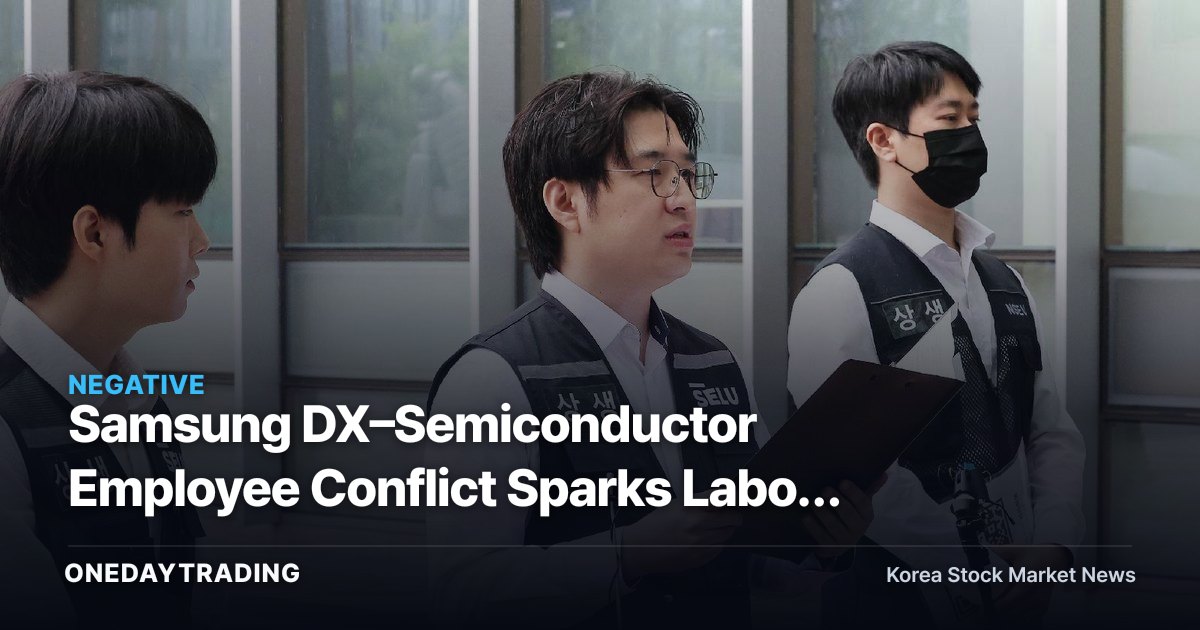
Employees belonging to Samsung Electronics' DX division are filing complaints with the Minister of Employment and Labor, alleging that a junior employee in the semiconductor division mocked them and pressured them to resign. Some union members have joined a so-called "complaint relay" — sharing screenshots of their submitted complaints as proof — continuing a form of collective expression.
They have raised a public question — "who protects the minority of workers?" — and argued that the representative-union system and union democracy are not functioning properly. The grievance that "even when negotiations end, we still earn nothing and are left branded as losers" shows that internal trust in wage and bargaining outcomes is being shaken. The key point is that the conflict has room to spread beyond a simple clash of emotions into the possibility of collective action.
Structural Background
At Samsung Electronics, DX and DS — two businesses of entirely different character — coexist within a single company. Semiconductors carry high volatility in incentive bonuses depending on the industry cycle, while the finished-products division is relatively stable but prone to accumulating a sense of deprivation over compensation levels. Under a multi-union system, when the representative union leads negotiations, complaints that the voices of minority job groups and minority unions are drowned out are bound to recur structurally.
In particular, during the transitional period in which labor-management relations are being institutionalized following the abolition of "no-union management," compensation gaps and representation issues spilling over into emotional conflict between divisions is a labor challenge that Korean conglomerates commonly face.
Impact on the Stock and Sector
- Samsung Electronics: The direct subject of this issue. The impact on near-term earnings is limited, but recurring labor-management conflict weighs on the Social (S) component of ESG ratings and on confidence in governance. A prolonged wage and incentive-bonus negotiation translates into labor-cost volatility and the risk of losing key talent.
- Semiconductor equipment and materials suppliers: Their revenue is tied to the operating stability of Samsung's production lines. If collective action leads to production disruptions, it could introduce variables into the downstream supply-chain schedule.
- Large domestic manufacturing exporters broadly: Companies with multi-union and incentive-bonus systems, such as Hyundai Motor and SK Hynix, share similar risks of cross-division compensation conflict. Upward pressure on labor costs could emerge as a variable common to the industry sector.
- Demand for HR and labor-relations consulting: If the need for conglomerates to overhaul their labor-management governance grows, a secondary effect of rising demand for related services is also possible.
Bull vs. Bear Scenarios
On the bullish side, if this conflict stays at the level of complaints and public opinion and does not escalate into an actual strike or production disruption, the share-price impact is effectively just noise. Samsung Electronics' fundamentals are driven by the memory cycle, its HBM competitiveness, and whether its foundry business recovers, so the weight of the labor issue is low.
On the bearish side, if collective action materializes or the cross-division conflict leads to the departure of key engineers, talent risk becomes a variable that cannot be ignored in semiconductors, where technological competition is fierce. The cost and reputational burden of prolonged labor negotiations could also act as a gradual discount factor on the valuation.
Investor Action Points
- Track the progress of wage and incentive-bonus negotiations and whether collective action is formalized, via union notices and media reports. The turning point is whether any mention of production disruptions emerges.
- At quarterly earnings releases, check the trend in labor and SG&A costs and management's comments on labor relations.
- Monitor changes in the Social and Governance ratings from major ESG agencies. A downgrade could affect institutional investors' order flow.
- The crux remains memory prices and the flow of HBM and foundry orders. Treat the labor issue as a secondary variable, and raise your exposure in response only when signals of production disruption appear.
Samsung Electronics Through Real-Time Data
Samsung Electronics' latest closing price is 346,500 won (0.00% vs. the previous day), and the signal light — combining foreign and institutional investor order flow with news and momentum — is 🟡 Neutral / Wait-and-See. With positive and negative signals mixed, this is a zone to watch.
- ▲ 52-week position — 93% of the 52-week high range — new-high territory
- ▲ News flow — 27 positive catalysts vs. 7 negative catalysts — positive catalysts in the lead
Recent related news is favorable, with 27 positive catalysts and 7 negative catalysts.
※ Price and foreign/institutional investor order-flow data are provided by Korea Investment & Securities (KIS), as of the time of publication.
This article is content automatically summarized and analyzed based on the original news. View the original (Maeil Business Newspaper, Corporate)