
3-Line Briefing
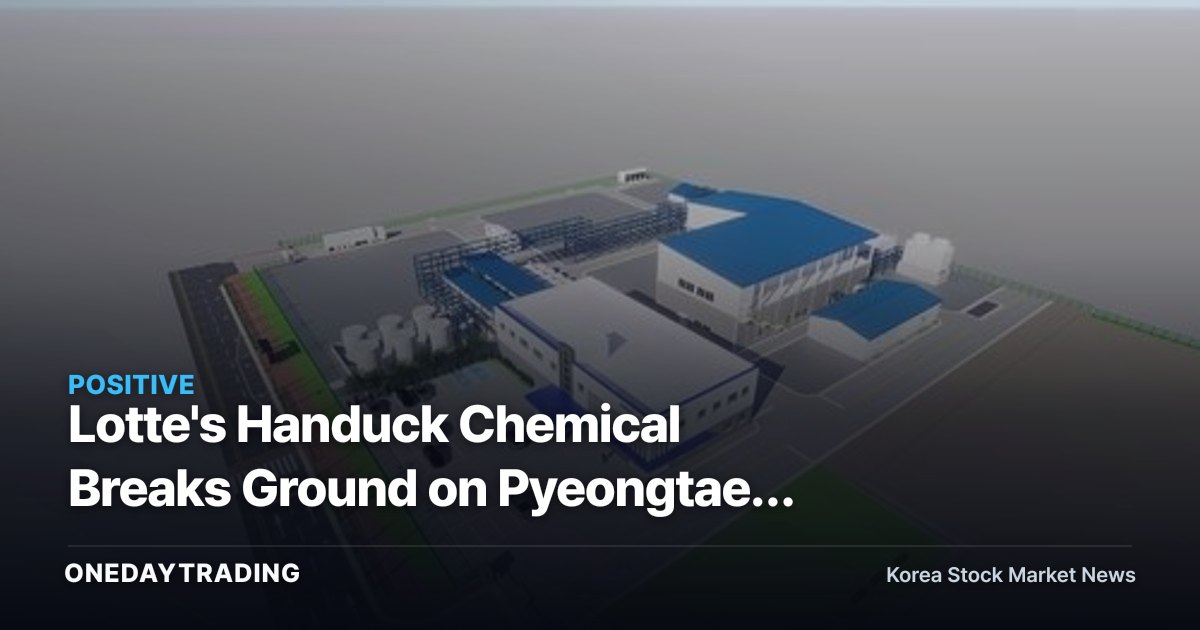
- Handuck Chemical, a member of Lotte's chemical group, broke ground on June 19 in the Poseung district of Pyeongtaek, Gyeonggi Province, on a facility to produce developer (TMAH, or tetramethylammonium hydroxide) for semiconductors and displays.
- Developer is a key consumable material that forms patterns after the lithography process, and is a downstream-linked product consumed steadily in proportion to utilization rates and wafer input volumes.
- The expansion is a strategic move to ride the recovery in downstream memory and foundry operations and the trend toward materials localization, and is more about securing mid-term capacity than about near-term earnings.
What's Changing
The key point of this groundbreaking is that it expands production capacity not for a finished product but for a process consumable. Semiconductor and display lines are hard to stop once they are running, and because developer is consumed repeatedly with every lot, revenue is tied to the line's utilization rate itself rather than to swings in chip prices. This is the structural reason why, when the memory cycle turns toward recovery, materials makers tend to feel the volume effect earlier and more steadily than equipment makers.
Another axis is localization and supply-chain diversification. High-purity TMAH has been a product with some dependence on Japan and other overseas sources, so when a major domestic chemical company expands capacity, the procurement stability of downstream customers such as Samsung Electronics (005930) and SK hynix improves. From the customers' standpoint, securing multiple suppliers is favorable for both pricing leverage and risk diversification, and adoption in a new line could lead to long-term supply contracts.
Reading the Numbers and Context
That said, this announcement is at the groundbreaking stage, and one should keep in mind that specific figures such as the timing of mass production, the scale of the expansion, and the investment amount have not been confirmed or disclosed. A new chemical line typically takes one to two years from groundbreaking to commercial operation, and in the early stages depreciation burdens run ahead of revenue, delaying the contribution to profit. This groundbreaking is therefore better read not as immediate earnings momentum but as a preemptive bet on capacity ahead of the expansion of next-generation fine-process nodes and new display investment.
Beneficiary and Adversely Affected Stocks
- Lotte Fine Chemical and Lotte Chemical (Lotte chemical group): Expansion of the electronic-materials portfolio through Handuck Chemical. A path toward structural improvement that reduces reliance on commodity chemicals and raises the share of high-value specialty and electronic materials.
- Dongjin Semichem: As a domestic leader in developer and photoresist, the Lotte chemical group's capacity expansion is favorable for expanding the domestic share but at the same time intensifies competition (a double-edged effect).
- ENF Technology: A process-chemicals maker handling developer, etchant and the like, an area that could benefit alongside a recovery in downstream demand.
- Samsung Electronics (005930) and SK hynix: An indirect benefit in the form of improved procurement stability and bargaining power from securing multiple suppliers of key materials.
Risk Check
- If the downstream memory and display investment cycle slows, the new line's utilization rate will be low and the capacity could remain nothing but a cost.
- Developer is a market where domestic competitors are already established, so price competition and gaining share will not be easy.
- Construction costs and investment in high-purity refining facilities between groundbreaking and mass production could weigh on near-term profitability.
- Electronic materials still account for a limited share of the Lotte chemical group's overall earnings, so the near-term impact on the group's share price may not be large.
One-Line Conclusion
The direction—materials localization and a recovery in downstream demand—is favorable, but until the timing of mass production and the scale of capacity are confirmed, the significance lies more in pre-empting capacity than in earnings. This is a phase to adjust one's weighting step by step while watching for future disclosure of the investment amount, the commercial-operation schedule, and whether long-term supply deals with downstream customers are signed.
Lotte Fine Chemical Through Real-Time Data
Lotte Fine Chemical's latest closing price is 48,250 won (-1.73% from the previous day), and the signal light combining foreign and institutional order flow with news and momentum is 🟡 neutral, wait-and-see. Positive and negative signals are mixed, making this a zone to watch.
- ▼ Trend alignment — short- and mid-term downward alignment (intraday -1.7% · 1 week -1.2% · 1 month -11.6%)
※ Price and foreign/institutional order-flow data are provided by Korea Investment & Securities (KIS) and are as of the time of publication.
This article is content automatically summarized and analyzed based on the original news. View original (Yonhap News, Industry)