
At a Glance
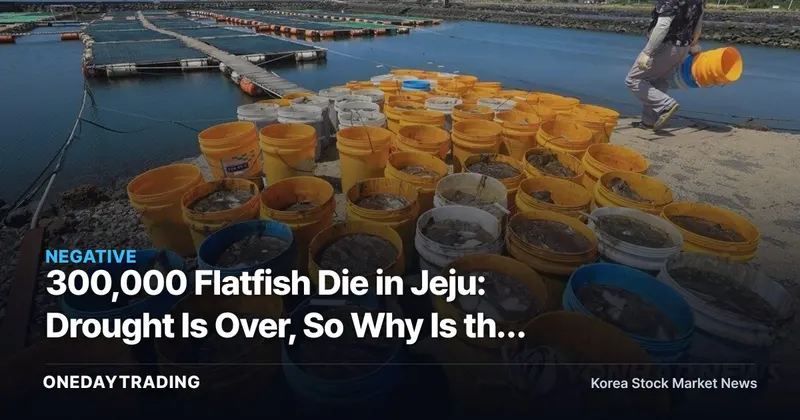
Heavy rain in Jeju has broken the drought, but the coastal waters where the island's flatfish farms are concentrated remain at elevated temperatures. The fact that this temperature gap led to the death of 300,000 flatfish shows that rainfall-driven drought relief, a staple of weather news, and the actual damage on fish farms move on different timelines. That is why land-based drought indicators and ocean water-temperature indicators need to be tracked separately.
Why It Matters Now
The reported facts are straightforward. Heavy rain fell across Jeju over the past weekend, ending the prolonged drought. But the seawater that flatfish and other farmed species live in doesn't cool quickly from a few rounds of rain. Even as air temperatures drop, seawater that has already warmed has a large heat capacity and cools slowly — and that lag resulted in the death of 300,000 flatfish.
For fish farmers, high water temperature is an invisible loss. As water temperature rises, dissolved oxygen levels fall, and flatfish become more vulnerable to disease as oxygen deprivation and stress weaken their immune systems. This is why die-offs accumulate over time rather than concentrating on a single day. The fact that the good news of drought relief and the bad news of a mass flatfish die-off emerged at the same time is not a coincidence — it reflects the difference in how quickly land and sea respond to temperature change.
This gap is also a signal for investors. Reading only the weather headlines and concluding that aquaculture and seafood-related risk has eased could mean missing an actual supply disruption. Since Jeju accounts for a large share of domestic flatfish farming, whether this die-off is confined to specific farms or reflects a broader high-water-temperature event across the region will determine its ripple effect on seafood supply and prices going forward.
Key Issues
- Drought relief and falling sea temperatures are separate matters: rainfall cools the atmosphere and surface water, but ocean temperature responds more slowly due to its greater heat capacity.
- The die-off is presumed to stem from reduced dissolved oxygen and stress-induced immune decline caused by high water temperatures.
- It remains unconfirmed whether the damage is a one-off incident limited to specific farms or a broader high-water-temperature phenomenon along the Jeju coast.
- The pace of farmers' loss recovery will depend on whether and when the damage is officially recognized as a disaster eligible for compensation.
Related Stocks (Tickers) & Sector Impact
- Aquaculture: A mass flatfish die-off directly reduces shipment volumes, putting upward pressure on next-quarter wholesale prices and procurement costs.
- Seafood distribution and processing: Higher procurement costs for flatfish and other white-fleshed fish could squeeze distribution and processing margins.
- Restaurants and food service (sashimi restaurants): Flatfish is a staple of Korea's live-fish sashimi market, so rising input costs could pressure menu prices higher.
- Fisheries disaster insurance and policy support: If the scale of the die-off is officially recognized as a disaster, related support payouts and insurance settlements become a follow-on variable.
Investment Considerations
- Assessing the true scale of the supply shock requires knowing what share the 300,000 fish represent of Jeju's total flatfish farming volume.
- The extent of the damage will vary greatly depending on whether the high water temperature is short-lived or persists throughout the summer.
- Flatfish prices could be offset by supply of substitute species or imported seafood, independent of the die-off volume.
- Confirming the timing of any disaster recognition and support announcements from the government or local authorities is key to assessing the actual loss burden on fish farmers.
Overall Outlook
In an optimistic scenario, if this die-off proves to be a localized incident and sea temperatures subsequently return to seasonal norms, the impact on flatfish prices and aquaculture-sector earnings could be absorbed within a short period. Conversely, if the high water temperatures persist into late summer, the damage could spread to other farmed species beyond flatfish, and rising seafood prices could add to broader food-service inflation — a scenario that cannot be ruled out. The key variable is not the land-based drought indicator, but how quickly actual water temperatures along the Jeju coast come down.
FAQ
What caused the flatfish die-off in Jeju?
It is presumed that sustained high seawater temperatures reduced dissolved oxygen levels, weakening the flatfish's immune systems through oxygen deprivation and stress and driving up mortality. The rain that ended the drought cooled the atmosphere and surface water but did not quickly bring down the temperature of seawater that had already warmed.
Will flatfish prices rise?
A mass die-off that reduces shipment volumes could put upward pressure on wholesale procurement costs, but whether that feeds through to consumer prices depends on how large the losses are relative to total supply and whether alternative volumes can be secured. Watching the next wholesale auction price release will give a clearer picture.
How long will the high-water-temperature conditions last?
As of this report, only the drought has been resolved — there is no evidence yet that sea temperatures have come down. Tracking when water temperatures return to seasonal norms and whether high-water-temperature advisories are lifted will be key to judging whether the damage spreads further.
This article was automatically summarized and analyzed based on the original news report. View original (Yonhap News, Industry)