
Key Takeaways
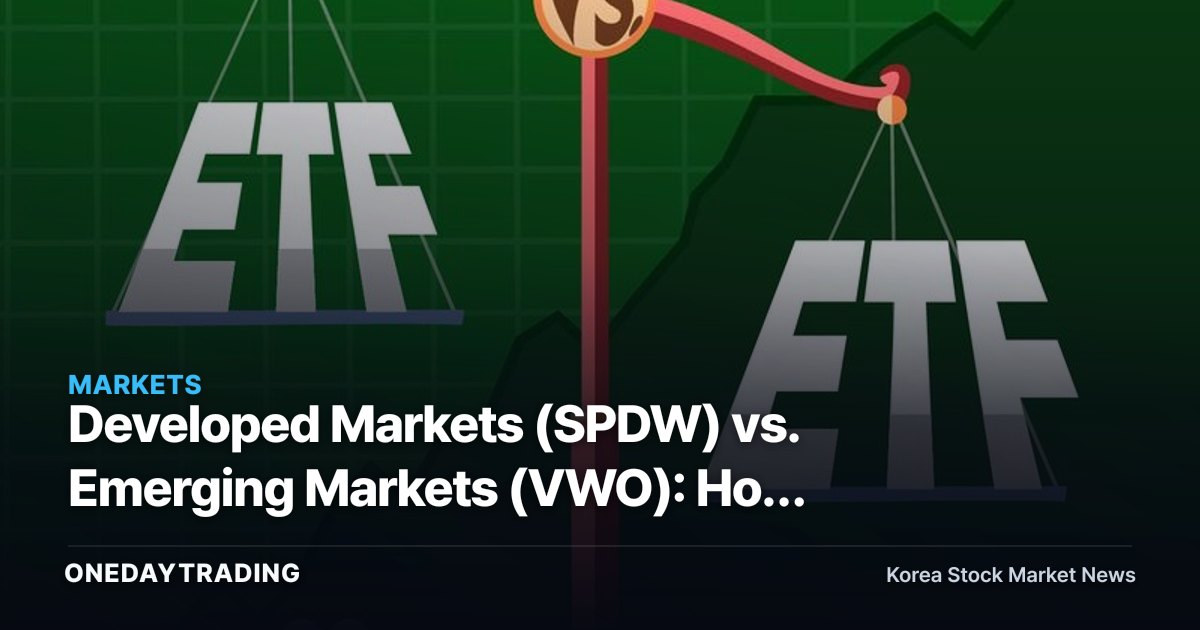
For an investor whose portfolio is concentrated in the single U.S. market, comparing SPDW and VWO is not merely a product choice but an asset-allocation decision about which region's economy, currency, and industries to bet on in the next cycle. The two ETFs share the same goal of overseas diversification, but the nature of the risk they hold is entirely different.
What Happened
State Street's SPDW invests broadly in developed-market equities outside the United States. Large caps from mature economies such as Europe, Japan, Canada, and Australia form its core, and its currency exposure is spread across the euro, yen, pound, and others. It is characterized by relatively low volatility and a strong value-stock tilt with a high dividend weighting.
Vanguard's VWO, by contrast, tracks the FTSE Emerging Markets Index. China, India, Taiwan, Brazil, and Saudi Arabia make up its major weightings, offering high growth potential but coming with political, currency, and regulatory risks. In particular, its Taiwan weighting includes a large position in the world's leading semiconductor contract manufacturer, which effectively links the ETF to the semiconductor industry cycle.
There is one classification difference Korean investors must be aware of. Under FTSE's standards, Korea is classified as a developed market and is therefore not included in VWO. In other words, buying an emerging-market ETF gives you no KOSPI exposure; instead, it ends up increasing your weighting in rival countries such as Taiwan and China.
Background and Context
In recent years, with U.S. Big Tech leading the S&P 500 to dominate global equity markets, there has been considerable skepticism about the value of overseas diversification. However, as concerns over stretched valuations and shifts in the dollar's trajectory have come to the fore, demand to shift some capital toward the relatively undervalued developed markets of Europe and Japan and toward high-growth emerging markets is reviving. Both SPDW and VWO are low-cost passive products, making them go-to candidates for long-term investors who prioritize cost efficiency.
Impact on the Market and Individual Stocks
- Taiwan and the semiconductor value chain: VWO carries a large weighting in Taiwan's leading semiconductor foundry, so inflows into emerging-market ETFs effectively amount to the same bet as a recovery in global semiconductor demand. This shares the same economic cycle as Korean semiconductor stocks.
- China exposure: VWO has a high China weighting, leaving it directly exposed to China's stimulus and regulatory risks. Chinese consumption and property indicators heavily influence the ETF's performance.
- European and Japanese value stocks: SPDW has a high weighting in traditional large caps such as financials, industrials, and autos, so it benefits substantially when interest-rate- and cycle-sensitive sectors recover.
- Dollar direction: Because both ETFs hold non-dollar assets, a weakening dollar adds currency gains, while a strengthening dollar erodes returns.
- No direct Korea exposure: Since buying VWO provides no KOSPI diversification, Korean investors should separately check for overlap with—or gaps relative to—their domestic holdings.
Investor Checkpoints
- Directly compare the two products' expense ratios and tracking error, and calculate how the cost difference compounds into total returns over a long holding period.
- If considering VWO, verify its China weighting and Taiwan semiconductor weighting in the product prospectus, and check whether they overlap with your portfolio's existing semiconductor and China exposure.
- Track the won-dollar exchange rate level and the U.S. Federal Reserve's rate path as currency variables. Signs of a shift toward a weaker dollar provide a rationale for increasing overseas ETF allocations.
- Keep China stimulus announcements and the schedule of European and Japanese monetary policy meetings on your calendar, and monitor shifts in regional momentum.
Outlook
In a scenario where dollar strength fades and emerging-market growth momentum revives, VWO may offer relatively higher expected returns; conversely, in a phase of global slowdown and risk aversion, SPDW—with its larger weighting in dividends and value stocks—has room to show defensive strength. That said, VWO carries the structural variables of China's regulatory and geopolitical risks, while SPDW also faces clear limitations in the low growth and demographics of Europe and Japan. Neither holds an absolute advantage, and for Korean investors, the key variable is how to blend developed and emerging markets in what proportion while avoiding overlap with domestic holdings.
This article is content automatically summarized and analyzed based on the original news report. View original (Yahoo Finance)