
At a Glance
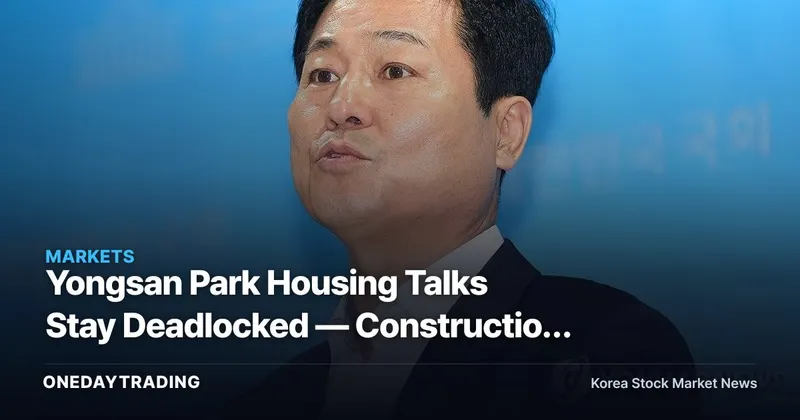
Housing supply at Yongsan Park failed to reach agreement even at the August 22, 2026 meeting, and the center of gravity in Seoul's housing supply policy is shifting from park development to easing regulations on redevelopment and reconstruction projects.
The debate over housing supply at Yongsan Park centers on a supply-policy standoff between the central government/ruling party and the Seoul city government over whether part of the park's core site can be used for housing for young people, newlyweds, and multi-child households.
Why It Matters Now
What investors should watch is not political rhetoric but sites that are actually ready to break ground. According to Yonhap News, Kim Young-bae, chairman of the Democratic Party's Seoul chapter, held a lunch meeting with Seoul Mayor Oh Se-hoon on August 22, but the two sides failed to narrow their differences over the use of Yongsan Park, the Yongsan rail yard redevelopment site, and greenbelt land. For supply expectations to be reflected in stock prices, what's needed is not another candidate-site announcement but concrete numbers on administrative procedures, soil-contamination remediation, traffic measures, and floor-area-ratio incentives.
The Seoul city government opposed using the core site of Yongsan Park for housing supply. Its reasoning cited neighborhood green space, legal procedures, traffic burden, and the time needed for soil remediation. All four factors push back the timeline for breaking ground. In a market where asking prices move first and actual transactions fail to keep pace, speed itself becomes the price.
Still, this is not a complete breakdown. The city government mentioned scattered alternative sites such as Camp Kim, Gyeongridan, and the Ministry of Foreign Affairs parking lot, as well as the Tancheon Water Reclamation Center, while Kim said there is room for negotiation on regulatory measures such as floor-area-ratio incentives for redevelopment and reconstruction. If the core Yongsan Park site remains blocked, the market will instead be looking at a combination of alternative sites and eased regulations for redevelopment projects.
Key Points of Contention
- Whether to repurpose the core site The central government and ruling party favor keeping open the option of using part of Yongsan Park, while Seoul opposes using the core site for housing. This difference is less about supply volume than about whether construction can actually begin.
- Scope of greenbelt deregulation Rep. Kim Young-bae cited the 2023 precedent of lifting greenbelt restrictions in the Seoripul area, but the city government maintained its principle of considering such moves only for already-degraded land.
- Feasibility of alternative sites The Camp Kim, Gyeongridan, and Ministry of Foreign Affairs parking lot sites have been floated as compromises, but some of them currently have residents or workplace demand, meaning relocation and site clearance would need to happen first.
- Funding Rep. Kim and Mayor Oh both left room for discussion on using part of the Future Response Fund to finance youth housing. Agreement on funding is the first step in moving supply policy from declaration to actual budget.
Impact on Related Stocks and Sectors
- Construction stocks If development of the core Yongsan Park site stays blocked, expectations for large civil-engineering and housing orders are unlikely to translate into numbers right away. Instead, if floor-area-ratio incentives for redevelopment and reconstruction take concrete shape, builders with strong competitiveness in Seoul redevelopment projects would be the first to react.
- Cement and building materials Volume effects only materialize once supply policy actually translates into groundbreaking. At this stage, permitting timelines and the start-of-construction date matter more for revenue visibility than which candidate site is chosen.
- REITs and real estate finance If housing supply for young people and newlyweds is designed as a rental structure, the frameworks for publicly supported private rental housing, REITs, and project financing become important. With interest-rate burdens still in place, funding costs are worth watching as a drag on returns.
- Seoul housing market The Yongsan Park debate stirs supply expectations for core Gangbuk-area locations, but expectations without agreement tend to show up in asking prices first. Without actual transactions and trading volume to back them up, such moves are hard to read as genuine price signals.
Points for Investors to Watch
- Both the August 20, 2026 meeting between the Minister of Land, Infrastructure and Transport and Mayor Oh, and the August 22 meeting between Rep. Kim and Mayor Oh, confirmed the same deadlock over using the core Yongsan Park site. When the same sticking point repeats, the policy premium gets discounted.
- The list of alternative sites is only a starting point. Real investment decisions require clarity on site ownership, relocation of existing occupants, soil remediation, traffic impact assessments, and the timeline for urban planning changes.
- Easing regulations on redevelopment and reconstruction is the more direct driver for construction stocks. That said, even if floor-area-ratio incentives increase, high construction and financing costs mean the profitability of redevelopment associations won't improve immediately.
- Discussions about using part of the Future Response Fund to finance youth housing need to be confirmed at the budget-drafting stage. A supply plan without funding tends to remain an announcement rather than lead to groundbreaking.
Overall Outlook
The optimistic scenario is that the debate over the core Yongsan Park site gets set aside and the supply package is rebuilt around scattered sites, the Tancheon Water Reclamation Center, and redevelopment/reconstruction incentives. In that case, the market would respond to actual buildable floor area and floor-area-ratio numbers across Seoul rather than to the symbolism of Yongsan. For construction stocks, an expanding pipeline of redevelopment projects is a more realistic catalyst than a single mega-development.
The risk is time. The city government has said that groundbreaking within the current administration's term is unlikely given soil-contamination remediation and administrative procedures. If that assessment holds, housing supply at Yongsan Park will end up being a case study in the bottlenecks of supply policy rather than a positive catalyst for stock prices. The indicators to watch next are the budget and policy proposals Seoul city is set to deliver to the Democratic Party's Seoul chapter by mid-September, follow-up talks between the Ministry of Land, Infrastructure and Transport and the city government, and the exact wording of the floor-area-ratio incentives for redevelopment and reconstruction.
Frequently Asked Questions
Why has housing supply at Yongsan Park stalled?
Housing supply at Yongsan Park has stalled because the central government and ruling party disagree with the Seoul city government over whether part of the park's core site can be converted to residential use. As of the August 22, 2026 report, the city cited legal procedures, traffic issues, soil-contamination remediation, and residents' quality of life as grounds for opposing the plan.
Is housing supply at Yongsan Park a positive catalyst for construction stocks?
Housing supply at Yongsan Park itself is not yet a positive catalyst for construction stocks, since there is no agreed timeline or volume for groundbreaking. However, if floor-area-ratio incentives for redevelopment and reconstruction are actually written into policy, that would be a more direct variable for builders with a large book of Seoul redevelopment orders.
Where should investors look to track Seoul's youth housing supply?
Seoul's youth housing supply should be tracked through alternative sites and budget allocations rather than the core Yongsan Park site. Key markers are the budget and policy proposals Seoul city is set to submit by mid-September 2026, discussions over using the Future Response Fund, and the administrative procedures for candidate sites such as Camp Kim, Gyeongridan, and the Tancheon Water Reclamation Center.
This article was automatically summarized and analyzed based on original news reporting. View Original (Yonhap News)