
Three-Line Briefing
- Hyundai Motor Group is expected to acquire the remaining 9.65% stake in Boston Dynamics held by SoftBank, lifting its ownership to 100%.
- Following its 2021 acquisition of an 80% stake at an enterprise valuation of roughly $1.1 billion, the move clears out external shareholders — handing the group sole decision-making authority over the robotics business.
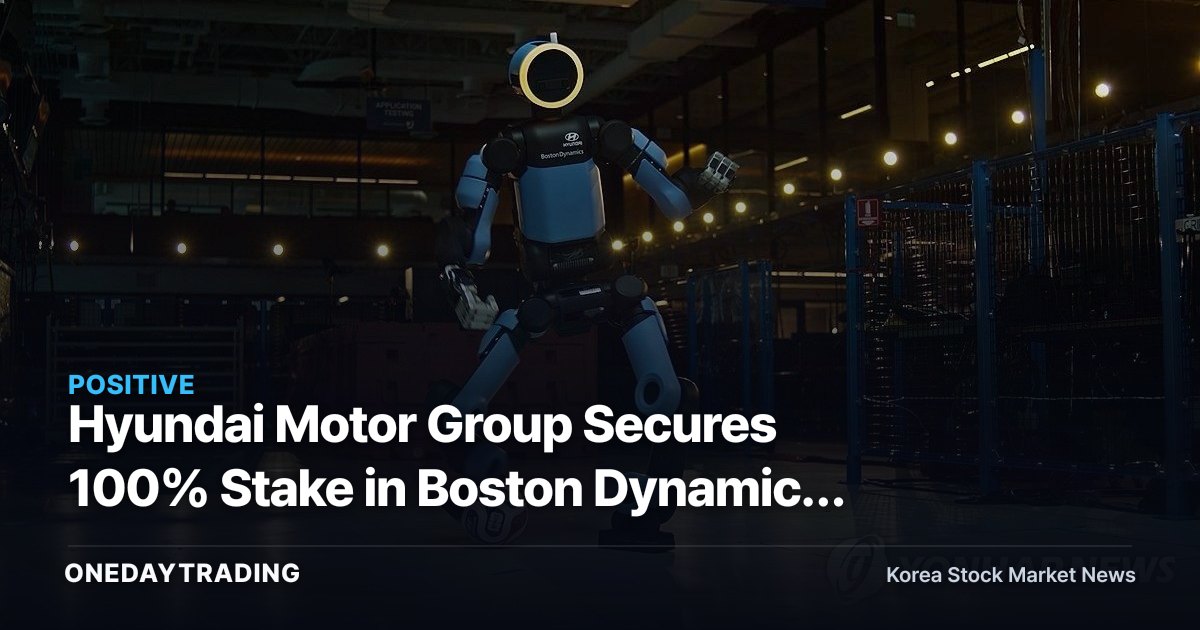
- The key things to watch are the pace of commercialization of the all-electric version of the Atlas humanoid and the Spot quadruped robot, along with the integration with automation at Hyundai Motor and Kia plants.
What Changes
The significance of this deal is less about a simple cleanup of shareholdings and more a signal that Hyundai Motor Group has firmly anchored robotics as a core pillar of its future-mobility portfolio. With SoftBank — a financial investor from outside the group — stepping away, friction over decisions such as dividends, liquidation, and new investment disappears, allowing the group to take full control of Boston Dynamics' capital allocation and mass-production strategy. While the burden of carrying a loss-making business grows heavier, it creates a structure in which the group can push long-term R&D forward without having to answer to outsiders.
The humanoid front is particularly worth noting. Boston Dynamics has retired its hydraulic Atlas and shifted to a fully electric new Atlas, and electrification offers advantages in mass producibility, serviceability, and unit cost when it comes to deployment on industrial sites. With 100% control, Hyundai Motor Group can secure a captive (internal demand) market by giving its own robots priority for adoption on Hyundai Motor and Kia production lines — a foundation for early production volumes and data accumulation.
On top of this, the group has been envisioning a setup in which it shares software and autonomy technologies across its robotics AI lab (the Boston Dynamics AI Institute), its autonomous-driving joint venture Motional, and urban air mobility (UAM). Full subsidiary status makes integrating this technology, talent, and data far smoother.
By the Numbers and Context
Hyundai Motor Group acquired roughly an 80% stake in Boston Dynamics from SoftBank Group in 2021, in a transaction valued at an enterprise value of about $1.1 billion at the time. By additionally buying the remaining 9.65% this time, the combined stake held by the group (including Chairman Euisun Chung's personal holding) and its affiliates reaches 100%. That said, Boston Dynamics is at a stage where it can hardly be said to have entered a full profit structure, so the speed at which the humanoid and logistics robot markets convert into actual revenue will be the turning point for any future re-rating of its enterprise value.
Beneficiary and At-Risk Stocks
- Hyundai Motor / Kia: Through Boston Dynamics, they can secure a path to lower manufacturing costs via plant automation and logistics efficiency, and leverage robotics as a new-growth narrative. In the short term, however, consolidating a loss-making subsidiary weighs on results.
- Hyundai Mobis: A components hub where intra-group supply linkages could be raised in areas such as robot drivetrains, electronics components, actuators, and sensors.
- Hyundai Wia / Hyundai Rotem: Affiliates whose business touchpoints with the group's robotics strategy could broaden in plant automation equipment and collaborative/logistics robots.
- Robot-component, reducer, and servo-motor companies: As humanoid mass production advances, demand for precision reducers, motors, and sensors rises, bringing the entire domestic robot-components value chain within the reach of expanding downstream demand.
- SoftBank Group: Selling off its entire stake to recoup capital, in line with a broader shift of its focus toward AI infrastructure investment rather than robotics.
Risk Check
- Visibility into commercial revenue from humanoids and industrial robots remains low, so it is hard to view full subsidiary status as immediately translating into improved group earnings.
- The impact on the group's cash flow and capital allocation from the funds required for the additional stake acquisition and the burden of continued R&D investment needs to be monitored.
- Global humanoid competition from the likes of Tesla's Optimus and Figure is intensifying, raising pressure on technology and unit-cost competition.
- Robotics themes tend to price in expectations in advance, so if a gap opens up versus actual orders and deliveries, valuation concerns could come to the fore.
Bottom Line in One Sentence
Full subsidiary status is a long-term move that clarifies Hyundai Motor Group's commitment to the robotics business, but until the humanoid's actual mass production and revenue conversion — and the easing of the loss burden — are confirmed, it is a stretch where the gap between expectations and profitability must be watched closely.
Hyundai Motor Through Real-Time Data
Hyundai Motor's latest closing price was 613,000 won (+2.00% versus the previous day), and the signal light combining foreign and institutional investor order flow with news and momentum is 🟡 Neutral · Wait-and-See. With positive and negative signals mixed, it is a stretch to watch.
Recent related news breaks down to 8 positive catalysts and 11 negative catalysts — a negative skew.
※ Price and foreign/institutional supply-demand (order flow) data are provided by Korea Investment & Securities (KIS) and are as of the time of publication.
This article is content automatically summarized and analyzed based on the original news. View original (Yonhap News, Industry)