
At a Glance
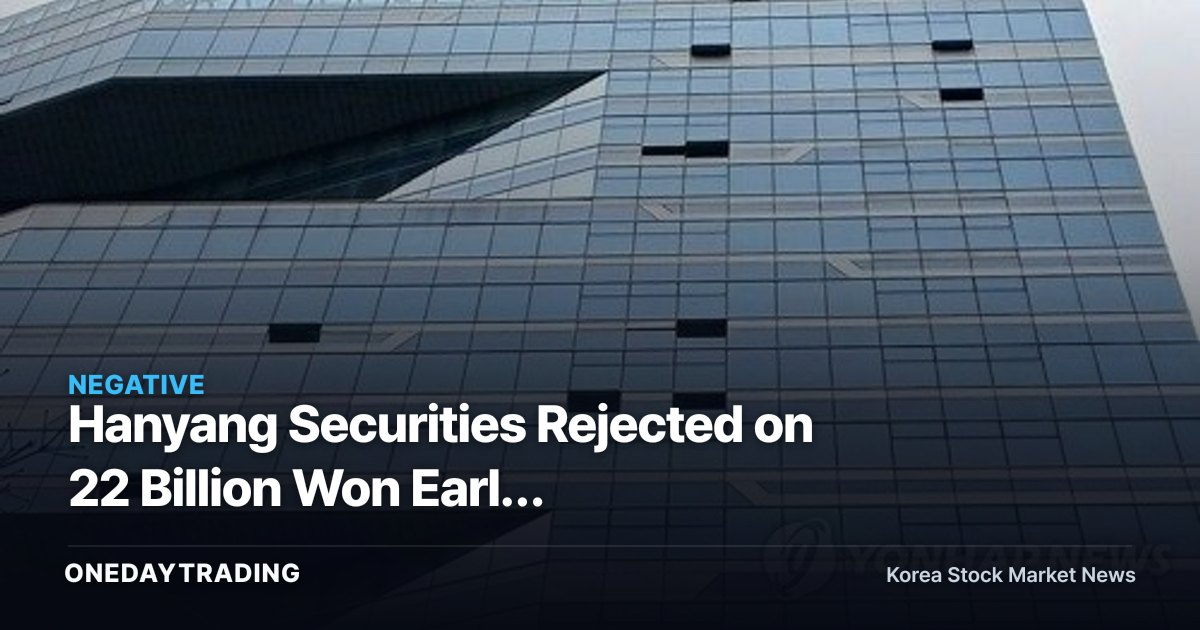
Hanyang Securities requested early redemption of 22 billion won in commercial paper (CP) issued by JoongAng Ilbo, but JoongAng Ilbo effectively declined, saying that individually redeeming the debt of a specific creditor ahead of maturity would be difficult. This goes beyond a simple difference of opinion between creditor and issuer; it is a signal prompting the market to take another look at the recoverability of brokerages' exposure to unlisted-company CP and at their credit-risk management frameworks.
The key question is how Hanyang Securities' asset quality and provisioning burden will move. If recovery is delayed until maturity or partial write-offs become necessary, it could affect quarterly earnings and capital metrics.
Why It Matters Now
CP carries short maturities and is largely unsecured, so when an issuer's cash flow tightens, recovery can be delayed or become reliant on refinancing. The very fact that Hanyang Securities was the first to request early redemption can be read as reflecting wariness about the issuer's ability to repay. Conversely, JoongAng Ilbo's response that individual redemption ahead of maturity would be difficult suggests either a fairness issue with other creditors if only a specific creditor were repaid first, or that immediately available liquidity may not be sufficient.
From an investor's standpoint, the points to watch are the size and weight of the exposure. The 22 billion won figure itself may be small for a large brokerage, but for a small- to mid-cap brokerage with a relatively limited capital base, it is a level that could sway quarterly profit. If recovery normalizes, it ends as one-off noise, but if it drags on, it could lead to loan-loss provisioning and the recognition of valuation losses.
This case also draws attention to credit-assessment and risk-management practices across the brokerage industry for those holding unlisted-issuer CP. The more a brokerage carries illiquid assets such as real estate project financing (PF) and bonds or CP of marginal companies, the more likely it is to face scrutiny over similar recovery risks.
Frequently Asked Questions
- What is the impact on Hanyang Securities If recovery of the 22 billion won is delayed, a provisioning burden and the possibility of valuation losses arise, which could weigh on quarterly earnings and soundness metrics.
- Why did JoongAng Ilbo refuse individual redemption Repaying only a specific creditor first would raise fairness issues, and immediately available liquidity may be limited, so the move is interpreted as a preference for lump-sum repayment at maturity.
- Why CP is risky Because it is an unsecured, short-term funding instrument, recovery is delayed when the issuer's cash flow seizes up, and there is little room to recover collateral.
- Will this spread across the brokerage industry It is closer to an individual-issuer issue, but it could serve as an occasion for risk reviews at brokerages with large unlisted-company CP and PF exposure.
Impact on Related Stocks and Sectors
- Hanyang Securities As the party directly holding the CP, it is the most sensitive, since a delay in recovery could feed directly into earnings through provisioning and valuation losses.
- Small- and mid-cap brokerage stocks The higher a firm's illiquid and credit exposure relative to its capital, the more wariness about similar risk could spread.
- The brokerage sector overall Combined with concerns over recovering real estate PF and marginal-company debt, credit-risk management capability could emerge as a factor differentiating valuations.
- Credit-rating and bond-related industry sectors Moves to re-rate or re-price unlisted-issuer CP could affect funding costs.
Points to Note When Investing
- Check in Hanyang Securities' quarterly report whether provisions have been set aside for this exposure and how soundness metrics change.
- Don't look only at the dollar amount; review it together with its weight relative to capital and its combined exposure with other illiquid assets.
- Track JoongAng Ilbo's maturity repayment schedule and whether it discloses funding or refinancing plans.
- Avoid overinterpreting an individual-stock issue as a negative catalyst for the entire brokerage industry, and assess each company's risk structure separately.
Overall Outlook
If normal repayment is made at maturity, this case wraps up as a temporary dispute over fund recovery, and its impact on Hanyang Securities' earnings may be limited. However, if repayment drags on or some loss recognition becomes necessary, there is room for the market's doubts about small- and mid-cap brokerages' credit-risk management to grow. A reasonable approach is to track recovery progress, provisioning trends, and the issuer's liquidity situation separately.
Hanyang Securities Through Real-Time Data
Hanyang Securities' latest closing price is 20,800 won (+3.48% versus the previous day), and the signal light combining foreign and institutional supply-demand (order flow) with news and momentum is 🟡 Neutral · Wait-and-See. Positive and negative signals are mixed, making this a zone to watch.
Recent related news is negative, with 0 positive catalysts and 1 negative catalyst.
※ Price and foreign/institutional supply-demand (order flow) data are provided by Korea Investment & Securities (KIS), as of the time of publication.
This article is content automatically summarized and analyzed based on the original news. View Original (Yonhap News Securities)