
Nomura’s KOSPI Outlook: Three-Point Briefing
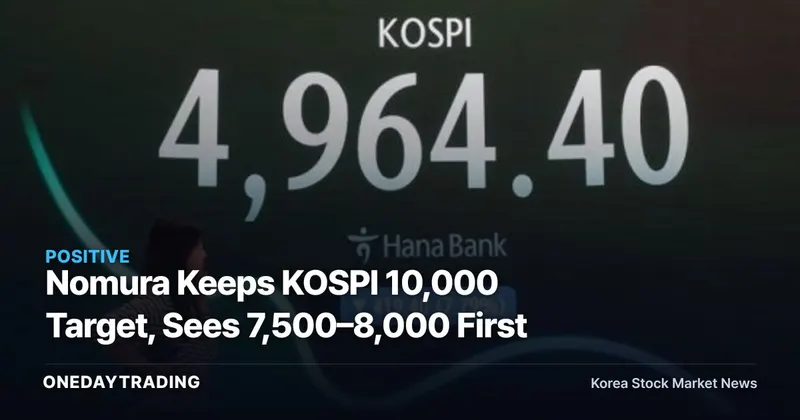
- On the 5th, Nomura maintained its existing KOSPI target of 10,000 and set a three-month target range of 7,500–8,000.
- The key point highlighted by Asia Economy Securities is the separation of time horizons, rather than the long-term target’s upside potential. The outlook for stronger corporate earnings and shareholder returns remains intact, but uncertainty over interest rates and AI data center investment could increase near-term volatility.
- The list of preferred stock picks, including Samsung Electronics and SK hynix, indicates Nomura’s direction, but investors should separately verify whether each company’s earnings and shareholder returns meet Nomura’s assumptions.
Why 7,500–8,000 Matters Before 10,000
Nomura maintained its existing KOSPI target of 10,000 on the 5th. This is not a prediction that the index will reach that level immediately. Investors should distinguish the three-month target of 7,500–8,000 from the case for a long-term rerating. No specific timeframe was given for the KOSPI to reach 10,000.
The KOSPI’s decline of more than 8% shortly after the market opened on the 6th, triggering a circuit breaker, shows how widely near-term prices can diverge from long-term estimates. What is currently visible is the growth in corporate earnings and shareholder returns that Nomura identified as upside drivers. What remains unknown is the actual level of interest rates and oil prices, and whether AI data center construction plans will be delayed or relocated.
Conditions Behind Nomura’s Valuation
PER compares a share price with forecast earnings, while PBR compares it with book value. Nomura valued the KOSPI at a forecast 2027 PER of 3.8 times and a forecast PBR of 1.1 times. Low multiples alone are not enough. Earnings and shareholders’ equity must remain in line with expectations for these figures to become the starting point for a rerating.
The KOSPI target of 10,000 applies a forecast PER of 7.1 times, based on an expected 2027 ROE of 31%. If uncertainty over interest rates persists, the multiple accepted by the market could remain low even if earnings forecasts hold. Conversely, continued growth in corporate earnings and shareholder returns would strengthen the case for narrowing the gap between 3.8 times and 7.1 times.
Cyndi Park, Nomura’s head of Korea research, said, “The Korean stock market appears oversold, but its fundamentals remain solid.” The focus of this assessment is not the sharp drop (plunge) itself, but whether the earnings and shareholder-return assumptions remain intact afterward.
How Shareholder Returns Could Drive a KOSPI Rerating
According to Nomura, KOSPI-listed companies have announced 77.6 trillion won in share buybacks so far this year and 62 trillion won in share cancellations. Share cancellations by KOSPI-listed companies are 3.5 times last year’s level. Cancellations are more directly relevant to investors than buyback announcements because they provide evidence that minority shareholders’ interests are being reflected in actual corporate decisions.
SK hynix’s decision to halt consideration of a Solidigm initial public offering was cited in the same context. Nomura viewed it as an example of minority shareholders’ interests influencing a major corporate decision. For target multiples to rise, such changes must extend beyond one-off decisions and lead to broader growth in shareholder returns across companies.
How to Read Nomura’s Preferred Picks, Including Samsung Electronics and SK hynix
- Samsung Electronics, SK hynix, Samsung Electro-Mechanics and Samsung SDS: These are among Nomura’s preferred stock picks. Reduced uncertainty over AI data center investment would help sustain related expectations, but it has not been confirmed whether construction plans will actually be delayed or relocated.
- LG Energy Solution, Doosan Enerbility and Hyundai Mobis: These companies are also on the preferred list. The materials provided do not specify the scale of benefits or earnings trajectory for each company, so the list itself should not be interpreted as an earnings forecast.
- Celltrion and HD Hyundai Marine Solution: These two companies are also among Nomura’s preferred stock picks. Because they operate in different industry sectors, investors should examine company-specific earnings and shareholder-return trends rather than assume identical share-price trajectories based solely on the KOSPI target.
Risks That Could Determine Near-Term Volatility
- Interest rates: Their actual level is unknown. Continued uncertainty would limit the pace of valuation expansion applied to the KOSPI.
- Oil prices: Future levels remain unknown, making it impossible to determine the direction or magnitude of their impact on corporate earnings.
- AI data center investment: It remains unconfirmed whether construction plans will actually be delayed or moved to other regions. If related investment weakens, the long-term earnings assumptions will need to be reassessed.
- Memory earnings: The actual impact from 2028 onward remains unknown. It must be confirmed in subsequent earnings before it can support an investment case for SK hynix and Samsung Electronics.
What to Monitor Next in the KOSPI 10,000 Thesis
The KOSPI target of 10,000 has no stated deadline, while 7,500–8,000 represents the path projected for the next three months. Investors should focus first not on the figures themselves, but on whether the assumptions of a 31% forecast ROE and a 7.1-times forecast PER for 2027 remain intact. Continued growth in corporate earnings and share cancellations would strengthen the rerating thesis, while adverse moves in interest rates or AI data center investment would first be reflected in volatility around the near-term target range.
Samsung Electronics Key MetricsAs of 2026-11-07
| Period Return | 1 Week -14.04% 1 Month -27.97% |
|---|---|
| Trading Value · Trading Volume | 132.9 billion won · 56,147,847 shares |
| Supply-Demand (Order Flow) | Foreign Investors Net selling of 166.2 billion won (4 consecutive days) Institutional Investors Net selling of 98.5 billion won |
| Recent News Tone | Positive Catalysts 2 · Negative Catalysts 4 |
Price and supply-demand (order flow) data are real-time figures from Korea Investment & Securities (KIS), while supply-demand (order flow) and news-tone aggregates are calculated independently by One Day Trading.
Supply-Demand (Order Flow) and Momentum Assessment🔴 Caution
Foreign investors, institutional investors, news and momentum indicators are showing negative signals.
- ▼Supply-Demand (Order Flow) ContinuityForeign investors posted net selling for 4 consecutive days (166.2 billion won)
- ▼Simultaneous SellingForeign investors sold a net 166.2 billion won · institutional investors sold a net 98.5 billion won
- ▼Trend AlignmentShort- and medium-term downtrend alignment (day -4.0% · 1 week -14.0% · 1 month -28.0%)
- ▼News Flow2 positive catalysts vs 4 negative catalysts — negative catalysts dominate
Upcoming Events to Monitor
- 11.12Index Options ExpirationLowKOSPI200 options expiration
- 11.26Bank of Korea Monetary Policy BoardHighBenchmark interest rate decision meeting
- 12.09FOMC Policy Rate DecisionHighU.S. Federal Reserve monetary policy announcement — direction of interest rates and the dollar
- 12.10Futures and Options ExpirationMediumQuadruple witching — watch for volatility and supply-demand (order flow) disruptions
This article was automatically summarized and analyzed from the original news report. View Original Article (Asia Economy Securities)