
At a Glance
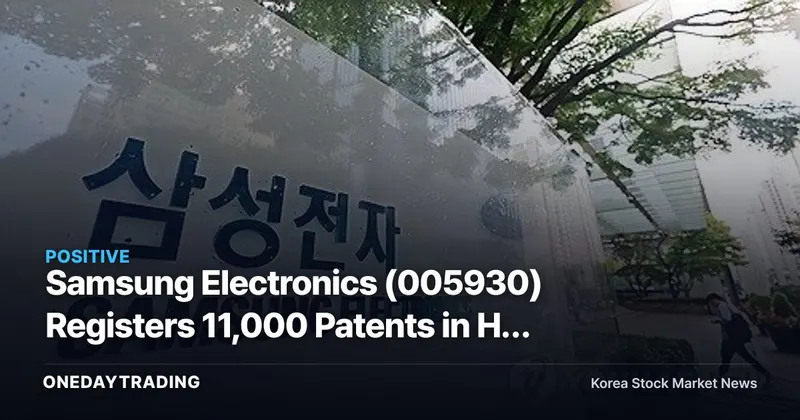
Samsung Electronics registered more than 11,000 patents in Korea and the United States in the first half of this year, bringing its cumulative total to nearly 300,000. This is the first time the company has surpassed 10,000 registrations in two consecutive half-year periods. Patent registration is a lagging indicator — examination typically takes two to three years after filing — so today's figures should be read as the output of R&D investment executed around 2022–2023.
Why It Matters Now
In the semiconductor industry sector, patents are not a metric that translates directly into revenue. The real significance lies in the sequencing. A lag caused by examination delays separates the moment filings rise from the moment registrations rise, and because of that lag, an increase in registrations confirms past investment intent rather than current earnings. The fact that Samsung Electronics has posted more than 10,000 registrations in two consecutive half-years means this isn't a one-off spike concentrated in a single quarter — it reflects a filing pipeline that has been steadily building up over several years.
There's a separate reason this indicator stands out right now. At a moment when competition over HBM stacking layer counts and foundry leading-edge process yields is playing out simultaneously, the depth of a company's patent portfolio determines its leverage in cross-licensing negotiations with rivals and its defense against patent litigation. A cumulative total of 300,000 patents doesn't guarantee absolute technological superiority, but it functions as an entry barrier that forces competitors to design around specific processes and structures.
Key Issues
- Registration counts alone cannot distinguish whether the increase reflects a genuine strengthening of technological leadership or simply an expansion of defensive filings.
- Because of the examination lag before registration, these figures reflect investment made two to three years ago rather than the current direction of R&D.
- Patent count is a matter of quantity; the actual commercial value depends on which process or product — HBM, foundry, mobile AP, and so on — each individual patent is applied to.
- The record of surpassing 10,000 registrations in two consecutive half-years demonstrates the continuity of the filing pipeline, but it does not necessarily mean earnings will improve next quarter.
Related Stocks (Tickers) and Sector Impact
- Samsung Electronics: The expanded patent portfolio strengthens its defensive position in patent litigation and licensing negotiations with rivals in memory (HBM stacking) and leading-edge foundry processes.
- SK Hynix: As a direct competitor to Samsung Electronics in the HBM market, Samsung's accumulation of related patents could act as a check on SK Hynix in future competition over HBM4 and later generations.
- Foundry customers/fabless companies: As Samsung's foundry division accumulates more process patents, Samsung gains greater negotiating leverage over process design with the customers that contract it for manufacturing.
Points for Investors to Note
- Patent registration counts are not directly tied to revenue or operating profit, so they are insufficient on their own as a basis for judging stock price direction.
- An increase in registrations does not confirm that the patents in question have actually been applied in mass-production processes — that needs to be verified separately, as defensive filings differ from commercialized patents.
- Samsung's relative standing can only be gauged by comparing its patent registration trend over the same period against competitors such as SK Hynix and TSMC.
- Patent metrics must be validated against substantive indicators — such as HBM's share of revenue and foundry utilization rates — that will be disclosed in the next earnings release.
Overall Outlook
On the optimistic side, registering over 10,000 patents in two consecutive half-years can be interpreted as a sign that Samsung Electronics has not cut back on R&D investment even as competition in memory and foundry intensifies. A patent portfolio totaling nearly 300,000 could serve as a buffer that lowers the risk of future patent disputes with rivals over next-generation HBM or advanced foundry processes.
The risks, however, are equally clear. A larger patent count does not necessarily mean a wider technology gap. Actual market share and profitability are determined by substantive indicators such as HBM yield, foundry utilization, and customer orders. Patents are merely the backdrop supporting those substantive indicators — they cannot substitute for them.
Frequently Asked Questions
How many patents did Samsung Electronics register in the first half of the year?
Samsung Electronics registered more than 11,000 patents in Korea and the United States in the first half of this year. This brought its cumulative registered patents to nearly 300,000.
Why is surpassing 10,000 registrations in two consecutive half-years a first?
Before this first half, there were half-years in which registrations exceeded 10,000, but never a case where the following half-year also exceeded 10,000. Because the registrations weren't concentrated in one particular period but continued in succession, this record demonstrates the sustainability of the pipeline.
Does the increase in patent registrations directly affect Samsung Electronics' stock price or earnings?
Patent registration is a lagging indicator that takes two to three years of examination after filing, so it is far removed from having an immediate impact on earnings. For actual investment decisions, indicators available in the next earnings release — such as HBM's share of revenue and foundry utilization rates — provide a more direct basis.
Samsung Electronics (005930) in Real-Time Data
Samsung Electronics's most recent closing price was 281,500 won (+3.87% versus the previous day), and the signal combining foreign investors/institutional investors order-flow (supply-demand) with news and momentum reads 🟢 Buy-leaning. Foreign investors, institutional investors, news, and momentum are all positive, making this stock (ticker) worth watching.
- ▲ Dual buying — Foreign investors +431.7 billion won · Institutional investors +368.2 billion won bought in tandem
- ▲ Trend alignment — Short- and medium-term trends aligned to the upside (+3.9% today · +5.0% over 1 week · +8.1% over 1 month)
- ▲ News flow — 11 positive catalysts vs. 3 negative catalysts — positive catalysts prevail
Recent related news skews favorable, with 11 positive catalysts versus 3 negative catalysts.
※ Price and foreign/institutional investor order-flow (supply-demand) data are provided by Korea Investment & Securities (KIS) and reflect figures as of publication time.
This article is automatically summarized and analyzed content based on the original news report. View original (Yonhap News)