
Blue Wave Shock Spreads to Samsung Electronics and SK Hynix
The sharp drop (plunge) in Samsung Electronics and SK Hynix on Nov. 6 signals more than a one-day shock to the index. The sell-off in AI-related stocks following the U.S. midterm elections, as reported by Yonhap News’ securities desk, rattled South Korea, the United States, Taiwan and Japan, ushering in a phase in which semiconductor investors are pricing in policy uncertainty ahead of technological promise.
The so-called “Blue Wave shock” refers to concerns over tighter Democratic regulation of data centers spreading into a sell-off in AI-related stocks and a decline in the market capitalization of major global equity markets. Although the specific regulations and whether they will be implemented remain unconfirmed, the market did not wait for clarity before discounting risk across the AI value chain.
What the KOSPI’s 6.02% Slide Really Means
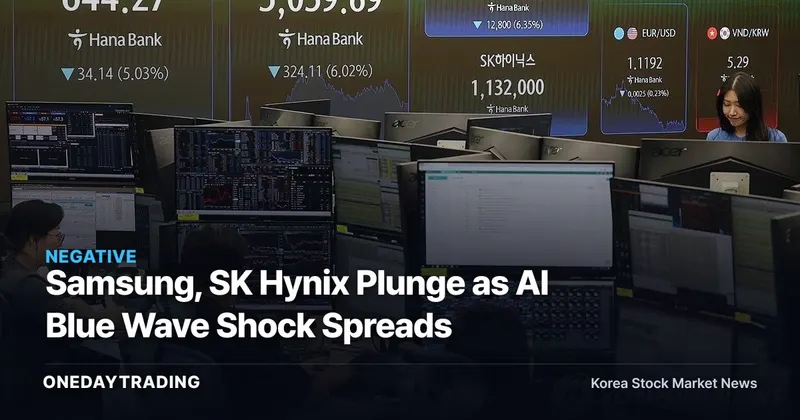
On Nov. 6, the KOSPI closed down 324.11 points, or 6.02%, at 5,059.69. The KOSDAQ also ended trading 34.14 points, or 5.03%, lower at 644.27. The simultaneous sharp drop (plunge) in Samsung Electronics and SK Hynix shows that the shock was not confined to a handful of stocks (tickers), but spread to South Korea’s semiconductor heavyweights and the broader market.
The distinction between what is confirmed and what remains uncertain is clear. A worldwide sell-off centered on AI-related technology stocks and sharp drops (plunges) in major indexes have been confirmed. What remains unknown are the details of the Democrats’ proposed data-center regulations, whether they will be implemented and whether the sell-off will persist over the long term.
The Significance of a $3.5 Trillion Global Market-Cap Loss
According to the Nikkei’s analysis of QUICK and FactSet data, global equity market capitalization stood at $154 trillion as of Nov. 5, down $3.5 trillion from the previous day. In won terms, roughly 4,773 trillion won vanished in a single day from a total of 210.025 quadrillion won. On Nov. 6, the Tokyo Stock Exchange’s Prime Market also lost 77 trillion yen in market capitalization, equivalent to 663 trillion won.
Global market capitalization has expanded 1.6-fold since OpenAI released ChatGPT in November 2022. This does not mean AI was solely responsible for the entire increase; rather, it shows how much market capitalization accumulated during the period of rising AI expectations. Because those expectations were priced in so broadly, policy concerns triggered simultaneous selling across multiple markets.
The Sell-Off Path From the Nasdaq to TSMC
On Nov. 5 local time, the Nasdaq Composite closed down 1,421.52 points, or 5.52%, at 24,315.00. The market capitalization of Nasdaq constituents fell by about $2.5 trillion, equivalent to 3,400 trillion won, marking the largest one-day decline on record.
The Dow Jones Industrial Average fell 1,833.06 points, or 3.44%, to 51,523.06, while the Standard & Poor’s (S&P) 500 ended down 334.89 points, or 4.36%, at 7,353.73. The shock then spread to Taiwan. Shortly after the market opened on Nov. 6, the TAIEX plunged 3,736.67 points, or 8.99%, its largest intraday decline on record.
Shares of TSMC, the world’s largest foundry and Taiwan’s biggest company by market capitalization, fell as much as 9.82% shortly after the open and had declined for seven consecutive trading sessions through Nov. 6. Because both foundry and memory-chip heavyweights fell together, rather than companies tied to an isolated materials or equipment issue, the market appears to have reassessed the entire AI investment narrative instead of a specific supply-chain bottleneck.
What South Korean Semiconductor Investors Should Distinguish
- Samsung Electronics: It suffered a sharp drop (plunge) alongside SK Hynix on Nov. 6. With no company-specific change in earnings reported, this was a case of policy concerns and the global sell-off in AI-related stocks feeding through to the share price.
- SK Hynix: Its simultaneous decline with Samsung Electronics showed that South Korea’s semiconductor heavyweights were not insulated from the global AI sell-off.
- TSMC: Its seven-session losing streak and a decline of as much as 9.82% shortly after the open show that AI concerns had spread into semiconductor contract manufacturing.
- KOSPI and KOSDAQ: They fell 6.02% and 5.03%, respectively. The market downgraded its overall risk assessment before any change in individual companies’ profits and losses was confirmed.
Four Things to Check Before Focusing on a Rebound
- Durability of the U.S. market rebound: U.S. stocks rebounded on Nov. 6 as bargain hunters stepped in after the previous day’s sharp drop (plunge). If the rebound continues, it may indicate that short-term selling pressure is easing.
- Correlation among semiconductor heavyweights: Investors should watch whether Samsung Electronics, SK Hynix and TSMC continue moving in the same direction. If their synchronized decline breaks, the scope of the shock’s transmission will change.
- Details of Democratic regulation: The available information does not specify the substance of the data-center regulations or whether they will be implemented. Until the policy’s scope is clarified, there is insufficient basis for calculating its company-specific impact.
- Major indexes and market capitalization: Investors should monitor not only rebounds in the KOSPI and Nasdaq Composite, but also whether the decline in global equity market capitalization comes to a halt.
Bargain Buying and Policy Risk Will Shape the Next Phase
In the bullish scenario, bargain buying seen in U.S. stocks on Nov. 6 persists and the synchronized decline in semiconductor heavyweights comes to an end. This would give the market room to distinguish policy concerns from actual damage to earnings.
However, Goldman Sachs Securities Vice President Takayuki Ishibashi said it was difficult to identify a catalyst capable of driving a rapid rebound and noted a sense of resignation among investors. Another Japanese asset-management industry official said that because buying had been so exuberant, the selling could become more intense once it began. No figures were provided for next-quarter shipments, yields or customer orders. The next key decision point, therefore, is not the rebound itself, but whether policy concerns translate into actual changes in semiconductor demand and investment flows.
KOSPI Index MetricsAs of 2026-11-07
| Performance by Period | 1 Week -11.71% 1 Month -25.64% |
|---|
Index, commodity and exchange rate figures are based on global markets and reflect values at the time of publication.
Samsung Electronics Key MetricsAs of 2026-11-07
| Returns by Period | 1 Week -14.04% 1 Month -27.97% |
|---|---|
| Trading Value · Trading Volume | 132.9 billion won · 56,147,847 shares |
| Supply-Demand (Order Flow) | Foreign Investors Net selling of 166.2 billion won (four consecutive days) Institutional Investors Net selling of 98.5 billion won |
| Recent News Tone | 2 Positive Catalysts · 4 Negative Catalysts |
Price and supply-demand (order flow) data are real-time figures from Korea Investment & Securities (KIS), while supply-demand (order flow) and news-tone tallies are calculated independently by OneDayTrading.
Upcoming Events to Watch
- 11.12Index Options ExpirationLowKOSPI 200 options expiration
- 11.26Bank of Korea Monetary Policy BoardHighBenchmark interest rate decision meeting
- 12.09FOMC Policy Rate DecisionHighFederal Reserve monetary policy announcement — direction of interest rates and the dollar
- 12.10Futures and Options ExpirationMediumQuadruple witching — watch for volatility and supply-demand (order flow) disruptions
This article was automatically summarized and analyzed from the original news report. View the original article (Yonhap News)