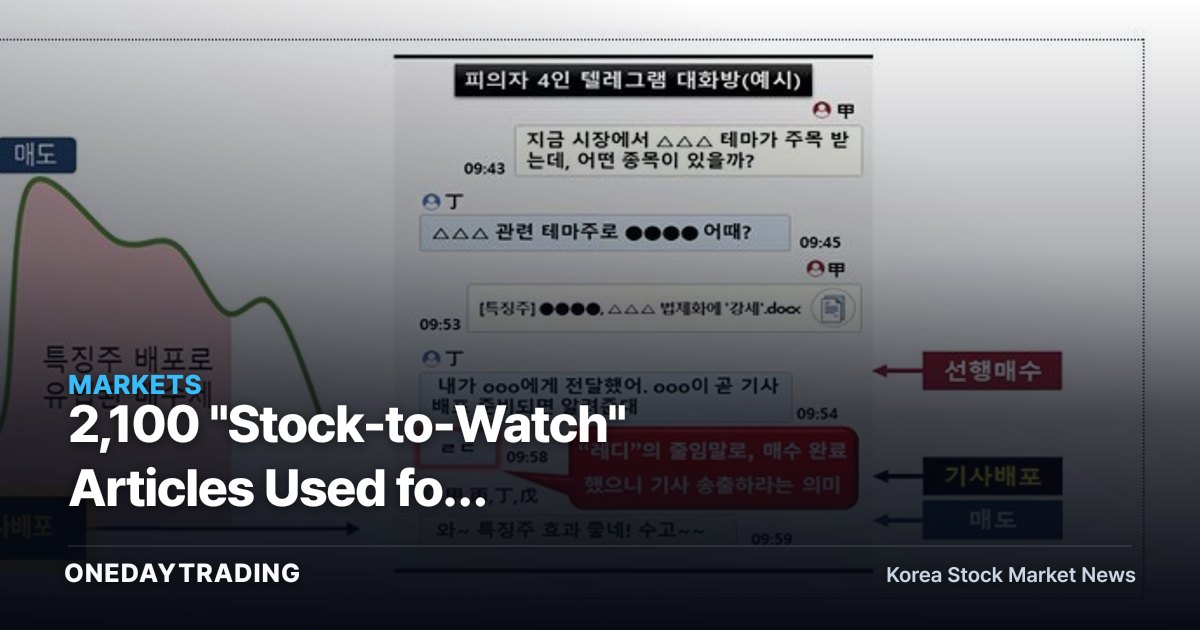

This case is not about a positive catalyst or negative catalyst that directly moves a particular stock's price; rather, it is a structural example of how information asymmetry in Korea's equity market is disguised as short-term profit. The pattern of accumulating a position before a single "stock-to-watch" article hits the market and then realizing the gain immediately after the article is published is the trap that most frequently ensnares retail investors who put short-term money into theme stocks and small- and mid-cap names. The crux of this news, therefore, lies less in the punishment itself than in the practical lesson of how to scrutinize the trading volume and information flow behind a surging stock (ticker).
Three-Line Briefing
- The Financial Supervisory Service's Capital Markets Special Judicial Police uncovered front-running that exploited roughly 2,100 "stock-to-watch" articles to reap some 9.3 billion won in illicit gains, and referred seven people — including active journalists — to prosecutors.
- Two people, a certified public accountant and an active journalist, were taken into custody, and the FSS reaffirmed its stance that there are no sanctuaries in stock-manipulation investigations.
- The case once again confirms the classic front-running structure in which those holding information first accumulate positions before an article is published and sell immediately after it is exposed.
What Changes
Front-running differs from ordinary day trading in that it uses non-public information. It works by exploiting in reverse the very nature of stocks-to-watch — where trading volume rises and short-term prices swing once an article runs — so that those involved in writing and distributing the article convert the information time lag into profit. The fact that an active journalist is among those referred to prosecutors suggests the trades may have been designed from the information-production stage itself.
On the regulatory side, the key point is that the FSS special judicial police exercised direct investigative authority, even deploying search-and-seizure and detention. The center of gravity is shifting from administrative sanctions toward criminal prosecution, which works to raise the cost of manipulative trading aimed at the short-term surge of theme stocks.
By the Numbers and Context
A simple conversion of 2,100 articles and roughly 9.3 billion won in illicit gains implies a structure in which gains of a few million won per case were repeatedly stacked up. This means the profits were accumulated not through one large operation but by repeatedly churning numerous small stocks-to-watch — showing that an individual stock's surge may not necessarily be driven by fundamentals alone. There is a need to factor into trading-volume analysis the possibility that a substantial portion of stock-to-watch-style surges may be a game of information timing.
Stocks That Benefit or Suffer
- No specific listed companies can be identified as direct beneficiaries or victims. This is because the matter is not an individual corporate issue but a structural event of strengthened market surveillance and sanctions.
- Small- and mid-cap theme stocks and stocks-to-watch: Having been the main stage for manipulative front-running, they may see the frequency of abnormal surges and trading turnover shrink amid the tightening crackdown.
- From a long-term perspective, improved market trust creates a relatively favorable environment for blue-chip large caps and legitimate value-investing capital.
Risk Check
- This referral does not immediately dampen theme-stock trading across the board, and its impact on short-term supply-demand (order flow) may be limited.
- Similar schemes tend to resurface in altered forms even after a crackdown, so the burden of verifying information still rests with retail investors.
- If distrust toward stock-to-watch articles in general becomes excessive, there is a risk that even legitimate information distribution could be dampened.
- It should also be kept in mind that referral to prosecutors is merely one stage of the investigative process and is separate from a final judicial ruling.
Bottom Line
Stronger market surveillance is a positive signal that raises trading transparency over the long term, but it offers little direct directionality for short-term stock supply-demand (order flow). When facing a surging stock-to-watch, a cautious approach is required — checking the background of the spike in trading volume, the source of the information, and the schedule of upcoming disclosures and earnings together.
This article is content automatically summarized and analyzed based on the original news report. View original (Maeil Business Newspaper, Securities)