
At a Glance
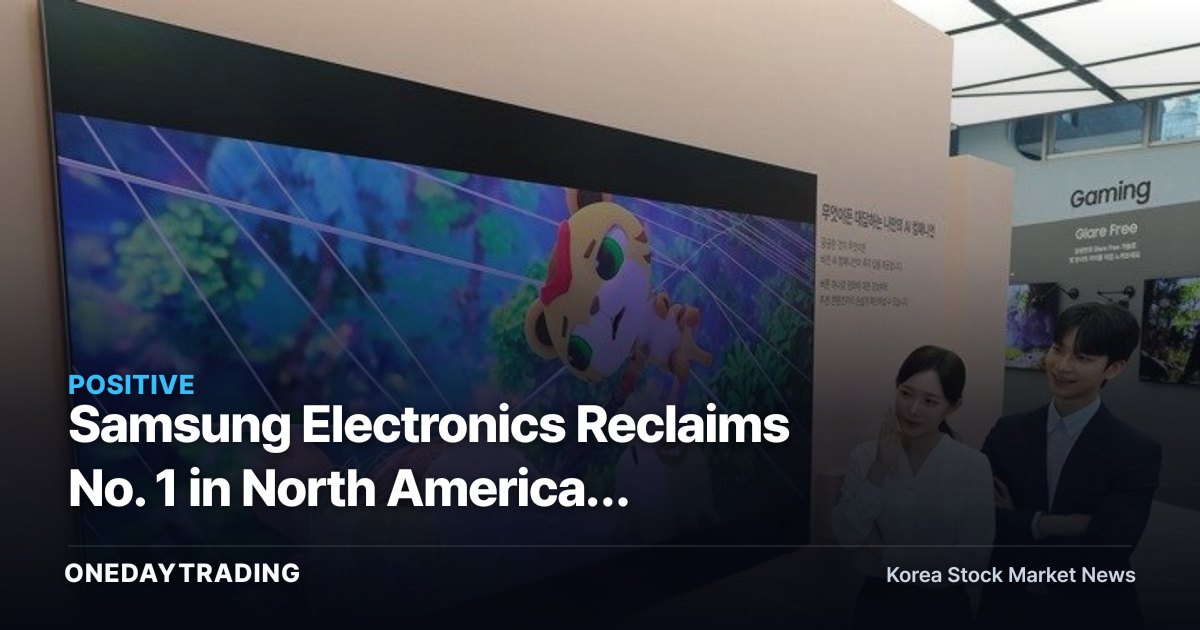
Samsung Electronics reclaimed the top spot in the North American Mini-LED TV market in the first quarter, having earlier ceded it to China's Hisense. With this summer's World Cup across North and Central America—a major sporting event poised to spur demand for large-screen, high-definition TV upgrades—this should be read not as a simple swing in market share, but as a signal of where premium home-appliance earnings are headed in the second half.
Why It Matters Now
Mini-LED packs tiny LEDs densely into an LCD backlight to boost contrast ratios. Priced below OLED yet offering better picture quality than standard LCD, it is a key category bridging the premium and upper-mid price tiers. The profitability of Samsung Electronics' Visual Display business hinges less on unit volumes than on product mix—that is, the share of high-end lines—so a recovery in Mini-LED share is directly tied to defending the average selling price (ASP).
Until now, Chinese players such as Hisense and TCL have eaten into the North American mid-to-low-end market with aggressive pricing strategies. Samsung's reclaiming of the No. 1 spot means it held its share by leveraging its brand and distribution advantages while partly countering the price competition. Sporting events typically act as a catalyst that lifts demand for new and replacement large-screen TVs, and a World Cup held across North and Central America provides a relatively favorable environment for Samsung and LG, which have a large presence in the North American market.
Frequently Asked Questions
- Why does Mini-LED matter? Because it is a growth category that absorbs premium demand by combining price competitiveness against OLED with better picture quality than LCD.
- Does the World Cup really help sales? Major sporting events act as short-term momentum that stimulates large-screen replacement demand, but the size and durability of the effect vary each time.
- Is the threat from Chinese players over? No. Their price offensive is structural, so the No. 1 share position can flip from quarter to quarter.
Impact on Related Stocks and Sectors
- Samsung Electronics Reclaiming the Mini-LED top spot is positive for the premium TV mix and ASP defense, but TVs account for a small share of overall earnings relative to semiconductors, so the impact on company-wide profit is limited.
- LG Electronics As a North American premium TV rival and an OLED powerhouse, it could share in the benefits amid expanding World Cup demand.
- LG Display Tied to TV panel demand and utilization rates, it is expected to benefit if large-screen panel shipments increase.
- LED and Component Makers For LED-related firms such as Seoul Semiconductor, wider Mini-LED adoption could translate into downstream demand.
Points to Watch When Investing
- Quarterly market share is highly volatile depending on the timing of new-product launches and promotions, so a first-quarter No. 1 ranking does not guarantee the full-year trend.
- If Chinese players continue their price offensive, margins could be eroded even while share is defended.
- The TV business accounts for a small share of Samsung Electronics' overall profit, so the share price as a whole is more heavily driven by the semiconductor cycle.
- Raw-material and panel prices, and whether North American consumer demand slows, are variables for demand.
Overall Outlook
If World Cup demand dovetails with the recovery in Mini-LED share, there is room to underpin the floor of second-half home-appliance earnings. That said, with price competition against Chinese players structurally persistent, it is reasonable to look beyond the share figures and check the Visual Display segment's operating profit margin and ASP trends together at the next earnings release. The key thing to watch is whether the No. 1 share position translates directly into improved profit.
Samsung Electronics by the Real-Time Data
Samsung Electronics' latest closing price is 362,500 won (+4.62% from the prior day), and the signal light combining foreign and institutional supply-demand (order flow) with news and momentum is 🟢 Buy-Leaning. Foreign investors, institutional investors, news, and momentum are positive, making it worth a look.
- ▲ Dual Buying — Foreign investors +874 billion won and institutional investors +689 billion won buying in tandem
- ▲ Trend Alignment — Short- and mid-term aligned to the upside (today +4.6% · 1 week +21.2% · 1 month +29.0%)
- ▲ 52-Week Position — 98% in the upper 52-week range — near new-high territory
- ▲ News Flow — Positive catalysts 26 vs. negative catalysts 7 — positive catalysts lead
Recent related news is favorable, with 26 positive catalysts and 7 negative catalysts.
※ Price and foreign/institutional supply-demand (order flow) data are provided by Korea Investment & Securities (KIS) and are as of the time of publication.
This article is content automatically summarized and analyzed based on the original news. View the original (Maeil Business Newspaper, Corporate)