
Summary
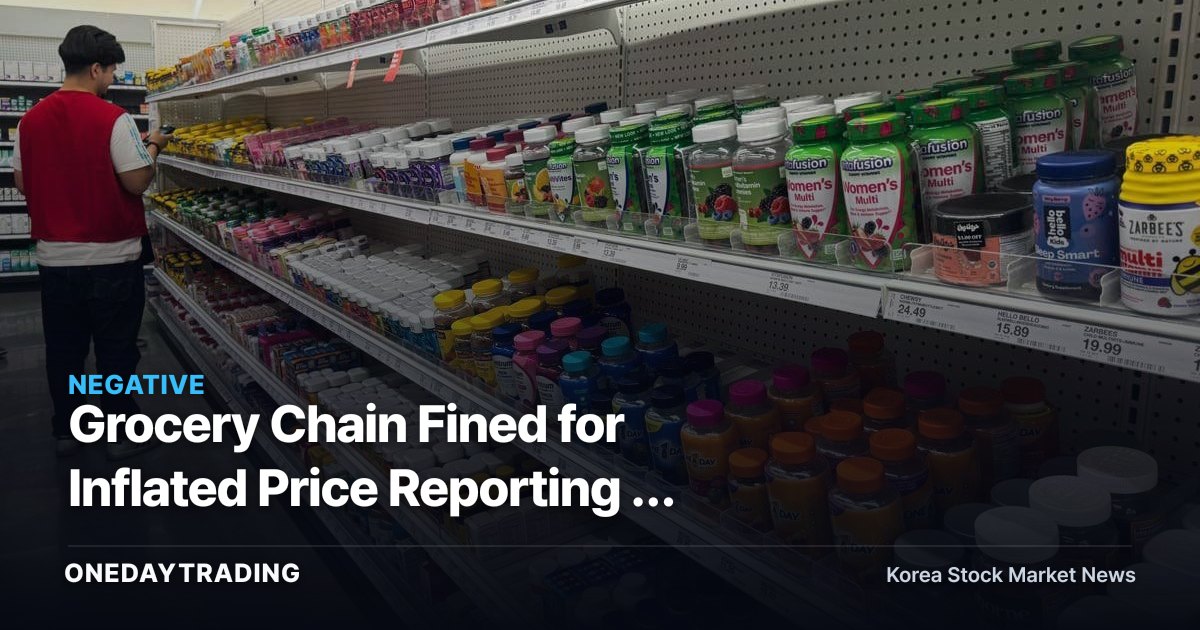
A major overseas grocery chain has been hit with a large fine over allegations that it reported prices higher than they actually were. While this may look like a penalty confined to a single company, the real significance is that it signals tightening price-transparency regulation across the grocery and retail sector as a whole. For domestic investors, it is an occasion to re-examine the compliance costs and margin visibility of large distribution stocks.
What Happened
The crux of this case is not a simple price increase, but the fact that the price information disclosed to regulators or consumers itself differed from reality. In a high-inflation environment, grocery prices sit on the front line of the inflation that households actually feel, and regulatory scrutiny has intensified accordingly. The fact that practices such as discrepancies between displayed prices and actual amounts charged, or the inflation of discount reference prices, became targets of sanctions serves as a warning to industry practices across the board.
The massive fine amounts only to a one-time loss for the company in question, but what the market is watching comes afterward. Once regulators begin taking direct aim at the accuracy of price reporting and labeling, the burden of inspections and system overhauls spreads across the entire sector. Ultimately, the change in the cost structure of the industry as a whole leaves a longer-lasting impact than the penalty on the sanctioned company.
Structural Background
Grocery retail is inherently a high-volume, low-margin business with operating margins in the low single digits. Sales volumes are large but margins are thin, so pricing policy and promotion design determine profitability. As price-labeling regulation grows stricter, the design freedom of discount marketing shrinks, and additional investment in price-verification systems and internal controls becomes necessary. The structure is one in which fixed compliance costs are piled on top of already thin margins.
Stock and Sector Ripple Effects
- E-Mart: As Korea's No. 1 grocery distributor centered on hypermarkets, tighter price-labeling and promotion regulation would directly hit margins through marketing operating costs and system burdens.
- Lotte Shopping: With a complex distribution structure spanning marts, supermarkets, and department stores, the scope of any pricing-policy change is broad.
- GS Retail and BGF Retail: Convenience stores rely heavily on promotions such as event pricing and buy-one-get-one offers, making them sensitive to regulation on price-labeling consistency.
- Food and beverage manufacturers: Supply-price and recommended-retail-price setting practices could also come under scrutiny, leaving room for the burden of pricing-transparency to spill over.
Bull vs. Bear Scenarios
The bear case is clear. If price-transparency regulation becomes a global trend, domestic distributors will also have to increase investment in price-verification and labeling systems along with staffing costs, while narrower room for discount design could simultaneously pressure both average transaction value and customer-traffic efficiency. That is a strain on already thin margins.
Conversely, the bull case holds that this penalty could actually become an opportunity for large, legitimate operators that have run their pricing policies conservatively and honestly to gain a trust premium and expand market share. The view is that a No. 1 operator with the capacity to navigate regulatory compliance can hold a relative advantage over smaller or rule-bending players. That said, this is an expectation built on the premise that the direction and intensity of regulation remain uncertain, so the variables are large.
Investor Action Points
- In domestic large-cap retail stocks' next-quarter earnings, check the trends in SG&A and marketing expenses and changes in operating margin alongside pricing-policy variables.
- Monitor the policy calendar for whether fair-trade and consumer-protection authorities' guidelines and sanction moves on price labeling spread domestically.
- Check the promotion weighting and reliance on event-driven sales at convenience stores and marts to distinguish stocks with high regulatory sensitivity.
- Compare quarter by quarter the degree to which the defensive nature of grocery demand offsets rising regulatory costs in a high-inflation, slowing-consumption environment.
E-Mart by the Real-Time Data
E-Mart's latest closing price is 87,500 won (-1.57% from the prior day), and the traffic-light signal combining foreign investor and institutional investor order flow with news and momentum is 🔴 Caution. Foreign investors, institutional investors, news, and momentum are all negative, so caution is warranted right now.
- ▼ Dual-front selling — foreign investors −200 million won and institutional investors −2.9 billion won selling in tandem
- ▼ Trend alignment — short- and mid-term downward alignment (intraday -1.6% · 1 week +0.0% · 1 month -14.6%)
Recent related news is negative, with 0 positive catalysts and 1 negative catalyst.
※ Price and foreign/institutional order-flow data are provided by Korea Investment & Securities (KIS), as of the time of publication.
This article is content automatically summarized and analyzed based on the original news. View original (Yahoo Finance)