
Key Summary
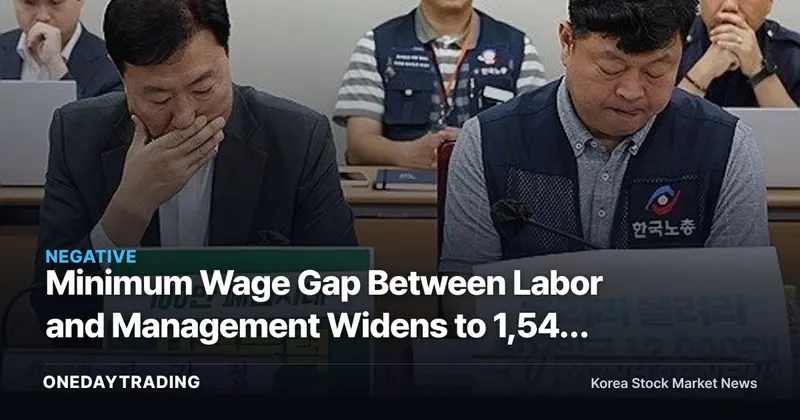
Negotiations over next year's minimum wage continue with labor and management still 1,540 won per hour apart (labor groups proposing 11,900 won, management proposing 10,360 won). What this figure tells investors isn't where the final settlement will land, but rather that labor cost risk has not yet been fully priced into share prices. The wider the gap, the longer the market tends to defer pricing in this variable until a resolution is reached.
What Happened
At the Minimum Wage Commission's deliberation on the 2nd, labor and management put forward proposals of 11,900 won and 10,360 won respectively, failing to find common ground. The gap between the two proposals is 1,540 won in absolute terms, translating into a double-digit percentage-point difference in proposed increase rates. The Minimum Wage Commission is typically composed of nine worker representatives, nine employer representatives, and nine public-interest representatives, so when both sides remain deadlocked, the mediating proposal from the public-interest members — who hold the deciding vote — tends to determine the final figure.
Minimum wage deliberations have frequently run past the statutory deadline (June 29) in the past, and given that deliberations are continuing again this time, the actual vote is likely to follow the usual timeline of mid-July or later, with the Ministry of Employment and Labor's final announcement due by August 5. In other words, the two figures on the table now are the starting point of negotiations, not the endpoint.
Background and Context
A minimum wage hike differs from other policy variables in that it directly affects cost structure rather than revenue. In particular, the convenience store, restaurant franchise, and large discount store sectors — which rely heavily on part-time and contract workers — have a high proportion of labor costs within SG&A expenses, meaning even a 1-2 percentage-point shift in the final agreed increase rate can make a tangible difference to franchisee profitability and headquarters' royalty revenue growth.
Impact on the Market and Stocks (Tickers)
- GS Retail (convenience store chain GS25) — Heavier labor cost burdens at franchise stores could lead to higher store closure rates or weaker royalty negotiating power; the higher the final increase rate is set, the more the burden eventually transfers to headquarters' earnings, albeit with a lag.
- BGF Retail (convenience store chain CU) — Shares the same structural risk as GS Retail, and given the nature of the convenience store industry sector, the late-night labor cost burden at 24-hour stores is relatively larger.
- E-Mart (large discount stores and Emart Everyday) — With a high proportion of offline store staff, rising labor costs could widen the profitability gap versus online operations further.
- Restaurant franchise industry sector overall — Though listed companies are few, rising cost burdens at franchise headquarters and logistics providers could indirectly affect earnings.
Investor Checkpoints
- The actual vote timing at the Minimum Wage Commission and the final increase rate — typically confirmable from mid-July onward, and no later than the August 5 official announcement.
- Progress of discussions on sector-specific differentiated application — if adopted, the burden on convenience stores and restaurants could be eased relative to a uniform increase scenario.
- The growth rate of labor costs within SG&A expenses when convenience store and retail large-cap stocks report Q2 earnings — a leading indicator of the degree of cost pressure.
- Where this year's agreed level stands relative to the trend in minimum wage increase rates over recent years — a benchmark for gauging the gap versus market expectations amid a low-growth backdrop.
Outlook
The optimistic scenario is one where public-interest member mediation settles the increase rate at a level not far from the trend of recent years, keeping the labor cost burden on convenience store and retail stocks within a range the market has already absorbed. Conversely, if the agreement lands close to labor's demand, a downward revision to next year's margin outlook for labor-cost-heavy sectors would be unavoidable. That said, it is still too early to determine the final outcome based solely on the wide gap at this early stage of negotiations, and a separate variable — whether sector-specific differentiated application is adopted — could further reshape the magnitude of the eventual impact.
GS Retail — Live Data Snapshot
GS Retail's most recent closing price is 23,600 won (0.00% vs. previous day), and the signal light combining foreign investors/institutional investors supply-demand (order flow) with news and momentum reads 🔴 Caution. Foreign investor activity and news flow are negative, so caution is warranted right now.
- ▼ Supply-Demand (Order Flow) Continuity — Foreign investors have been net sellers for 8 consecutive days (−500 million won)
Recent related news is negative overall, with 0 positive catalysts and 1 negative catalyst.
※ Price and foreign/institutional investor supply-demand (order flow) data are provided by Korea Investment & Securities (KIS) and reflect figures as of publication time.
This article is automatically summarized and analyzed content based on the original news report. View original (Yonhap News)