
Summary
iM Securities says supply lead times are gradually lengthening for both multilayer ceramic capacitors (MLCCs)—a focus of growing investor interest—and the process equipment used to make them. Longer lead times point less to near-term shipments than to a shift in the medium- to long-term supply-demand balance, directly affecting component makers' pricing power and utilization rates. The key question is whether this trend reflects a temporary inventory adjustment or a structural bottleneck driven by rising demand.
The Full Story
iM Securities' assessment puts weight on the fact that delivery times are lengthening simultaneously—not only for finished MLCCs but also for the process equipment used to produce them. Tightening supply of the components themselves can be read as a short-term mismatch between demand and supply, but longer equipment delivery times mean it is difficult to ramp supply quickly through capacity expansion. In other words, it is a signal that even if demand recovers, capacity (production capability) may not follow immediately, leaving supply-demand tight for some time.
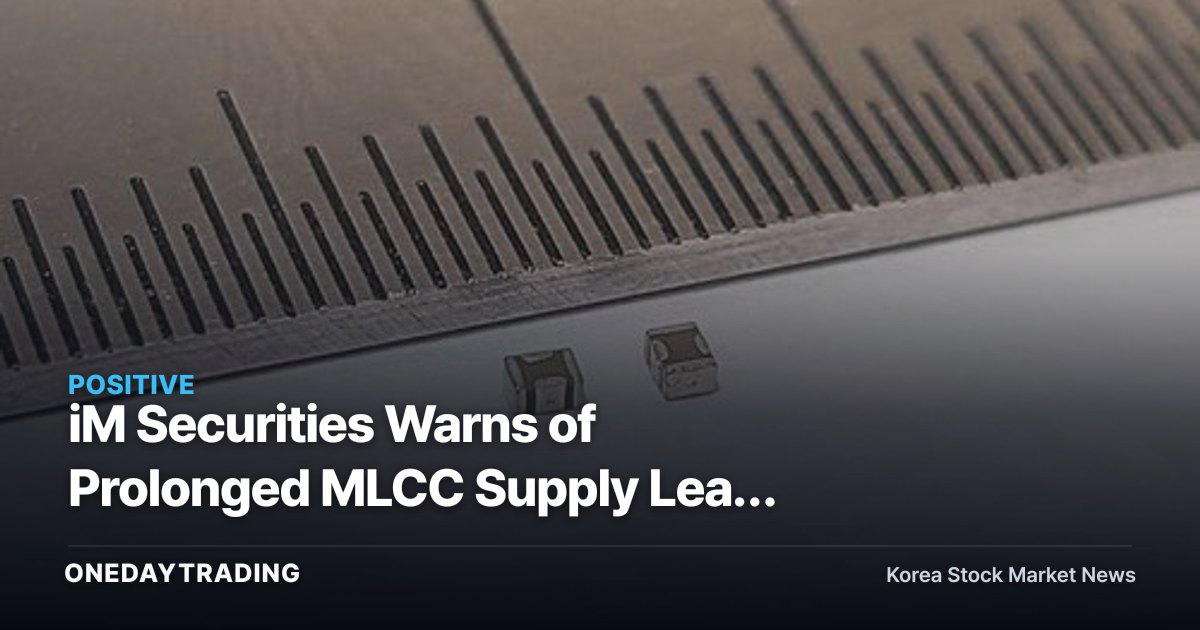
MLCCs are essential passive components that stabilize electrical current in electronic circuits, with anywhere from several hundred to a thousand used in a single smartphone and more than 10,000 in an electric vehicle. Because there are clear structural sources of demand where the content per device keeps rising, longer supply lead times are a variable that can translate into improvements in average selling price (ASP) and utilization rates.
Structural Background
MLCC supply-demand has traditionally hinged on IT set demand such as smartphones and PCs, but the center of gravity has recently been shifting toward high-capacity, high-reliability products for automotive electronics and AI servers. Automotive and server-grade products have long qualification periods and high barriers to entry, making short-term capacity expansion difficult. Add lengthening equipment delivery times, and new capacity is delayed—potentially creating an asymmetry in which the higher value-added product tiers see supply grow even tighter.
Stock and Sector Ripple Effects
- Samsung Electro-Mechanics: As Korea's MLCC sector bellwether, it has a high mix of high value-added products for automotive and servers. If supply tightening feeds through to better pricing and utilization, this is the stock (ticker) where earnings leverage could show up most strongly.
- Samhwa Capacitor: A component maker with exposure to industrial and automotive capacitors, it is a direct beneficiary candidate of a downstream demand recovery and an improving pricing environment.
- Cosmo AM&T and Daejoo Electronic Materials: Part of the supply chain for core MLCC materials (dielectric powders and electrode materials), these are upstream-linked names whose materials demand rises alongside higher component utilization.
- MLCC process equipment stocks: Longer equipment delivery times can imply a sizable order backlog, which may act as order-intake momentum for makers supplying core process equipment such as lamination and sintering tools.
Bull vs. Bear Scenarios
On the bull side, with automotive and AI servers emerging as structural demand sources at the same time and equipment bottlenecks slowing the supply ramp, tight supply-demand could lift pricing and margins. On the bear side, the risks are equally clear. If the longer lead times stem not from real demand growth but from companies pre-emptively building inventory (speculative demand), prices could reverse quickly under a double inventory burden when IT set demand slows again. In addition, component stocks may already have partly priced in expectations of an industry recovery, leaving valuations stretched—so investors should watch for any gap between expectations and the actual trend in shipments and pricing.
Investor Action Points
- At the next quarterly earnings release, check the trends in MLCC segment utilization, ASP, and automotive mix to verify whether longer lead times have actually translated into better pricing.
- To distinguish whether the shift in lead times reflects real demand or speculative demand, look at smartphone and PC shipments alongside electric-vehicle and server investment indicators.
- Use equipment order and contract disclosures to confirm whether the capacity-expansion cycle is genuinely turning.
- Review how much recovery expectation and valuation are already reflected in component stock prices, and prepare for a possible pullback once the positive catalyst is exhausted.
Samsung Electro-Mechanics in Real-Time Data
Samsung Electro-Mechanics' latest closing price is 2,296,000 won (+4.36% versus the prior day), and the signal light combining foreign and institutional investor supply-demand (order flow) with news and momentum is 🟢 Buy Bias. With news and momentum positive, the stock merits attention.
- ▲ Trend Alignment — short- and medium-term upward alignment (today +4.4% · 1 week +27.1% · 1 month +122.6%)
- ▲ 52-Week Position — top of the 52-week range at 99% — new-high territory
- ▲ News Flow — 5 positive catalysts vs. 0 negative catalysts — positive catalyst bias
Recent related news is favorable, with 5 positive catalysts and 0 negative catalysts.
※ Price and foreign/institutional investor supply-demand (order flow) data are provided by Korea Investment & Securities (KIS), as of the time of publication.
This article is content automatically summarized and analyzed from the original news report. View original (Yonhap News Securities)