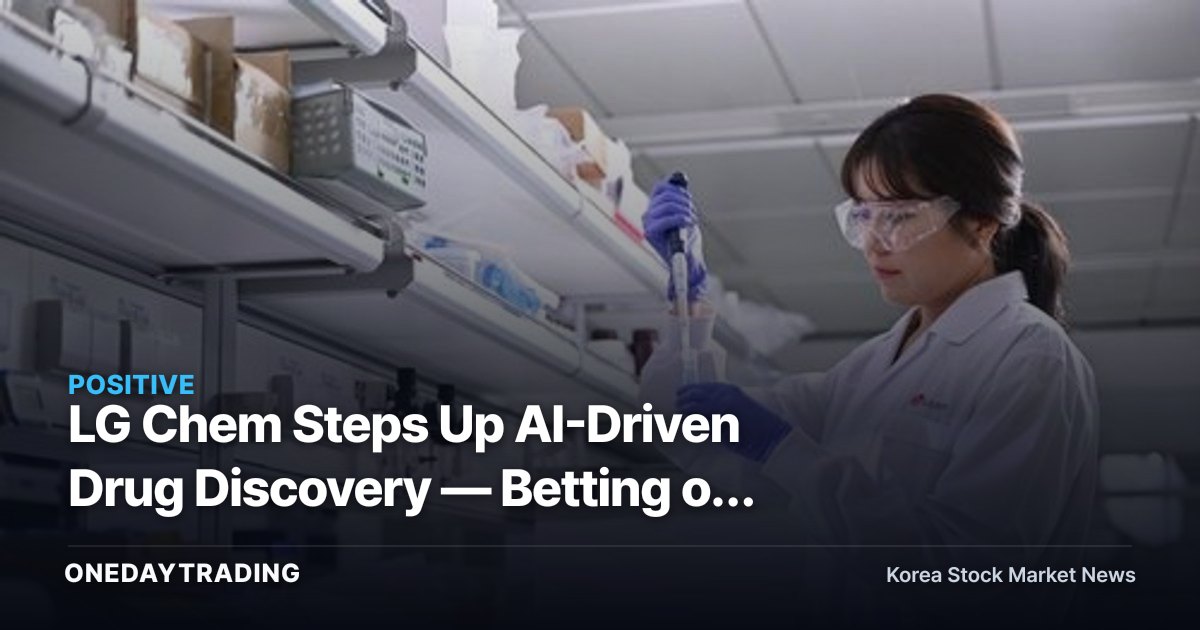

In an industry where the average cost of developing a single new drug exceeds 1 trillion won and more than 90% of candidates drop out after entering clinical trials, efficiency at the candidate-discovery stage is directly tied to the rate of return on R&D capital. LG Chem's move to build an AI ecosystem and launch joint drug-candidate research with Lab Genius is not merely about adopting new technology — it reads as an attempt to use data to patch the structural weakness of the traditional pharma model, which spent enormous R&D budgets yet delivered low clinical success rates. If this trend takes hold, R&D productivity and valuation benchmarks could shift in tandem across domestic pharmaceutical companies that hold drug pipelines.
Three-Line Briefing
- LG Chem has built an AI ecosystem and begun drug-candidate discovery in earnest.
- It has set up a joint research framework with AI firm Lab Genius to drive efficiency at the discovery stage.
- This signals that AI drug-discovery competition in domestic pharma-bio is accelerating, led by major players.
What Is Changing
Traditional drug development narrows down viable candidates by individually testing tens of thousands of compounds in the lab, so time and cost rise linearly. AI-based discovery aims to shorten the candidate-derivation timeline and screen out early failure costs upfront — by reducing the very number of compounds that need to be synthesized and tested, through protein-structure prediction, molecular design, and pre-simulation of toxicity and efficacy.
The key point is that LG Chem is not relying solely on its own capabilities but has partnered with an AI specialist. Pharmaceutical companies hold vast clinical and experimental data and disease-domain knowledge but lack modeling infrastructure, while AI firms have strong algorithms but lack data for validation. Combining the two creates a mutually complementary structure of data and algorithms that can raise learning efficiency beyond what either could achieve alone.
Reading the Numbers and Context
That said, this announcement is at the joint-research launch stage, and quantitative metrics such as specific investment size, target indications, and the candidate-derivation timeline have not been disclosed. In AI drug discovery, greater efficiency at the discovery stage does not immediately translate into clinical success, and the validation process from preclinical through Phase 3 trials still takes years. The current significance, therefore, needs to be viewed as closer to a shift in R&D direction than a contribution to earnings.
Beneficiary and Affected Stocks
- LG Chem: If candidate-discovery efficiency improves in its Life Sciences division, which handles the new-drug business, there is room for this to translate into eased long-term R&D cost burdens and a re-rating of pipeline value.
- Hanmi Pharmaceutical / Yuhan Corporation: As major pharmaceutical firms with their own drug pipelines and track records of technology licensing-out, expectations for improved R&D productivity from adopting AI discovery are high.
- SK Biopharmaceuticals: With in-house development capabilities in areas such as central nervous system drugs, it is a direct candidate to benefit from the spread of AI-based discovery.
- Daewoong Pharmaceutical: With a high share of new-drug development, discovery-stage efficiency gains could affect the pace of its pipeline expansion.
Risk Check
- As an early-stage joint research effort with no concrete results or timeline, near-term earnings impact is limited.
- AI-derived candidates must still pass efficacy and safety validation in preclinical and clinical trials, and the chance of failure remains.
- In pharma-bio, share prices hinge on clinical results and regulatory approvals, making volatility high while valuation burdens persist.
- Competition is intensifying among domestic and global Big Pharma and AI drug-discovery startups, making technological differentiation the key.
Bottom Line
The direction — a shift in the R&D paradigm — is positive, but until verifiable milestones such as candidate-derivation disclosures, target indications, and technology licensing-out emerge, it is reasonable to approach this by separating expectations from substance.
LG Chem Through Real-Time Data
The latest closing price of LG Chem is 358,000 won (-0.83% versus the previous day), and the signal light combining foreign-investor and institutional-investor order flow with news and momentum is 🟡 Neutral · Wait-and-See. With positive and negative signals mixed, this is a zone to watch.
※ Price and foreign/institutional supply-demand (order flow) data are provided by Korea Investment & Securities (KIS), as of the time of publication.
This article is content automatically summarized and analyzed based on the original news. View original (Yonhap News, Industry)