
Summary
The clash between private equity funds (PEFs) and conglomerate owners is no longer just a fight over management control — it has become a structural question of who commands capital at Korean large-cap companies with dispersed shareholdings. The moves by MBK Partners and Chairman Kim Byung-ju go beyond single-stock (ticker) volatility, as seen in the Korea Zinc–Yongpoong dispute, and are a variable investors should watch closely, since they could trigger a broader re-rating of listed companies where owner-family stakes are low.
Background of the Dispute
MBK Partners, widely regarded as one of Asia's largest private equity firms, has repeatedly found itself at the center of management-control deals involving major Korean conglomerates. Led by Chairman Kim Byung-ju, the firm has pursued a leveraged buyout strategy — acquiring companies, raising their value, and then reselling them — a process in which it has both clashed with existing owner families and, at other times, joined forces with them.
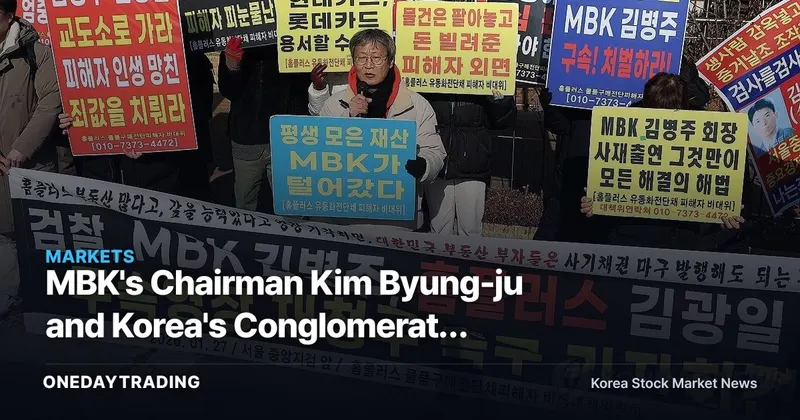
The most prominent example is the management dispute over Korea Zinc between the Yongpoong–MBK alliance and the Choi family. When the stake calculations between two families that had long co-managed the group fell out of balance, outside capital sided with one party, escalating the situation into an attempted hostile takeover. On the other hand, Homeplus, the large retailer MBK had previously acquired, entering corporate rehabilitation proceedings showed that private-equity-led acquisitions don't always end in success.
This is the backdrop for market calls that "whoever created the problem must clean it up" — a demand that the parties who diluted ownership and loosened the chain of accountable management should ultimately bear responsibility for resolving the fallout. It echoes the lesson of the 2008 financial crisis, when conglomerates that collapsed under excessive debt-driven expansion offer a cautionary parallel now being revisited.
Structural Background
Many Korean listed companies have low direct equity stakes held by controlling families and have instead maintained management control through circular shareholding and friendly stakes. This structure serves as leverage to control a group with minimal capital during boom times, but it becomes a weakness with thin defenses once outside capital starts accumulating shares.
Private equity funds exploit this gap. Companies with undervalued assets, inefficient business units, or succession disputes tend to become targets. On the other hand, funds typically operate on an exit horizon of around five years, which draws criticism that they skew toward short-term cash-flow improvements and gains from resale rather than long-term value creation.
Impact on Stocks (Tickers) and Sectors
- Korea Zinc: As the direct party to the management dispute, its shares show the greatest volatility depending on changes in share accumulation, treasury stock, and dividend policy. It is a double-edged sword, since the dispute premium could diverge from intrinsic value drivers such as earnings and zinc prices.
- Yongpoong: As the axis allied with MBK, the direction of the dispute and changes in the value of its Korea Zinc stake are directly tied to its corporate value.
- Financial and brokerage sector: If demand for large-scale M&A advisory and acquisition financing rises, it creates revenue opportunities for brokerages' investment banking divisions.
- Mid- and large-cap listed companies with low owner-family stakes: These may be cited as potential next targets for activist investors or private equity funds, drawing expectations of a governance re-rating, but that alone does not guarantee improved earnings.
Bull vs. Bear Scenarios
The bull case holds that intervention by outside capital pressures companies toward shareholder returns and efficiency measures — such as expanded dividends, treasury share cancellations, and divestment of non-core businesses — which can resolve undervaluation. As the governance discount narrows, a re-rating of corporate value becomes possible.
The bear-case variables are equally clear. Share prices propped up by a dispute premium face reversal pressure the moment the conflict is resolved or the accumulating party exits its position. Heavily leveraged acquisitions carry the risk of turning into distress — as seen in the Homeplus case — if interest rates rise or industry conditions worsen, and short-term exit pressure can erode a company's capacity for long-term investment.
Investor Action Points
- For stocks (tickers) involved in disputes, monitor share-accumulation and vote-count developments through equity change disclosures (5% rule filings) and the schedules of extraordinary shareholder meetings and board meetings.
- Check quarterly earnings and operating cash flow to gauge whether the share price is moving on a dispute premium rather than on intrinsic value (earnings and assets).
- For deals with a high proportion of acquisition financing, review interest rate levels and debt maturity structures together, and monitor changes in corporate bond issuance and credit ratings.
- For thematic stocks (tickers) expected to become private equity targets, factor in the risk of expectations being priced in ahead of time, until an actual shareholder-return policy is formally announced.
Korea Zinc: A Real-Time Data Snapshot
Korea Zinc's most recent closing price was 1,128,000 won (+2.73% from the previous day), and the signal combining foreign and institutional investor supply-demand (order flow) with news and momentum reads 🟢 Net Buying Bias. With foreign investors, institutional investors, and momentum all positive, this stock (ticker) may be worth watching.
- ▲ Sustained supply-demand (order flow) — Foreign investors have been net buyers for 5 consecutive days (+1.3 billion won)
- ▲ Dual buying — Foreign investors (+1.3 billion won) and institutional investors (+300 million won) buying in tandem
Recent related news is mixed, with 2 positive catalysts and 2 negative catalysts.
※ Price and foreign/institutional investor supply-demand (order flow) data are provided by Korea Investment & Securities (KIS) and are as of the time of publication.
This article was automatically summarized and analyzed based on the original news report. View original (Yonhap News)