
Key Takeaways
The 454 billion won supply agreement signed by Samsung Electro-Mechanics is the first concrete evidence that the expansion of AI data center infrastructure is structurally pulling MLCC demand higher. What underpins brokerages' decision to raise target prices to 3 million won isn't the order size itself, but the chain reaction it triggers — higher utilization rates, improved ASP, and a margin recovery. The moment the market declares a "4th MLCC cycle," the first question investors should ask isn't whether the cycle is real, but how much of that cycle the current share price has already priced in.
What Happened
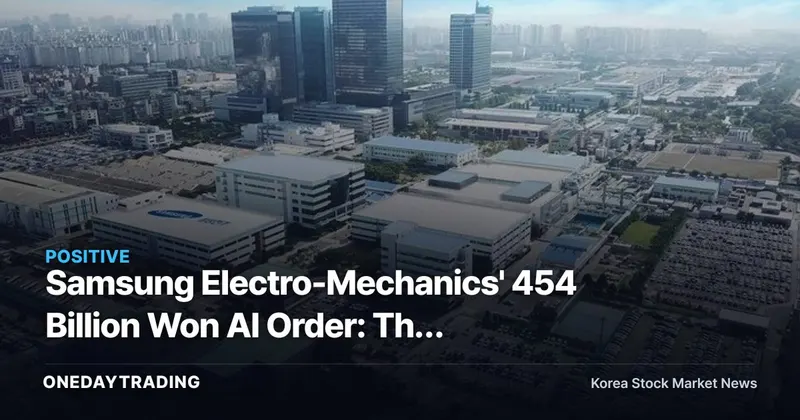
Samsung Electro-Mechanics disclosed a 454 billion won multilayer ceramic capacitor (MLCC) supply contract believed to be for a global Big Tech company's AI data centers. The order size alone makes this a large-scale deal, accounting for a significant share of the MLCC division's annual revenue. Immediately after the disclosure, the stock posted a sharp gain and climbed to the No. 4 spot by market capitalization on the KOSPI, while a string of brokerage reports set target prices at 3 million won, quickly reshaping the upper end of consensus.
MLCCs are core passive components that stabilize the supply and blocking of electric current. While a single smartphone uses about 1,000 of these components, an AI accelerator server requires tens of thousands per unit. As GPU integration density rises, the number of high-capacitance, low-ESL MLCCs needed to filter out power noise grows exponentially. This order is being read as a signal that Samsung Electro-Mechanics has effectively secured verified-supplier status in this high-performance segment.
The industry views this order as the starting point of a "4th MLCC cycle" because the nature of end demand is different this time. After the 1st cycle (smartphones), the 2nd (EV battery management systems), and the 3rd (automotive electronics broadly), AI data centers have emerged as the fourth demand engine. High-capacitance MLCCs for data centers carry a clear price premium over general-purpose products for consumer electronics, meaning that even the same volume translates into a different ASP and margin structure.
Background and Context
Global Big Tech's AI infrastructure investment has moved beyond simply buying GPUs and is now spreading across the entire cooling, power, and passive-component ecosystem. As server cluster scale grows, demand for power-stabilization components increases nonlinearly. Whereas MLCC demand once centered on smartphones and automotive electronics was highly subject to seasonality and inventory-cycle swings, data center demand is tied to Big Tech's annual capex plans, making it relatively more predictable. This is the core reason brokerages are treating this as structural growth rather than a one-off order.
Technological positioning is also a variable in this cycle. High-capacitance MLCCs hinge on the ability to thin dielectric layers to below 1μm, a segment in which Samsung Electro-Mechanics competes head-to-head with Japan's Murata and TDK. As data center customers push to diversify their supply chains, the fact that Samsung Electro-Mechanics has completed technical qualification works in favor of both a stronger order pipeline and greater pricing leverage.
Impact on the Market and Stocks
- Samsung Electro-Mechanics: The direct beneficiary. The 454 billion won order feeds through into higher utilization rates and improved ASP for the MLCC division, accelerating the pace of margin recovery. That said, with the stock already having climbed to the No. 4 spot by market capitalization on the KOSPI, it's hard to rule out that it has entered a near-term zone where expectations are already priced in.
- Domestic MLCC materials suppliers: A rise in Samsung Electro-Mechanics' utilization rate feeds through, with a lag, into higher demand for materials such as barium titanate (BaTiO₃), a key dielectric raw material. The direction is the same, but investors should factor in the time lag.
- Global MLCC competitors (Murata, TDK): In the near term, growth in the overall AI server pie outweighs any zero-sum competition among suppliers. However, the pace at which these rivals simultaneously expand capacity is the key variable determining how well Samsung Electro-Mechanics can defend its ASP.
- AI infrastructure passive-component theme: Passive components used alongside MLCCs for power stabilization — inductors, connectors, and the like — are drawing attention under the same demand logic. How strongly this theme spreads is proportional to Big Tech's capex guidance.
- Samsung Electronics: Any benefit here is indirect. If Samsung Electro-Mechanics' MLCCs and Samsung Electronics' HBM are being supplied to the same AI data center customer, a joint-beneficiary narrative could form — but whether the customers actually overlap needs separate verification.
Investor Checkpoints
- Quarterly revenue-recognition structure: How many quarters the 454 billion won order is recognized over determines the timing of any earnings surprise. Investors should directly check the change in the share of data-center-bound MLCC revenue at Samsung Electro-Mechanics' quarterly earnings releases (typically in January, April, July, and October).
- Big Tech capex guidance: The direct trigger for MLCC demand is the pace at which Meta, Microsoft, Amazon, and Google execute their data center investments. Any downward revision to their quarterly guidance would immediately weigh on the outlook for Samsung Electro-Mechanics' order pipeline.
- Competitors' capacity-expansion plans and ASP trends: If Murata and TDK accelerate capacity expansion in tandem, the supply-shortage premium will be diluted. Tracking both competitors' capex disclosures and Samsung Electro-Mechanics' MLCC ASP in parallel is necessary to judge whether the margin improvement is sustainable.
- Valuation-level check: The 3 million won target price bakes in a fairly optimistic scenario. The faster consensus has been revised upward, the larger the potential multiple pullback if next quarter's earnings fall short of expectations — investors should weigh this risk in advance.
Outlook
The structure of the bullish scenario is solid. AI data center infrastructure investment is likely to continue beyond 2026, and the trend of rising MLCC content per accelerator server is unlikely to reverse short of a technological setback. If this order allows Samsung Electro-Mechanics to build a track record in high-performance MLCCs, its pricing leverage on follow-on orders should also increase. This is the essential basis for the target-price upgrades.
Still, the gap between the narrative and the numbers always needs checking. For the 4th MLCC cycle to lift both utilization and ASP at once, demand must be absorbed quickly without a supply glut forming. If global MLCC makers' capacity expansions overlap, the resulting supply burden could weigh on ASP two to three quarters down the line. The current share price has already priced in a substantial portion of the expectations for the early stage of the cycle — whether data-center-bound revenue actually meets consensus expectations in next quarter's results will be the first test determining whether the valuation is justified.
Samsung Electro-Mechanics: A Real-Time Data Snapshot
Samsung Electro-Mechanics' most recent closing price was 2,205,000 won (+0.96% from the previous day), and the composite signal combining foreign investor/institutional investor supply-demand (order flow) with news and momentum reads 🟢 Buy-leaning. With foreign investors, institutional investors, and momentum all positive, this stock (ticker) is worth watching.
- ▲ Supply-demand (order flow) continuity — foreign investors net-bought for a 4th straight day (+111.8 billion won)
- ▲ Dual buying — foreign investors +111.8 billion won and institutional investors +43 billion won bought in tandem
- ▲ Trend alignment — short- and medium-term trends aligned to the upside (day +1.0% · 1 week +12.3% · 1 month +10.0%)
- ▲ 52-week range position — 91% toward the upper end of the 52-week range — near record-high territory
※ Price and foreign/institutional investor supply-demand (order flow) data are provided by Korea Investment & Securities (KIS) and reflect the time of publication.
This article is content automatically summarized and analyzed based on the original news report. View original article (Maeil Business Newspaper, Securities)