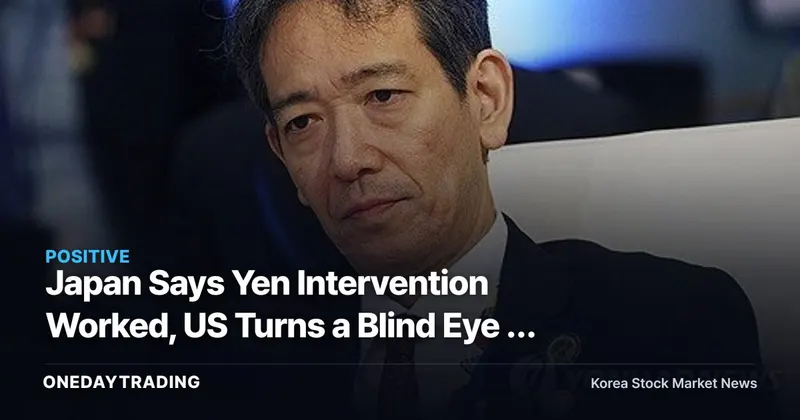

At a Glance
The head of Japan's foreign exchange authority said the market intervention aimed at defending the yen's value had been effective. The remark came just after the yen slid to its lowest level in 40 years, and it was also confirmed that the US does not oppose the intervention. This reads not as a crack in monetary policy coordination, but as a sign that room for further action remains.
Why It Matters Now
The root cause of the weak yen is the interest rate gap between the US and Japan. Intervention cannot close that gap. Selling dollars to buy yen is less a tool for reversing the trend than one for slowing the pace of decline. Still, there's a separate reason markets are reacting to this remark: the fact that the US isn't opposing the intervention itself signals a lower chance that Washington would push back with issues like a currency manipulator designation if Japan intervenes again. In effect, Japanese authorities now have more room to deploy their ammunition.
This dynamic carries straight over to the won. The won and the yen, as currencies of Asian exporting economies, tend to move together closely. If the yen finds a floor, the KRW/USD exchange rate may also get some relief from further downward pressure. Conversely, if the intervention fails and the yen sets a fresh low, the won is likely to face renewed weakening pressure as well. What the market has priced in so far is relief that "the intervention worked" — what it hasn't yet priced in is whether that relief holds until the next Bank of Japan (BOJ) meeting.
FAQ
- Q. Why did the yen weaken to a 40-year low? A. As the US maintained high interest rates while Japan kept rates comparatively low, yen-selling aimed at capturing the rate differential accumulated over time.
- Q. What exactly does market intervention involve? A. It's a measure in which Japanese authorities sell their dollar holdings and buy yen to artificially slow the pace of the yen's decline.
- Q. Why does it matter that the US isn't opposing this? A. When the US raises objections to an ally's foreign exchange intervention, the political burden grows — this time, that risk has diminished.
- Q. What's the impact on the won? A. Since the won and yen tend to move in tandem as Asian exporter currencies, if the yen's decline stabilizes, the won could also see somewhat reduced pressure toward further weakness.
Related Stocks/Sector Impact
- Hyundai Motor·Kia: They compete directly with Japanese automakers like Toyota and Honda in overseas markets. A prolonged weak yen favors the price competitiveness of Japanese cars, but if the yen's slide stabilizes, that gap narrows.
- POSCO Holdings·Hyundai Steel: They compete with Japanese steelmakers in export markets. The cost and price competitiveness gap that widened due to the weak yen could ease.
- Shipbuilders such as HD Hyundai Heavy Industries: Since they compete with Japanese shipbuilders for orders, the yen's level affects negotiating leverage on order pricing.
- Large-cap KOSPI stocks with heavy export exposure overall: If the won continues to weaken alongside the yen, export unit prices become more favorable, but the burden of raw material import costs also rises — a double-edged effect.
Investment Considerations
- Intervention is a tool for slowing the pace, not reversing the trend. As long as the US-Japan rate gap doesn't narrow, the possibility of renewed yen weakness remains open.
- Won-yen co-movement is a tendency, not a fixed rule. Domestic supply-demand (order flow) factors — such as foreign investor flows and the trade balance — could cause divergence.
- There's a time lag before expectations of improved export competitiveness translate into actual earnings. Investors should distinguish between short-term stock price reactions and the earnings impact that shows up next quarter.
- Whether and how strongly Japan intervenes again is at the authorities' discretion, making it difficult to predict. It's worth distinguishing between rhetoric in official statements and the actual scale of funds deployed.
Overall Outlook
In the optimistic scenario, the intervention stabilizes market sentiment, the yen and won both form a bottom together, and concerns over eroding relative competitiveness for exporters ease. The risk is that, as long as the US-Japan rate gap persists, the intervention's effect proves only a temporary reversal, with the yen again testing new lows and pressure for won weakness building back up. The next things to watch are the outcome of the Bank of Japan's (BOJ) monetary policy meeting, the release of the US Consumer Price Index (CPI), and whether the KRW/USD rate tests its upper range again.
This article is automatically summarized and analyzed based on the original news report. View original (Yonhap News Agency, Securities)