
The crux of this issue is not ONE Store, the unlisted app-market subsidiary itself, but the direction of the portfolio restructuring at its listed parent company, SK Square. From an investor's perspective, a subsidiary sale can be read two ways. Selling off a non-core asset to recover cash and simplify the asset base around SK Hynix is a positive signal for a holding-company-style business trading at a large NAV discount; but if the lowball sale alleged by the union materializes, the low recovery value dilutes the very benefit of the restructuring. Even for the same sale, the price and process determine how the stock is valued.
Three-Line Briefing
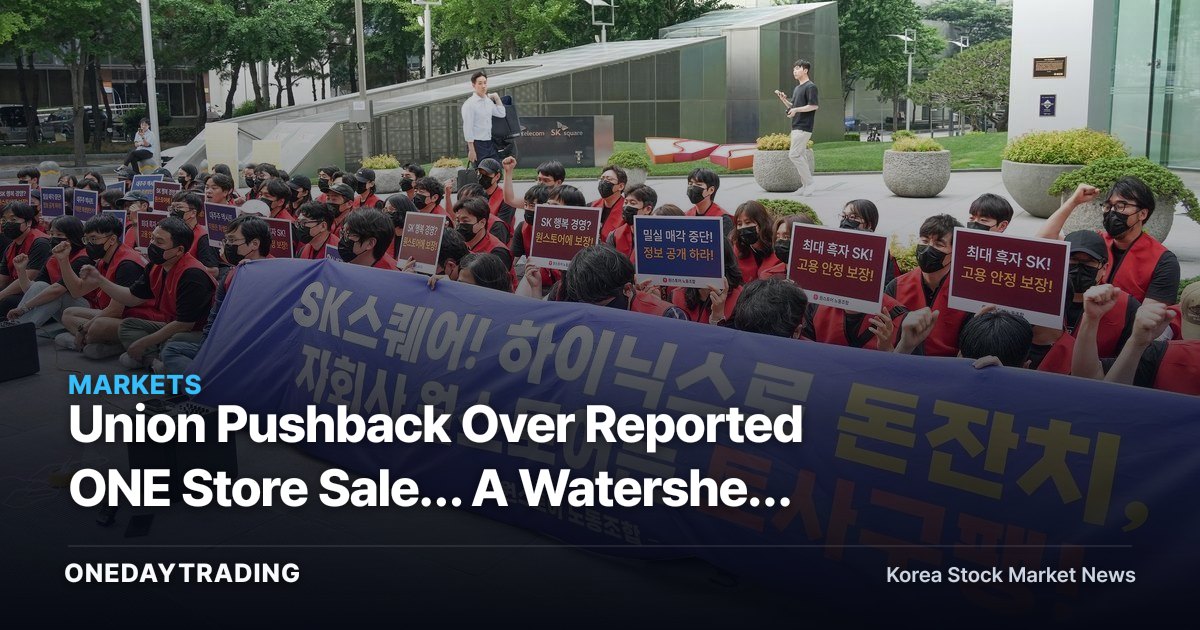
- The ONE Store labor union held a rally in front of parent company SK Square's headquarters, demanding a halt to the behind-closed-doors, lowball sale and job security.
- ONE Store is an app market under SK Square that withdrew its IPO in 2022, and sale speculation has resurfaced.
- The point of contention is not the sale itself but the sale price, process, and employment-succession terms, which will determine the quality of SK Square's asset restructuring.
What Changes
SK Square has the strong character of an investment-type holding company whose largest asset is its stake in SK Hynix. Platform subsidiaries like ONE Store drew expectations on the strength of their growth story, but expanding market share in a global app-market dominated by the Google-Apple duopoly proved difficult, and the IPO has been put on hold. Selling such an asset to convert it into cash would let SK Square simplify its asset mix around semiconductors and secure funding for shareholder returns and new investments.
The problem is bargaining power and price. The union taking issue with a lowball, behind-closed-doors sale may be a signal that the sale terms under discussion fall short of internal expectations. If the sale price is low, the value-realization effect expected from the restructuring shrinks, and if the conflict over employment succession drags on, there is also a risk that closing the deal itself is delayed.
By the Numbers and Context
ONE Store has a history of pursuing a KOSPI listing in 2022 only to withdraw the offering amid weak demand in book-building. The gap between the valuation the market assigned back then and the sale price now being floated is the essence of this conflict, and because outside investors such as Krafton participated in equity investments, the sale valuation is directly tied to existing shareholder value. That said, as this is still at the speculation stage—with the seller, price, and acquisition candidates not officially confirmed—the certainty of any figures is limited.
Beneficiary and Affected Stocks
- SK Square: If the sale is completed at a fair price, asset simplification and cash recovery would help narrow the NAV discount. Conversely, a lowball or delayed sale would weaken the restructuring effect.
- Krafton: With a history of participating in an equity investment in ONE Store, the sale valuation directly affects the valuation of that investment asset.
- SK Telecom and the SK group holding lineup: The direction of SK Square's asset restructuring is indirectly relevant to the consistency of the group's ICT and semiconductor portfolio strategy.
- Domestic app-market and platform industry sector: A change in the ownership structure of a homegrown app market acts as a medium- to long-term variable for payment-fee dynamics and ecosystem competition.
Risk Check
- This is still at the speculation stage, with the sale price and acquisition candidates unconfirmed, so the deal could fall through or its terms could change significantly.
- If union pushback and employment-succession conflicts drag on, it could lead to a delayed closing or increased costs.
- The key driver of SK Square's share price remains the value of its SK Hynix stake, so the standalone impact of a ONE Store sale may be limited.
- If a lowball sale materializes, there is a risk that the very expectation of asset-value realization is undermined.
Bottom Line
A sale of ONE Store could be one pillar of SK Square's asset simplification, but until the price, process, and employment terms are confirmed, it is hard to conclude it is a positive catalyst. It is reasonable to use whether the sale is officially confirmed, the announced valuation, and the progress of labor-management agreement as your confirmation indicators.
SK Square in Real-Time Data
SK Square's latest closing price is 1,501,000 won (+6.23% vs. the prior day), and the signal light combining foreign and institutional investor supply-demand (order flow) with news and momentum is 🟢 Buy Bias. With institutional investors, news, and momentum positive, it is worth keeping an eye on.
- ▲ Trend Alignment — short- and mid-term aligned to the upside (intraday +6.2% · 1 week +34.3% · 1 month +26.1%)
- ▲ 52-Week Position — top of the 52-week range at 99% — new-high territory
- ▲ News Flow — 3 positive catalysts vs. 0 negative catalysts — positive bias
Recent related news is favorable, with 3 positive catalysts and 0 negative catalysts.
※ Price and foreign/institutional investor supply-demand (order flow) data are provided by Korea Investment & Securities (KIS) and are as of the time of publication.
This article is content automatically summarized and analyzed based on the original news. View original (Yonhap News, Industry)