
At a Glance
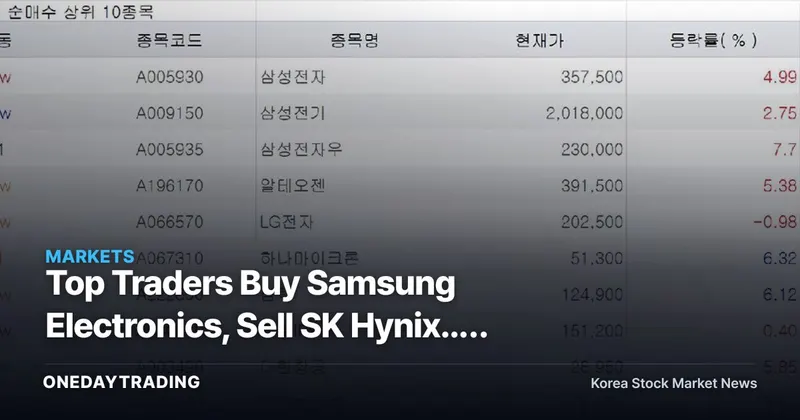
In this morning's trading, the top 1% of investors by returns split sharply by direction: they bought Samsung Electronics and Samsung Electronics preferred stock, while selling SK Hynix, SK Inc., SK Networks, and SK Square. Even within the same large-cap semiconductor space, capital is rotating from one side to the other — a signal better read as a relative re-rating between the two camps than as a simple positive or negative catalyst.
Why It Matters Now
The implication for investors is clear. This trading pattern reflects value-rotation behavior: locking in profits on SK Hynix, which has already rallied on the HBM boom, and redirecting capital toward Samsung Electronics, which has lagged behind. Seeing both buying and selling within the same industry sector suggests the market isn't turning bearish on the semiconductor industry sector itself, but rather weighing the gap in valuation and earnings momentum between individual stocks (tickers).
The buying in Samsung Electronics is underpinned by expectations that its business mix — heavily weighted toward commodity DRAM and NAND — could belatedly gain leverage as memory prices rebound. There's also a view that its catch-up potential in foundry and HBM isn't yet fully reflected in the share price. SK Hynix, by contrast, has already priced in much of its HBM first-mover advantage, which can be read as a stage where the urge to take profits outweighs further upside.
FAQ
- Why did top traders buy Samsung Electronics? — The core logic is Samsung's earnings-recovery leverage from its large exposure to commodity products when memory prices rebound, combined with expectations that the market will start pricing in a narrowing HBM and foundry gap.
- Does selling SK Hynix signal an industry slowdown? — Not necessarily. It's more reasonable to view this as relative-value trading — taking profits on a stock (ticker) where the HBM premium is already priced in and rotating into an undervalued one.
- Why were SK Inc., SK Square, and SK Networks also sold? — As the group's holding company and affiliates, these stocks tend to trade together, so they appear to have become targets for accompanying profit-taking alongside the sale of the core subsidiary.
- Should retail investors copy this trade? — Top 1% trading activity is only a reference indicator, not a standalone basis for a decision, and the very fact that buying and selling are split suggests low conviction on direction.
Related Stocks and Sector Impact
- Samsung Electronics — Net-buy target. As its revenue mix leans heavily toward commodity products, an upturn in the memory price cycle could highlight a larger earnings recovery.
- Samsung Electronics preferred stock — Bought alongside the common shares. Its dividend appeal and discount versus the common stock serve as buying incentives.
- SK Hynix — Net-sell target. With its HBM first-mover premium already priced in, profit-taking pressure is relatively high.
- SK Square, SK Inc., SK Networks — Sold together as an SK group basket. Profit-taking in the core semiconductor stock (ticker) appears to have spilled over into the supply-demand (order flow) for the holding company and its affiliates.
- Semiconductor equipment/materials/parts suppliers — If expectations build for a recovery in Samsung's capex and utilization rates, the positive spillover could extend to back-end and materials suppliers.
Points to Watch
- Morning trading by the top 1% is a short-term trend that can reverse within the same day, not a confirmed signal of a trend.
- Because Samsung's and SK's earnings structures differ, the stock (ticker) that benefits most could shift again depending on memory prices, HBM demand, and the exchange rate.
- Profit-taking in a stock that has already rallied should be distinguished from bearishness on the industry, and should not be mistaken for a deterioration in fundamentals.
- Investors should directly track next quarter's earnings, HBM supply-contract disclosures, and trends in fixed-transaction prices for DRAM and NAND as concrete indicators.
Outlook
In an optimistic scenario, a full-fledged rebound in memory prices would open a window in which Samsung Electronics, which has lagged so far, enjoys both an earnings recovery and a valuation re-rating at the same time. That said, because HBM demand depends heavily on specific customers and the AI capex cycle, the relative advantage between the two stocks (tickers) could flip again at any time depending on shifts in investment spending or price negotiations. The current split between buyers and sellers shows a market where returns hinge on stock selection and entry timing rather than conviction about direction.
Samsung Electronics: Real-Time Data
Samsung Electronics's most recent closing price was 359,500 won (+5.58% versus the previous day), and the composite signal combining foreign investor/institutional investor supply-demand (order flow) with news and momentum reads 🟡 Neutral / Wait-and-see. With positive and negative signals mixed, this is a stretch worth watching closely.
- ▼ Supply-Demand (Order Flow) Streak — Foreign investors have posted net selling for 4 straight days (−181.9 billion won)
- ▲ 52-Week Range Position — Top 95% of the 52-week range — near record-high territory
Recent related news runs 22 positive catalysts versus 21 negative catalysts, a broadly favorable tilt.
※ Price and foreign/institutional investor supply-demand (order flow) data are provided by Korea Investment & Securities (KIS) and reflect figures as of publication.
This article is auto-summarized and analyzed content based on the original news report. View original (Maeil Business Newspaper, Securities)