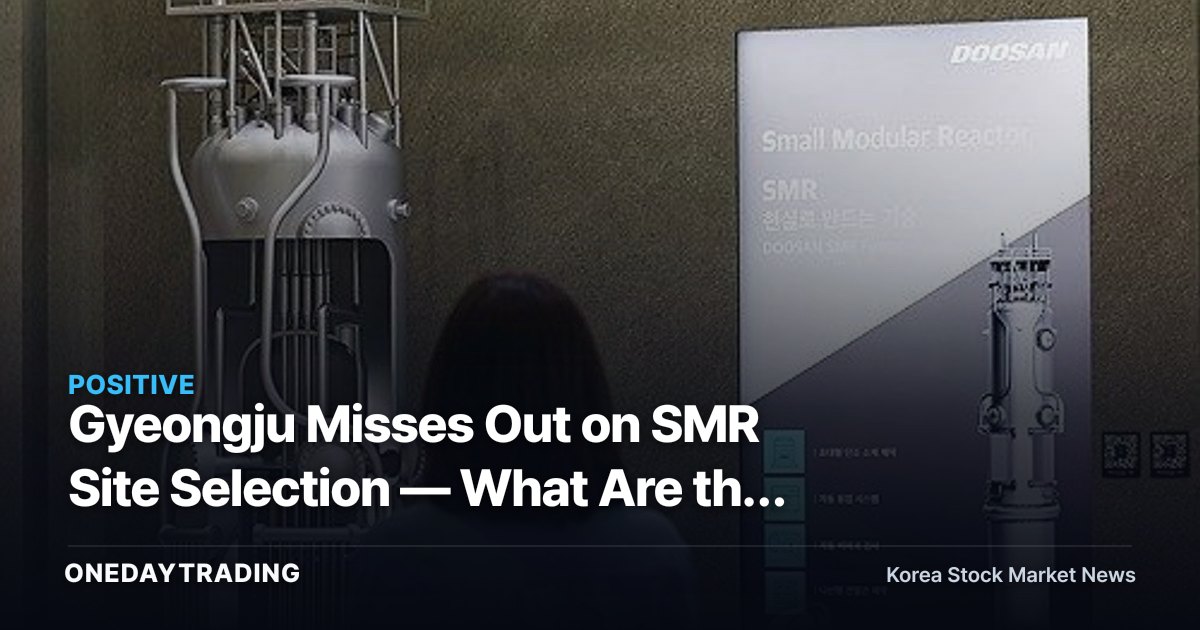

On the surface, Gyeongju's failure to be selected as a small modular reactor (SMR) site looks like one municipality losing a bid to host the project. From an investment standpoint, however, the real takeaway lies elsewhere: regardless of which city was chosen, the government-led national SMR demonstration and industrial-complex program is in fact advancing to its next stage. A confirmed site signals that the value chain running through future permitting, design, and equipment orders is beginning to turn — and the benefit is likely to accrue not to real estate in a particular region, but to the listed supply chain responsible for SMR equipment and design.
Three-Line Briefing
- Gyeongju was dropped from the government's SMR site selection; the city said it accepts the outcome.
- Unlike the municipal hosting contest, the national SMR program itself proceeds on schedule.
- The focus of the benefit is not the region but the nuclear equipment and design supply chain.
What Changes
This decision settles one of the location variables in the SMR program. At the municipal level, Gyeongju pursued its bid on the strength of its existing nuclear infrastructure and the location of Korea Hydro & Nuclear Power's headquarters, but it was edged out in the final round of candidates. Even so, the very fact that the site-selection process moved forward reduces the project's uncertainty by one notch.
The more important change for investors is the visibility of the project timeline. Once a site is fixed, environmental impact assessment, standard design approval, and orders for core equipment proceed in sequence. Unlike large conventional reactors, SMRs are built by manufacturing modules in a factory and assembling them on site, so equipment suppliers capable of repeat production can see a faster turnover of orders — a point that differentiates SMRs from conventional nuclear plants.
The Numbers in Context
SMRs typically refer to small reactors with a generating capacity of 300MW or less, and the government has been pursuing the development of a Korean innovative SMR (i-SMR) as a national policy task. This announcement, however, is limited to the site-selection outcome; key figures such as the specific project cost, order scale, and groundbreaking timing are matters to be disclosed in subsequent steps. It is therefore premature to assume that earnings will flow through to theme stocks at this point, and until order disclosures emerge, it is more reasonable to view this as a phase in which expectations are being priced in ahead of the fundamentals.
Beneficiary and At-Risk Stocks
- Doosan Enerbility: As the key domestic manufacturer of SMR main equipment and reactor modules, it has the most direct path to an expanding order backlog as orders materialize.
- KEPCO E&C: A nuclear design specialist whose role could come to the fore in the SMR standard design approval process.
- KEPCO KPS: Its nuclear maintenance and operations service revenue could see medium- to long-term benefits as new reactor types expand.
- Woojin Inotech and BHI: As instrumentation and equipment partners, they could capture spillover from orders, though the scale is highly variable.
Risk Check
- There is a time lag — in the form of permitting delays — between site selection and actual orders and groundbreaking.
- SMR theme stocks have priced in expectations to a large degree, so valuation pressure may have accumulated.
- Momentum can cool quickly if policy or budget shifts, or if the project schedule is adjusted.
- Profit-taking pressure from funds that bought on expectations tied to the regions that lost the bid.
Bottom Line
Gyeongju's elimination is merely a regional issue, while the SMR industry itself is moving to its next stage — a medium- to long-term opportunity for supply-chain companies. Still, until actual order disclosures and project costs are confirmed, this is a phase in which the gap between expectations and earnings warrants caution.
Doosan Enerbility Through Real-Time Data
Doosan Enerbility's latest closing price is 101,100 won (-2.03% versus the previous day), and the signal light combining foreign and institutional supply-demand (order flow) with news and momentum is 🟡 Neutral — Wait and See. With positive and negative signals mixed, this is a phase to watch.
- ▲ News flow — 4 positive catalysts vs 0 negative catalysts — positive bias
Recent related news is favorable, with 4 positive catalysts and 0 negative catalysts.
※ Price and foreign/institutional supply-demand (order flow) data are provided by Korea Investment & Securities (KIS), as of the time of publication.
This article is content automatically summarized and analyzed based on the original news report. View original (Yonhap News, Industry)