
At a Glance
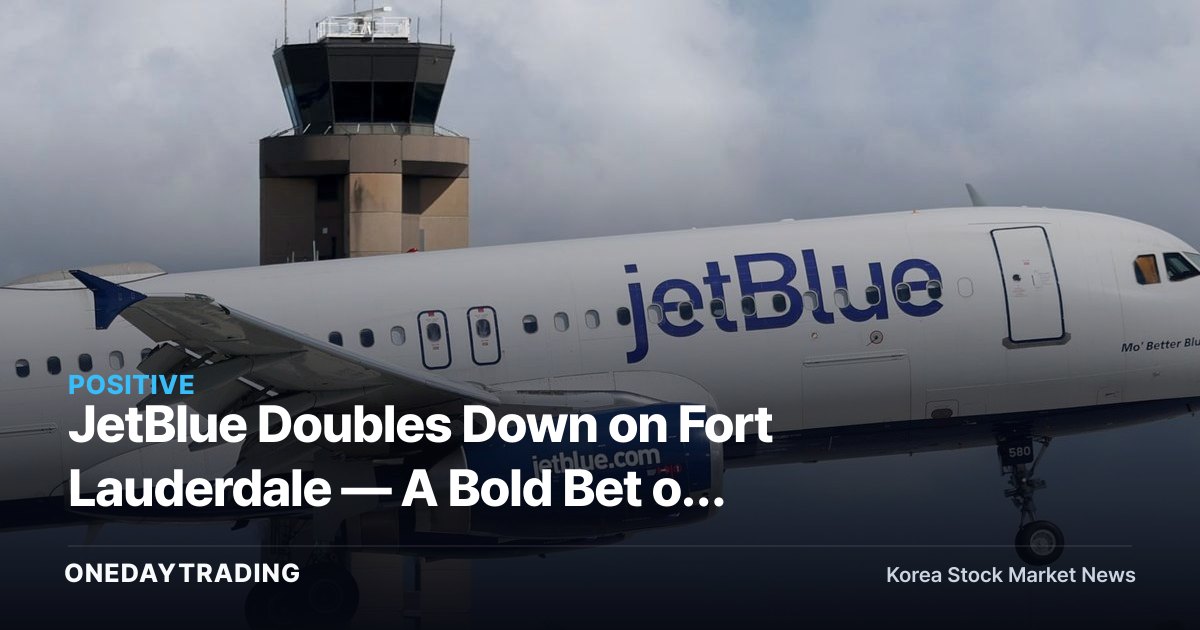
U.S. budget carrier JetBlue Airways has launched a major investment push to build Florida's Fort Lauderdale–Hollywood International Airport into a core hub. The strategy involves opening a new airport lounge and expanding the airport into an international gateway. However, head-to-head competition with American Airlines—which effectively dominates nearby Miami International Airport—is unavoidable, and that rivalry is likely to determine whether the bet pays off.
Why It Matters Now
JetBlue has long shown strength on routes linking the U.S. Northeast with Florida, but it has been criticized for limitations in profitability and route network compared with the major carriers. Located within the Miami metropolitan area yet relatively less congested and carrying lower cost burdens such as landing fees, Fort Lauderdale is seen as an attractive hub for JetBlue as it seeks to maintain its low-cost structure.
What stands out in this investment is that it goes beyond simply adding flights to include stronger high-value services such as a new lounge. This is read as a move to target both higher-yield business and premium demand and international connecting traffic to the Caribbean and Latin America. Since airlines find it hard to protect margins through fare competition alone, securing ancillary revenue and loyal customers becomes the key.
The competitive landscape is daunting. Miami airport is American Airlines' core hub, with an overwhelming share of Latin American routes. For JetBlue to build Fort Lauderdale into an international gateway, it will have to erode that stronghold to some degree, which could lead to downward fare pressure and higher marketing costs.
Frequently Asked Questions
- What kind of company is JetBlue? A New York–based mid-to-large U.S. budget carrier, it has established its position on Northeast and Florida routes by balancing value for money with in-flight service.
- Why Fort Lauderdale rather than Miami? Miami is American Airlines' hub, where competition is fierce and costs are high, whereas Fort Lauderdale offers lower costs and greater room for growth.
- Why does the lounge investment matter? It is a strategy to lift profitability through ancillary revenue beyond fares and by securing premium customers, complementing the limits of the low-cost model.
- How is this relevant to Korean investors? The direct investment target is U.S. airline stocks, but it serves as a reference indicator for reading global air travel demand, oil prices, and the competitive structure of the airline industry.
Impact on Related Stocks and Sectors
- JetBlue Airways (JBLU) If hub expansion and stronger international service succeed, revenue and market share could improve, but the burden of upfront investment costs may weigh on near-term earnings.
- American Airlines (AAL) Intensifying competition on Miami and Latin American routes would increase the burden of defending fares and market share.
- Major U.S. airlines such as Delta and United Sharper competition on Florida and Latin American routes could create fare pressure across the industry.
- U.S. airline and travel/leisure sector A gauge of the recovery trend in international travel demand, tied to travel demand momentum.
- Korean airline stocks such as Korean Air Direct relevance is low, but it serves as an indirect reference indicator for shifts in global airline competition and the oil-price environment.
Points to Watch When Investing
- The airline industry is sensitive to oil prices, exchange rates, and economic cycles, leaving it vulnerable to external shocks.
- In the early stages of hub expansion, facility and marketing costs are front-loaded, which can suppress near-term profitability.
- Competition with American Airlines risks escalating into a bruising fare war.
- For U.S.-listed airline stocks, exchange rates and overseas-stock taxes add extra variables for Korean investors.
Overall Outlook
In an optimistic scenario, Fort Lauderdale could become a turning point that drives a rebound in JetBlue's profitability by absorbing both a low-cost structure and international demand. If premium strategies such as the lounge raise the average spend per passenger, there is room to transcend the limits of being a budget carrier. On the risk side, however, if competition with a formidable American Airlines, the burden of upfront investment, and oil-price and economic volatility all come into play at once, results may fall short of expectations. A balanced approach that separates short-term costs from medium-to-long-term growth potential is needed.
This article is content automatically summarized and analyzed based on an original news report. View original (CNBC)