
Summary
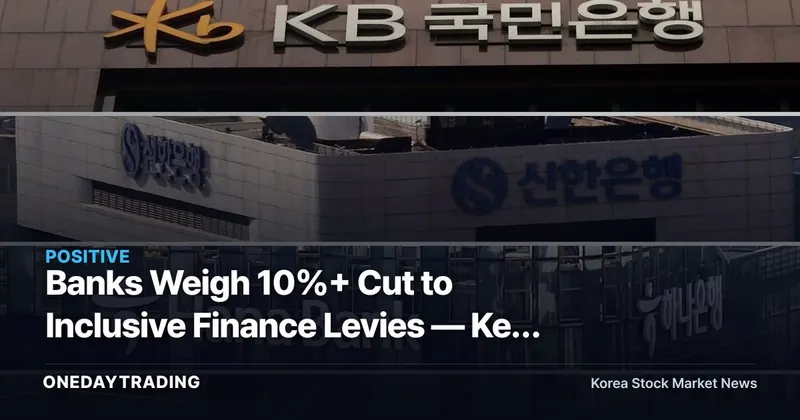
Financial regulators are reviewing a plan to cut mandatory contributions to the Korea Inclusive Finance Agency by more than 10% for banks that demonstrate strong financial-inclusion earnings performance. These levies function as a quasi-tax that banks pay annually on a mandatory basis, so if the reduction is enacted, top-performing banks would see lower operating expenses — directly benefiting net profit and dividend capacity. However, because the size of the cut and its effective date have yet to be finalized, the actual earnings impact is likely to vary across institutions.
Background
The core shift is a move away from a uniform levy structure toward a differentiated system tied to each bank's financial-inclusion performance. Until now, the contributions have functioned largely as a fixed cost proportional to a bank's outstanding household and corporate loan balances. The proposed reform would attach an incentive layer: banks with strong records of lending to low- and mid-credit borrowers or linking to policy-backed inclusive-finance products would qualify for reductions exceeding 10%.
From the banks' perspective, these levies have long been viewed as a burden — a recurring cost disconnected from operating performance. A reduction, therefore, goes beyond simple cost savings; it creates a structure in which banks that excel at financial inclusion also gain a competitive cost advantage. Conversely, underperformers would carry a relatively heavier burden, potentially widening the cost gap between institutions.
Structural Context
The backdrop to this discussion includes mounting public scrutiny of the interest income banks accumulated during the high-rate cycle, as well as a policy intent to have private banks absorb more of the funding needs of low- and mid-credit borrowers. Rather than imposing direct regulations, the authorities are using cost incentives as a carrot to encourage banks to voluntarily expand financial inclusion. The design offers banks regulatory relief while simultaneously rewarding those that align with the policy agenda.
Stock (Ticker) and Industry Sector Implications
- KB Financial Group: Kookmin Bank carries a large absolute levy base given its sizable household and SME loan book, meaning that even a uniform reduction rate could translate into a comparatively large cost saving in absolute terms.
- Shinhan Financial Group: Eligibility for differentiated incentives will hinge on the bank's track record in handling policy-linked inclusive-finance products. The contribution to non-interest expenses and overall earnings warrants close monitoring.
- Hana Financial Group: A levy reduction layered on top of ongoing cost-efficiency improvements could provide a tailwind for the group's SG&A ratio management.
- Woori Financial Group: The size of any reduction will depend on whether the group's financial-inclusion earnings meet the evaluation criteria — making this a key differentiating variable across financial holding companies.
- Kakaobank: As an internet-only bank with a relatively high share of low- and mid-credit loans, it may score favorably on financial-inclusion metrics — though this is a double-edged sword given the associated asset-quality pressures.
Bull vs. Bear Scenarios
On the bullish side, because the levies have historically been a fixed cost unrelated to operating performance, any reduction could flow almost directly to pre-tax income. This would lower the cost burden relative to equity, broadening capacity for shareholder returns such as dividends and share buybacks.
On the bearish side, the uncertainty is real. The reduction rate, effective date, and criteria for designating top-performing banks are still under review, so the actual earnings benefit may be limited. Furthermore, if banks expand lending to low- and mid-credit borrowers to improve their financial-inclusion scores, delinquency rates and credit loss provisions may rise — potentially eroding the gains from the levy reduction. It also bears noting that bank stock valuations are more broadly driven by the interest rate outlook and household lending regulations.
Investor Action Points
- Monitor the regulator's final announcement for confirmation of the reduction ceiling, effective date, and criteria for selecting top-performing banks.
- Track changes in the levy and other operating expense line items, as well as SG&A ratio trends, in each financial holding company's quarterly earnings reports.
- Assess delinquency rates and loan-loss provision trends alongside any expansion in low- and mid-credit lending to determine whether asset-quality costs are offsetting levy savings.
- Watch earnings releases and IR materials to see whether the levy reduction feeds into shareholder return commitments such as dividend payout ratios and share buyback programs.
KB Financial Group — Real-Time Data Snapshot
KB Financial Group's most recent closing price is ₩149,300 (−1.71% vs. prior day). The composite signal integrating foreign investor and institutional supply-demand (order flow), news flow, and momentum reads 🔴 Caution. Foreign investors, institutional investors, news, and momentum are all negative, warranting caution at this time.
- ▼ Supply-Demand (Order Flow) Continuity — Foreign investors have been net sellers for 4 consecutive sessions (−₩9.4 billion)
- ▼ Dual-Side Selling — Foreign investors −₩9.4 billion · Institutional investors −₩3.1 billion selling simultaneously
- ▼ Trend Alignment — Short- and medium-term downtrend aligned (day: −1.7% · 1 week: −5.7% · 1 month: −2.9%)
Recent related news shows 3 positive catalyst items vs. 4 negative catalyst items — a net negative tone.
※ Price and foreign investor/institutional supply-demand (order flow) data are sourced from Korea Investment & Securities (KIS) and reflect the time of publication.
This article is auto-summarized and analyzed content based on the original news source. View original article (Yonhap News — Securities)