
Key Takeaways
Intel's record high is not merely a stock-price event — it is a signal that capital has begun betting again on the revival of the foundry and advanced-packaging businesses that the market had effectively written off. For Korean investors, the crux is how Intel's comeback shakes up the advanced packaging and HBM supply-chain competition that SK Hynix and Samsung Electronics have led.
The hiring of former Vice Chairman Lee Seok-hee, a one-time SK Hynix CEO, reveals Intel's intent to directly absorb memory and packaging expertise, and — coupled with U.S. semiconductor self-reliance policy — has become a variable in the medium-to-long-term reshaping of the supply chain.
What Happened
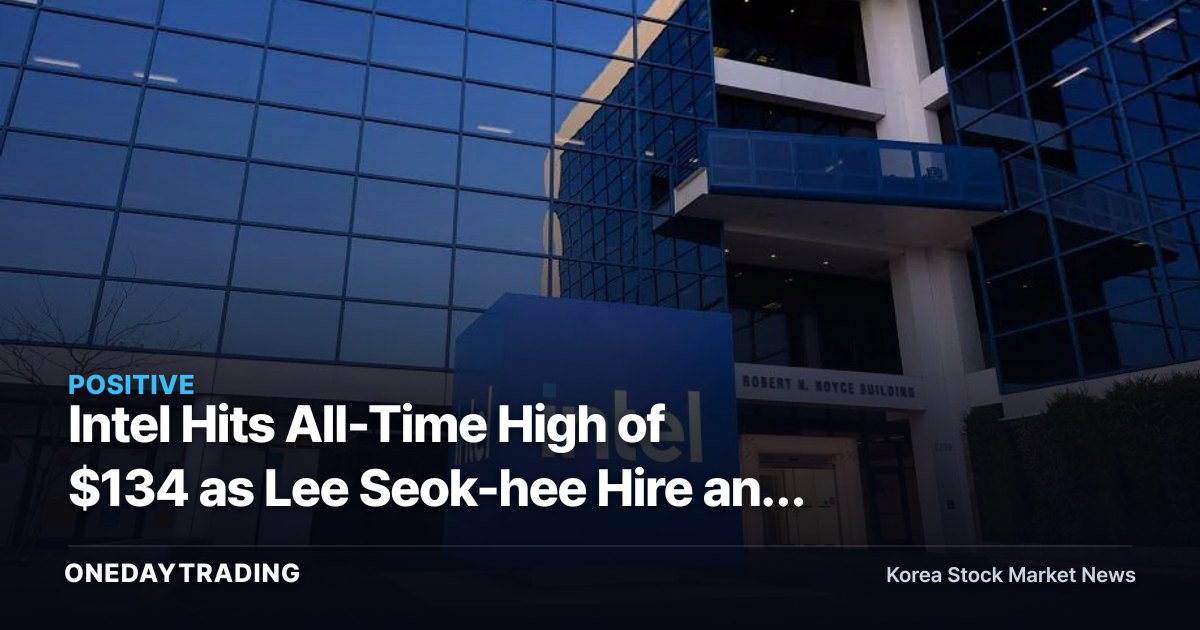
Intel's stock rose 10% in a single day on the 18th to close at $133.99, setting a new all-time high. There were two direct catalysts. First, former President Trump made remarks to the effect that Apple and Intel would partner to produce semiconductors within the United States, bringing expectations of policy benefits to the fore. Second, it emerged that Intel had hired former Vice Chairman Lee Seok-hee, who had served as SK Hynix's CEO, to oversee its advanced-packaging business.
Lee Seok-hee is a seasoned veteran in memory and back-end packaging, and his hiring is read as a move to fill — with Korean talent — the packaging and heterogeneous-integration capabilities that have been pinpointed as Intel's weakness. Intel had been carrying two challenges at once: securing external foundry customers and restoring the competitiveness of its own process technology. The prospect of partnering with a major customer like Apple carries significant weight in terms of utilization rates and credibility.
That said, it should be noted that Trump's remarks carry a strong flavor of political messaging rather than a formal contract, and the actual mass-production volume and timing have yet to be confirmed.
Background and Context
Intel has lost the market's trust over the past several years amid foundry losses and process delays, and it has been sidelined in the AI-semiconductor cycle led by Nvidia and TSMC. The U.S. government is pushing the reshoring of the semiconductor supply chain as a core industrial policy, and Intel is the leading candidate to benefit most from that policy.
As the limits of process miniaturization draw near, advanced packaging has emerged as a key technology for boosting performance, becoming — alongside HBM — a central axis of the memory and back-end competition. Intel's hiring of key Korean talent in this domain, where Korean firms have led, is an expression of its determination to catch up technologically.
Impact on the Market and Stocks
- Intel (INTC): Direct upside momentum, as expectations of policy benefits and the securing of Apple as a customer are reflected simultaneously. However, given the stock's short-term surge, the key question is whether it translates into actual orders and earnings.
- Apple (AAPL): If the U.S.-based production partnership takes concrete shape, it would diversify the supply chain and ease policy risk. Conversely, the burden of higher costs is a variable.
- SK Hynix: The departure of key packaging talent is a factor raising competitive intensity over the medium-to-long term. The short-term earnings impact is limited, but the number of rivals to contend with in the talent-and-technology competition grows.
- Samsung Electronics: It cuts both ways — if Intel catches up in foundry and packaging with U.S. policy support, competition to attract customers could intensify.
- TSMC: A revival of Intel's foundry is a long-term threat to erode market share, but the short-term technology gap remains wide.
Investor Checkpoints
- Check the next quarterly earnings release and press materials to see whether the Apple-Intel partnership moves beyond verbal remarks into actual mass-production contracts and volume disclosures.
- Examine whether the quarterly loss reduction at Intel's foundry (IFS) division and the number of external customer orders show an improving trend.
- Monitor related technology announcements to see whether Intel's advanced-packaging roadmap and mass-production schedule take concrete shape following the Lee Seok-hee hire.
- Track, on a policy-calendar basis, the actual disbursement of subsidies under U.S. semiconductor support policy and any change in the intensity of pressure on Korean firms.
Outlook
The optimistic scenario is one in which U.S. policy support combines with the securing of major customers like Apple, allowing Intel's foundry to recover its utilization rate and profitability while the hiring of Korean talent narrows the packaging gap. In that case, there is room for Intel to be re-rated as a late-cycle beneficiary of the AI cycle.
Conversely, the risks are clear. The stock has already surged, so much of the expectation is priced in, and it will take time and verification before remarks and partnership intentions convert into actual revenue. If the foundry's turn to profitability is delayed or the Apple partnership fails to translate into concrete volume, the valuation burden could boomerang. For Korean firms, this is a threat — but at the same time, room coexists to find partnership opportunities amid the reshaping of the U.S. supply chain.
This article is content automatically summarized and analyzed based on the original news report. View original (Maeil Business Newspaper, Securities)