
Summary
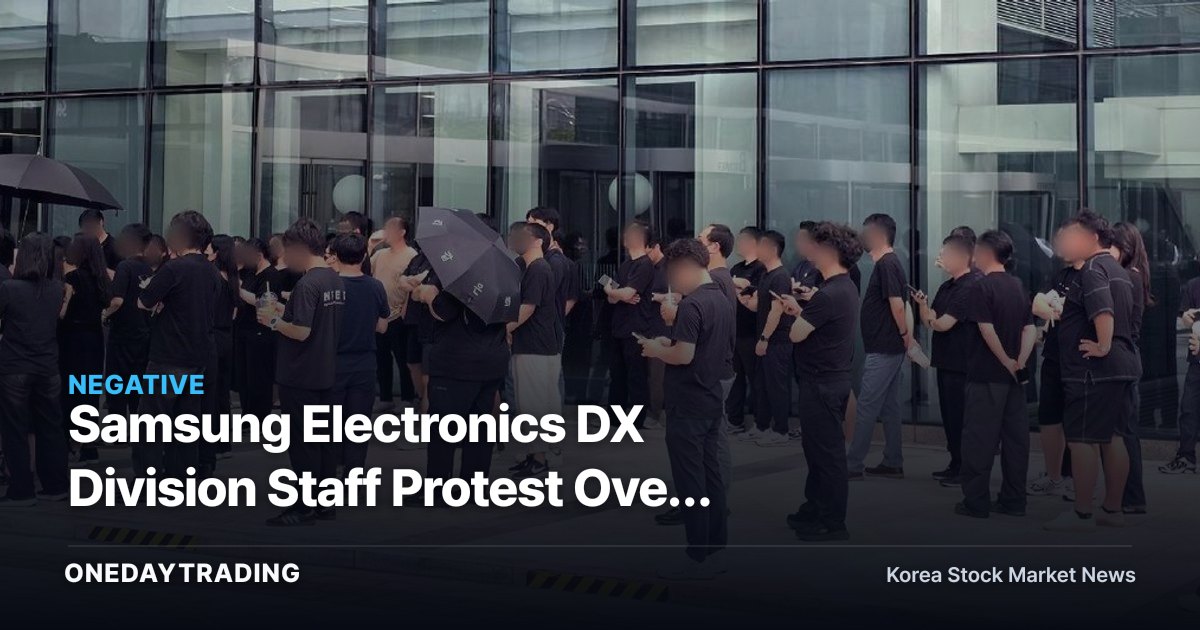
Dissatisfaction over performance bonuses among employees in Samsung Electronics' DX division — which oversees the company's finished-product businesses — is spilling over into visible action, including a "wear black" campaign and rising union membership. This is not merely an internal dispute but a signal that ties slowing DX profitability to future labor-cost and labor-relations bargaining pressures, and it could act as gradual pressure on Samsung Electronics' operating cost structure and investor sentiment.
Why Investors Should Watch
Performance bonuses are variable labor costs linked to earnings. The fact that grievances have built up enough for employees to take to the streets is evidence that the DX division's profit strength has fallen short of expectations, and as the union's bargaining power grows, demands for fixed-cost wage increases could intensify going forward.
What Happened
Employees in the DX (Device eXperience) division — responsible for finished products such as home appliances, TVs, and smartphones — have launched a collective "wear black" campaign at the Suwon site in Gyeonggi Province. Led by the Donghaeng Union, the campaign has drawn continued participation since a certain point, and union membership was observed rising over the same period.
The core issue is dissatisfaction with how performance bonuses are calculated and sized. As a perception took hold among employees that the finished-product business receives an insufficient share of rewards compared with the semiconductor (DS) division, individual grievances are turning into an organized expression of dissent.
Structural Background
Samsung Electronics has traditionally maintained a labor-management consultation-centered culture, but in recent years the formation of multiple unions has shifted the bargaining landscape. With DX division margins under pressure from softening demand and intensifying competition in the global home appliance and smartphone markets, a reduction in variable compensation such as performance bonuses is likely to make employee grievances recur structurally.
Ripple Effects Across Stocks and Sectors
- Samsung Electronics: The subject of the issue. The DX division's labor-management conflict could weigh as a labor-cost bargaining burden and a short-term productivity variable. That said, the company's profit center still rests on semiconductors, so the immediate hit to earnings is limited.
- LG Electronics: As a home appliance and TV competitor, it shares the same labor-cost environment and wage-increase trends. It serves as a gauge of labor-cost pressure across the industry sector.
- SK hynix: Not a direct party, but the debate over the bonus gap between semiconductors and finished products could fuel intensifying competition over talent compensation during a memory upcycle.
- Home appliance and electronic-component suppliers: They could be indirectly affected through downstream order flow if the DX division changes its production and procurement policies.
Bull vs. Bear Scenarios
On the bullish side, this issue may amount to no more than incidental noise in a phase where a semiconductor recovery drives company-wide earnings. If labor negotiations conclude amicably and DX demand improves, compensation grievances should ease naturally.
On the bearish side, there is a risk that expanding union membership strengthens bargaining power, raises labor costs structurally, and delays the recovery of DX division margins. The clear variable is that if the collective action drags on or spreads to other business units, cost and reputational burdens would grow.
Investor Action Points
- Check the DX division's operating margin and labor-cost trend at the next quarterly earnings release.
- Track changes in union membership rates and the progress of collective bargaining over wages and performance bonuses.
- Examine shifts in the weighting of semiconductors versus DX within company-wide profit to gauge the true significance of the labor issue.
- Use the labor-cost and labor-relations trends of peer appliance makers such as LG Electronics as a comparative benchmark.
Samsung Electronics by the Real-Time Data
Samsung Electronics's latest closing price is 362,500 won (+4.62% from the previous day), and the traffic-light signal combining foreign and institutional order flow with news and momentum is 🟢 Buy-leaning. With foreign investors, institutional investors, news, and momentum all positive, the stock warrants attention.
- ▲ Dual-engine buying — foreign investors +872.7 billion won · institutional investors +689.0 billion won buying in tandem
- ▲ Trend alignment — short- and mid-term aligned to the upside (today +4.6% · 1 week +21.2% · 1 month +29.0%)
- ▲ 52-week position — 98% in the upper 52-week range — near new-high territory
- ▲ News flow — 28 positive catalysts vs. 7 negative catalysts — positive catalysts lead
Recent related news is favorable, with 28 positive catalysts and 7 negative catalysts.
※ Price and foreign/institutional order flow data are provided by Korea Investment & Securities (KIS), as of the time of publication.
This article is auto-summarized and analyzed content based on original news. View original (Maeil Business Newspaper, Corporate)