
What the Member-Welfare Event Signals for Investment Decisions
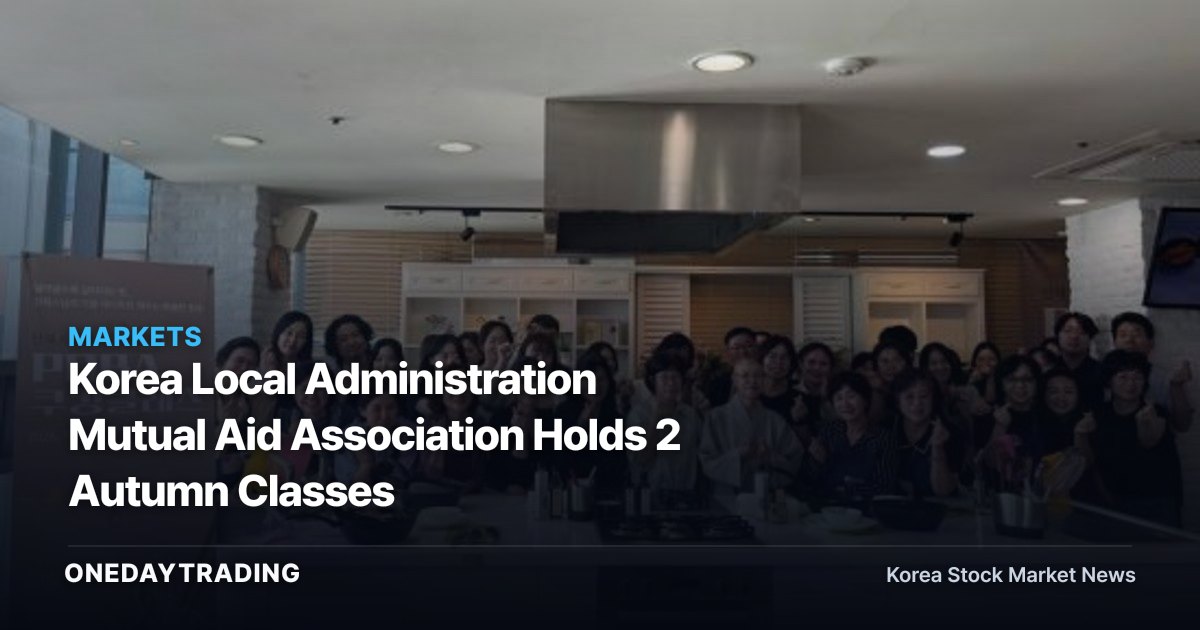
The Korea Local Administration Mutual Aid Association held the “Monk Seonjae’s Autumn Recipes” POBA cooking class with Monk Seonjae. According to Asia Economy Securities, the association announced the event on the 14th, and the program took place on the 5th and 12th. From an investor’s perspective, this news is less about a contract that could move a listed company’s revenue than about how a financial institution allocates resources to member services and designs participation experiences.
The event was organized as a member-welfare program. Members and their companions learned about the taste and value of seasonal ingredients and took part in a hands-on cooking experience. Its significance therefore lies not in a short-term stock-price catalyst, but in the association publicly presenting an operating activity that broadens member engagement separately from financial-product sales or return-rate disclosures.
How the Program Was Structured with Monk Seonjae
Monk Seonjae was introduced as a master of temple cuisine. Based on the core philosophy of temple food, the monk explained cooking methods that preserve the flavor and balance of ingredients, while participants prepared dishes themselves using seasonal produce. The program was designed as more than a simple demonstration, combining learning and practice so members could continue thinking about healthy eating after the event.
The association gave participating members 100% domestically produced soybean oil developed with Monk Seonjae’s involvement. “100%” applies to the fact provided by the Korea Local Administration Mutual Aid Association and is not a figure that can be converted into product sales or the association’s earnings. The number of participants, venue and event cost were not available in the public materials, so there is no basis for calculating cost-effectiveness.
Why Stock-Price and Industry-Sector Effects Should Be Viewed Separately
The direct parties behind the event were the Korea Local Administration Mutual Aid Association and Monk Seonjae. The disclosed information included no supply contract with a listed company, advertising spending, food revenue, change in membership or financial target. Linking a particular food or retail stock (ticker) to the event as a beneficiary would therefore go beyond the facts. From a financial-sector perspective as well, no mechanism was presented by which holding a member-welfare program would change the association’s investment returns or capital ratio.
However, a format in which members participate with companions expands the audience for welfare programs from individual members to accompanying family members. If this format is repeated and participation data accumulates, it could become an operating indicator of which cultural, health or leisure programs attract demand at the association. Conversely, low participation or rising costs could change whether programs continue and how they are structured, but this material contains none of the figures needed to make that assessment.
Confirmed Facts and What to Check Next
An association official said, “Through this cooking class, we hope our members were able to reflect on the meaning of healthy food and create happy memories with their loved ones.” The official added, “We will continue introducing diverse member-welfare programs to support our members’ healthy and happy daily lives.” These remarks describe the direction of member welfare and do not indicate a specific budget, participation target or achievement of results.
The next indicators for investors are follow-up disclosures, not the event’s own stock-price reaction. If the association discloses participant numbers, costs, satisfaction or repeat-participation rates for future member-welfare programs, a minimum basis for comparing operating efficiency will emerge. Continued data could show whether experiential welfare is a one-off event or a regular service. If no additional figures are disclosed, however, there will be limited grounds for directly applying this cooking class to financial earnings forecasts or valuations of related listed companies.
This article was automatically summarized and analyzed based on the original news report. View the original (Asia Economy Securities)