
At a Glance
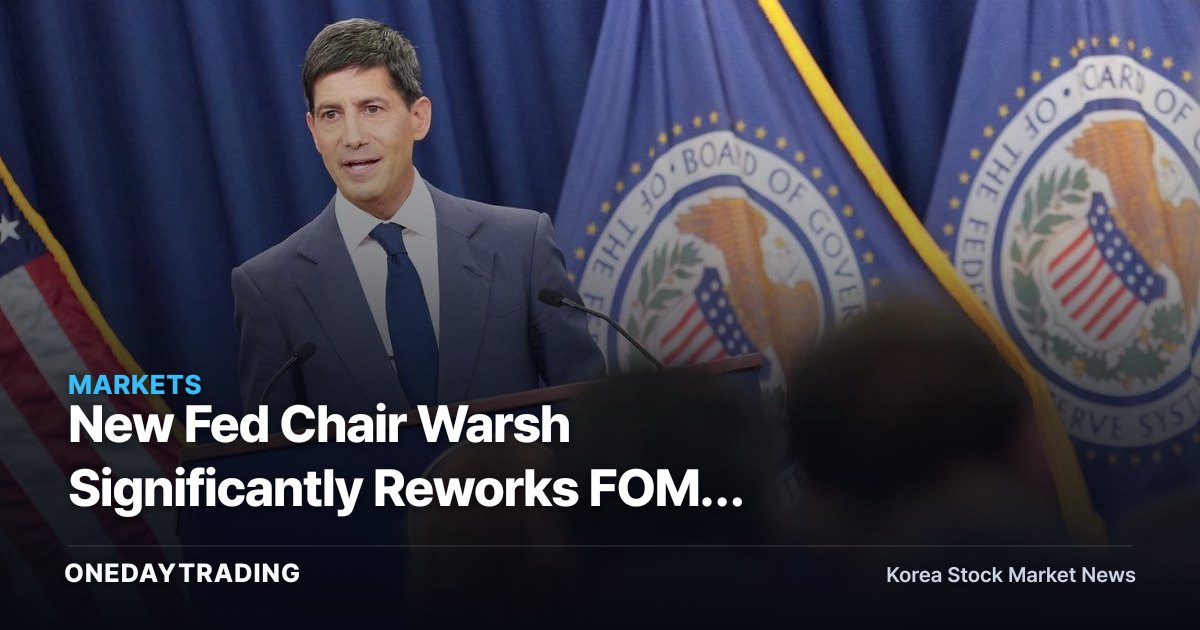
The Federal Open Market Committee (FOMC) statement is the primary text markets read to gauge the future path of interest rates. When a new chair substantially changes the language relative to the prior meeting (April), it is not mere editorial tidying — it suggests the very tone of monetary-policy communication may have shifted. For Korean investors, this is a variable that simultaneously unsettles both rate-cut expectations and the question of dollar strength.
Why It Matters Now
Changes to the statement's wording matter because they are the refined signal the Fed sends to markets ahead of the dot plot or the press conference. If a single adjective describing the assessment of inflation, employment, or growth — or a single conditional clause about patience or room for further tightening — is dropped or added, the bond market immediately pulls forward or pushes back its expected timing of a cut. If a new chair reworks the sentence structure right after taking office, it is read as an intent to stamp their own policy character on the statement, temporarily lowering the predictability of upcoming meetings.
Korean equities sit at the far end of this chain. If the Fed reads as hawkish, the dollar strengthens, the won-dollar exchange rate rises, and pressure for foreign investors to pull capital out increases. Conversely, if a clear signal of cuts emerges, risk appetite revives, which is favorable for KOSPI semiconductor and growth stocks. During a leadership transition, these two scenarios easily clash over the interpretation of a single sentence, so the expansion of volatility itself is a near-term risk.
Frequently Asked Questions
- Does the statement's wording alone determine the direction of rates? No. The wording is only a signal; the actual decision is confirmed afterward by inflation and employment data and the dot plot. That said, it has a strong power to price in market expectations ahead of time.
- How does it affect the exchange rate? A hawkish reading tends to lead to a stronger dollar and weaker won, while a dovish reading tends to do the opposite.
- Is it a positive catalyst for Korean exporters? A weaker won is favorable for the translated earnings of exporters such as Hyundai Motor and Samsung Electronics, but this can be offset if it coincides with an exodus of foreign investor supply-demand (order flow).
- When should I look for confirmation? The release of the next FOMC minutes and the U.S. Consumer Price Index (CPI) are the first points of confirmation.
Impact on Related Stocks and Sectors
- Samsung Electronics & SK Hynix (semiconductors): If rate-cut expectations revive, it favors growth stocks carrying heavy valuation burdens; in a hawkish pivot, foreign investor supply-demand (order flow) could weaken.
- Hyundai Motor & Kia (autos): A weaker won improves export profitability, so these names react sensitively to the direction of the exchange rate.
- KB Financial & Shinhan Financial Group (financials): A prolonged high-rate environment helps defend net interest margins (NIM), but concerns over an economic slowdown weigh as a credit-cost burden.
- Kakao & Naver (internet): As rate-sensitive growth stocks, the clearer the signal of cuts, the greater the room for a recovery in their multiples.
Points to Watch When Investing
- When the interpretation of a single sentence in the statement tilts excessively to one side, reversal volatility can emerge.
- The exchange rate and foreign investor supply-demand (order flow) do not always move in the same direction, so a simple exchange-rate bet — even on exporters — is risky.
- The early period of a chair transition is a transitional phase in which market trust in policy consistency is still forming, making it easy to overreact to one-off news.
- It is safer to adjust position sizing while watching both the U.S. data-release calendar and the won-dollar level together.
Overall Outlook
If the wording was reworked toward strengthening rate-cut expectations, risk appetite may recover, opening a favorable environment for KOSPI growth stocks and foreign net buying. Conversely, if the tone is hawkish and leaves room for further tightening, a weaker won and shrinking supply-demand (order flow) could combine to increase near-term correction pressure. The key is to confirm in the next CPI and minutes whether this change in wording carries through as a consistent message; until then, a realistic approach is to use the exchange-rate level as the first gauge and prepare for volatility.
Samsung Electronics Through Real-Time Data
Samsung Electronics' latest closing price is 346,500 won (+1.02% versus the previous day), and the signal light combining foreign investor and institutional investor supply-demand (order flow) with news and momentum is 🟡 Neutral — Wait and See. With positive and negative signals mixed, it is a zone to watch.
- ▼ Supply-demand continuity — Foreign investors net sellers for 3 consecutive days (−668 billion won)
- ▲ Trend alignment — Short- and mid-term upward alignment (today +1.0% · 1 week +14.5% · 1 month +28.1%)
- ▲ 52-week position — 92% of the 52-week high band — new-high territory
- ▲ News flow — 25 positive vs 5 negative — positive catalysts dominate
Recent related news is favorable, with 25 positive and 5 negative items.
※ Price and foreign/institutional investor supply-demand (order flow) data are provided by Korea Investment & Securities (KIS) and are as of the time of publication.
This article is content automatically summarized and analyzed based on original news. View original (CNBC)