
At a Glance
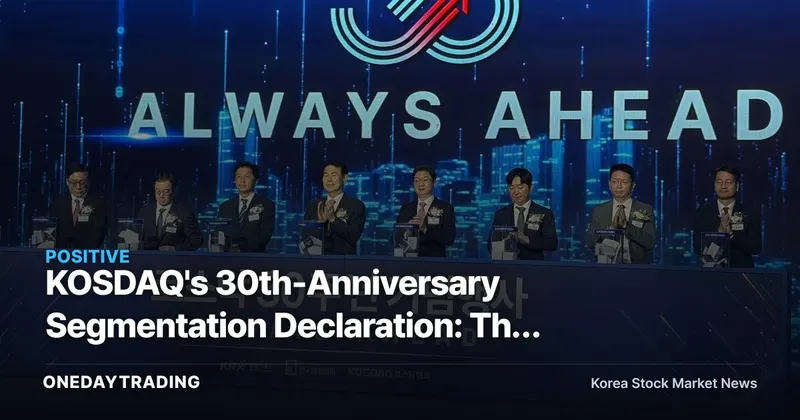
On the day KOSDAQ marks its 30th anniversary, the Korea Exchange (KRX) has rolled out two measures at once: the introduction of a segment that separates out quality companies, and tougher standards for delisting weak companies. It is no coincidence that the index did not react immediately to the announcement. The market is watching the execution timeline rather than the declaration itself, and that gap is now the key variable for KOSDAQ.
Why It Matters Now
KOSDAQ has one chronic structural problem: low foreign ownership. While foreign investors hold roughly 30% of KOSPI's market capitalization, their share of KOSDAQ has been stuck at less than half that level for years. The reason is clear — the index carries a high proportion of weak companies, making it difficult for institutional investors to design benchmarks around it. The new segmentation is aimed directly at this problem.
Once a top-tier segment is created, the supply-demand (order flow) mechanism changes. If stocks (tickers) that meet financial-soundness and growth criteria are grouped into a separate tier, domestic pension funds and global institutional investors can design independent benchmarks within KOSDAQ. If global index providers such as MSCI and FTSE go so far as to track segment-listed stocks (tickers) separately, an entirely new channel for foreign investor order flow would open up — a channel that simply does not exist today.
Tougher delisting standards work through a different channel. Lengthy review periods have allowed marginal companies to linger in the index, which has weighed down KOSDAQ's overall multiple. If the pace of delisting accelerates, the relative weight of blue-chip stocks (tickers) within the index rises, mechanically satisfying the conditions for a multiple re-rating. That said, this effect plays out over the medium term rather than the short term — and it is precisely this execution speed that the market has yet to price in.
Frequently Asked Questions
- Will the new segmentation lift the entire KOSDAQ index? The key story is not the index as a whole but the reallocation of capital within it. Institutional demand is likely to concentrate on stocks (tickers) admitted to the top segment, while lower-tier or general-segment names are likely to be relatively neglected — creating a lopsided flow structure.
- Which types of stocks (tickers) are most at risk from tougher delisting standards? Companies with years of accumulated operating losses and those with a history of qualified audit opinions are the top candidates. The scope of the impact will become clearer once the Exchange specifies exactly which metrics will be tightened as delisting criteria.
- Will foreign investor order flow react to the announcement alone? No. The finalization of segment-admission criteria, incorporation into MSCI Korea's review, and benchmark resets by major pension funds all need to happen first before the shift in order flow becomes real. That institutionalization process typically takes at least six months to a year.
- Which direction do leading bio and IT names face? Large-cap KOSDAQ bio and IT stocks (tickers) that meet the financial requirements are strong candidates for the top segment. If admitted, an expanded institutional demand base should reduce volatility and add a structural premium to their multiples.
Related Stocks (Tickers) and Sector Impact
- Alteogen: KOSDAQ's largest biotech by market capitalization. With strong pipeline visibility and a solid financial structure, it is a strong candidate for the top segment. Given its currently low foreign ownership, it stands to see the biggest improvement in supply-demand (order flow) if the segmentation effect materializes.
- Ecopro BM: KOSDAQ's leading battery-materials stock (ticker). However, with earnings volatility having widened in recent quarters, whether it benefits will hinge on how heavily financial stability is weighted in the top-segment criteria.
- HLB: A large-cap KOSDAQ biotech whose share price is closely tied to clinical trial events. The key variable is how the segmentation criteria are designed for stocks (tickers) listed under the special bio-listing track.
- KOSDAQ marginal and small-cap stocks (tickers) broadly: The direct casualties of tougher delisting standards. Holding shares of companies with accumulated losses risks trading halts and total-loss scenarios becoming a reality upon delisting.
- Brokerage retail divisions: Brokerages with a high share of KOSDAQ small-cap trading will see reduced trading value in that segment as delisting of weak stocks accelerates. On the other hand, a concentration of capital into blue chips could boost institutional brokerage demand — so the net direction depends on each firm's business mix.
Investment Considerations
- Undefined-criteria risk: The specific metrics for distinguishing the top segment have not yet been disclosed. Buying into presumed segmentation beneficiaries before the criteria are announced amounts to speculative trading.
- Potential implementation delays: Public hearings and rule revisions mean actual implementation could take more than six months. Share prices that rally on initial expectations could give back those gains if implementation is delayed.
- Valuation burden: Many of KOSDAQ's leading blue chips already trade at elevated multiples. There is limited room for segmentation-related expectations to push those multiples meaningfully higher still.
- Risk of holding weak stocks (tickers): With tougher delisting standards on the way, positions in financially fragile names should be reassessed against the delisting-review schedule.
Overall Outlook
This first segmentation declaration in KOSDAQ's 30-year history is arguably the most substantive step yet toward reshaping its supply-demand (order flow) structure. But an announcement and its execution are two different things — and KOSDAQ's 30-year history includes no shortage of reform announcements that never translated into results.
In the optimistic scenario, the segmentation criteria are defined clearly and quickly, dovetailing with MSCI Korea's review schedule. In that case, the multiple premium on KOSDAQ blue chips admitted to the top segment could rise meaningfully from current levels. In the risk scenario, stakeholder pushback complicates the criteria-design process, or the criteria end up so loosely defined that the intended selection effect is diluted.
Three indicators to watch next: the disclosure timeline for the detailed segment-admission criteria, whether the number of delisting reviews for weak companies actually rises, and the point at which foreign investors' net buying in KOSDAQ turns direction. It is these three factors — not the declaration itself — that will determine whether the announcement becomes an actual institutional reform.
This article was automatically summarized and analyzed based on the original news report. View original (Yonhap News Securities)