
3-Line Briefing
- The U.S. Treasury's expanded long-term government bond buyback is a policy aimed at suppressing interest rates, but for Korean investors, it's a variable that simultaneously opens the door to dollar weakness and a reassessment of alternative assets.
- According to Maeil Business Newspaper's securities section report on August 22, the U.S. Treasury announced on August 19 that it would at least double the scale of its long-term government bond buyback program.
- On August 21, the dollar index fell to the 98.6-98.7 range, and Bitcoin broke through the $70,000 mark the previous day.
What's Changing
Dollar weakness and the rebound in gold and Bitcoin are not simply a matter of risk appetite. As the United States wades deeper into the government bond market to suppress long-term rates, investors price in both the benefits of rate stability and the cost of eroding confidence in the dollar. What this really signals is that volatility in U.S. long-term bonds is shaking the central axis of asset allocation, from gold to Bitcoin.
A government bond buyback is a method by which the government repurchases bonds circulating in the market to manage liquidity and prices. Lowering long-term rates can stabilize bond prices, but the underlying causes — fiscal deficits and national debt — remain unchanged. The market has begun to reinterpret the interest-rate problem as a dollar-value problem.
For Korean investors, the first channel is the exchange rate. When the dollar weakens, returns on overseas assets measured in won terms are partially diluted. Conversely, assets like gold, Bitcoin, and silver — which move on declining confidence in the dollar — are once again being called upon as portfolio hedges. On the KOSPI, rather than export stocks, industry sectors sensitive to import costs amid won strength, along with precious-metals and crypto-related stocks (tickers), may react first.
Numbers in Context
Immediately after the U.S. Treasury's August 19 announcement of the expanded long-term bond buyback, the dollar index fell to the 98.8 range, marking its lowest level in three months since May. In the August 21 morning session, the dollar index continued to trade around 98.6-98.7. The market reacted more sensitively to whether the policy signals tolerance for a weaker dollar than to the suppression of U.S. long-term rates itself.
The logic behind gold and Bitcoin differs, but they share the same starting point. Gold pays no interest, so the lower rates fall, the lower the cost of holding it becomes. Bitcoin is more sensitive to institutional spot ETF flows and exchange supply-demand (order flow), but when confidence in the dollar wavers, the narrative of it as a digital alternative asset strengthens. Bitcoin's move past $70,000 is a scene where that narrative has translated into price.
Winners and Losers
- Korea Zinc: Rising gold and silver prices are reflected first in the value of held metal inventories and investment sentiment, rather than smelting margins. However, won strength could partly weigh on revenue converted from exports.
- Coinbase: Rising Bitcoin prices and increased trading value are direct variables for fee revenue. If institutional funds shift toward spot ETFs, the increase in exchange spot trading volume could be smaller than the rate of price appreciation.
- MicroStrategy: The value of its Bitcoin holdings determines the sensitivity of its stock price. In a rising market, its leveraged character becomes more pronounced, but as Bitcoin volatility increases, the discount rate applied also rises.
- Newmont: Rising gold prices push up the per-unit revenue for gold mining companies. If energy and labor costs rise in tandem, the gain in gold prices does not fully flow through to operating profit.
- Korean Air: Dollar weakness works in the direction of lowering aircraft lease payments and dollar-denominated debt burdens. If oil prices rise simultaneously, the cost-improvement effect is offset.
Risk Check
- If foreign capital continues flowing into U.S. AI stocks, dollar weakness could prove short-lived. Should the dollar strengthen again, the joint rally in gold and Bitcoin would lose momentum.
- Rising oil prices support dollar demand and heighten inflation concerns. In that case, expectations for lower long-term rates would be shaken, putting renewed pressure on the multiples of rate-sensitive assets.
- If net ETF inflows and exchange holdings are not confirmed following Bitcoin's break above $70,000, this becomes a phase where the price narrative has gotten ahead of itself.
- If the perception strengthens that the bond buyback fails to resolve fiscal problems, an opposite scenario opens up in which long-term rates and the dollar become unstable simultaneously.
Bottom Line
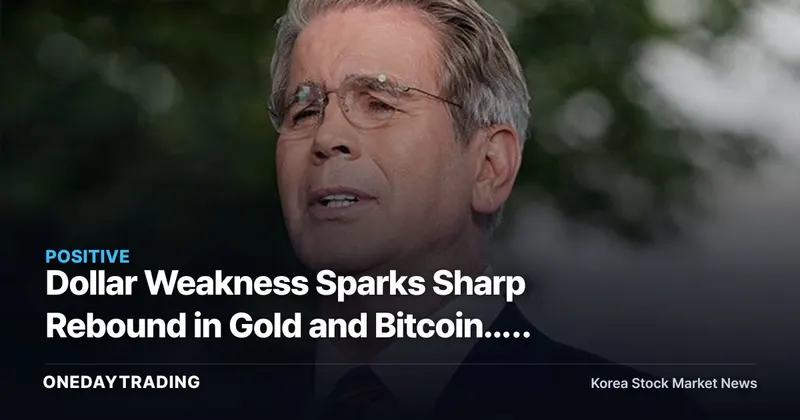
Bessent's expanded long-term bond buyback is favorable for rate stability, but since it is a policy underwritten by dollar confidence, it is a positive catalyst for gold and Bitcoin, and a signal for dollar-asset holders to review their currency hedges.
Frequently Asked Questions
Why does dollar weakness benefit gold prices?
Gold is a leading safe-haven asset traded in dollars, so when the dollar's value falls, the purchasing power of holders of other currencies increases. When interest rates decline, the opportunity cost of holding gold also decreases, creating favorable conditions for gold prices.
What should be confirmed after Bitcoin's break above $70,000?
For Bitcoin's break above $70,000 to be sustained, one needs to watch net inflows into spot ETFs, declining exchange holdings, and whether funding rates are overheating. If the price rises alone while new capital inflows remain weak, volatility increases following the short-term surge.
How does the U.S. long-term government bond buyback affect the Korean stock market?
The U.S. long-term government bond buyback is favorable for growth-stock valuations through expectations of lower long-term rates. However, if dollar weakness leads to won strength, the exchange-rate momentum for large-cap exporters such as automakers and semiconductor companies could weaken.
This article is content automatically summarized and analyzed based on the original news report. View original (Maeil Business Newspaper Securities)