
At a Glance
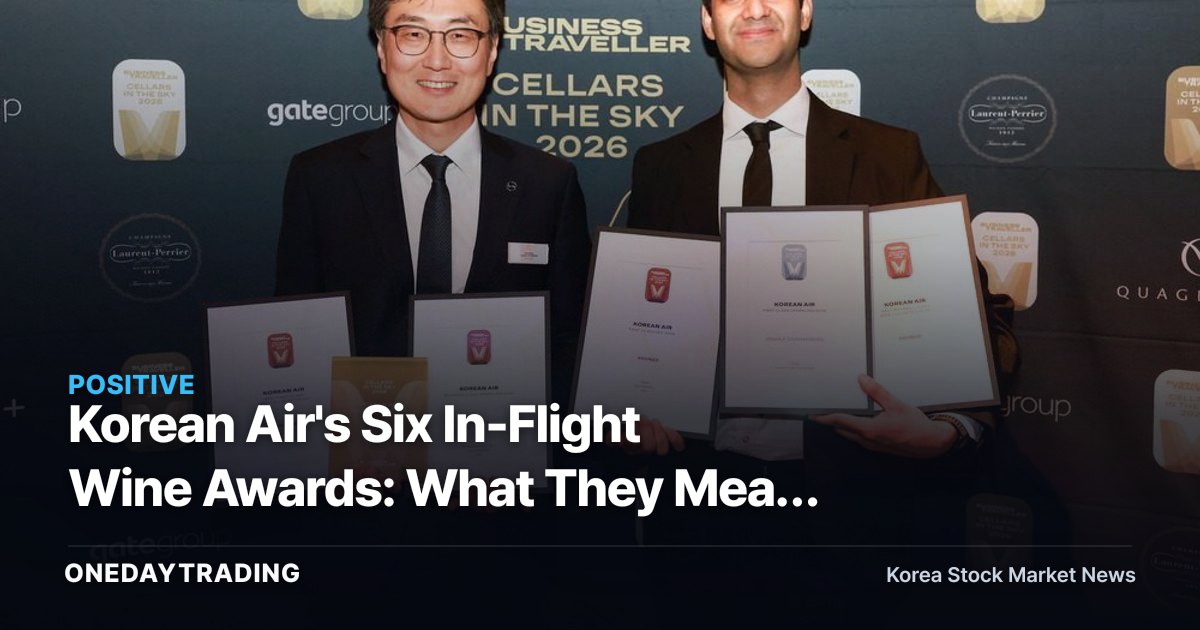
Korean Air won awards in six categories — including one gold medal and four bronze medals — at the Cellars in the Sky Awards 2026 held in the UK. While this may look like one-off brand news, it deserves attention from an airline-stock perspective because the quality of in-flight food and beverage is a non-price competitive factor directly tied to the fare-defending power of long-haul premium seats.
Why It Matters Now
An airline's profitability hinges on revenue per seat. High-yield seats in particular — such as first class and Prestige class — are chosen not on price but on seat pitch, lounge access, and the in-flight food and beverage experience. International recognition for wine and meal quality serves as an intangible underpinning for the occupancy and unit price of these premium seats, and this is a path that can translate into higher yield (revenue per seat) than competitors even on the same routes.
Notably, Korean Air is in the midst of integrating Asiana Airlines. Because the post-integration carrier moves closer to a near-monopoly position on domestic long-haul routes, the importance of a strategy that justifies fares through service quality rather than price competitiveness grows. A repeated track record of international awards becomes supporting evidence that strengthens the integrated carrier's premium brand positioning.
That said, the wine awards themselves are not a variable that changes quarterly earnings. What actually moves airline share prices remains passenger demand, oil prices, the exchange rate, and cargo freight rates. It is more reasonable to interpret this news as a cumulative reinforcement of brand equity.
Frequently Asked Questions
- Do in-flight wine awards directly affect earnings — They are not a variable directly tied to short-term earnings. Rather, they are a long-term brand factor that contributes to premium-seat preference and unit-price defense.
- Why does Korean Air invest so much in food and beverage — Because first class and Prestige class are sold on experience rather than price, in-flight F&B is a key means of differentiation.
- How does this differ from competitors — Repeated wins at awards where global full-service carriers compete strengthen the integrated carrier's premium identity.
- What are the real metrics investors should watch — Not wine, but passenger yield, load factor, oil prices, and the won-dollar exchange rate.
Impact on Related Stocks and Sectors
- Korean Air — The core player. Strengthening the premium brand is favorable for defending the unit price and occupancy of high-yield long-haul seats, and aligns with the Asiana integration synergy narrative.
- Jin Air — A low-cost carrier in the Korean Air group. It will be affected as one axis of the group's aviation portfolio during the post-integration LCC restructuring.
- Airline/transport sector — Highlighting full-service carriers' service competitiveness becomes a differentiating factor for the industry sector during a premium-demand recovery phase.
- Duty-free, in-flight catering, and travel-related plays — An expansion of premium passenger demand is indirectly linked to in-flight catering supply and high-end travel demand.
Points to Watch When Investing
- This news is not a fundamental variable. Share-price judgments must be confirmed by next quarter's passenger and cargo earnings and load-factor disclosures.
- Oil prices and the won-dollar exchange rate are the two major variables in airline costs. Rising oil prices and a weaker won are downside factors that overwhelm the awards effect.
- It is necessary to continually monitor financial-structure variables such as the debt burden related to the Asiana integration and the schedule for winding down subsidiaries.
- If valuations already reflect integration expectations, additional upside room may be limited.
Overall Outlook
In an optimistic scenario, long-haul premium demand stays solid as the integration completes, allowing a picture in which accumulated service competitiveness is converted into higher yield. Conversely, if a surge in oil prices, a weaker won, and rising integration costs coincide, the brand-positive news gets overshadowed by an earnings slowdown. Ultimately, the weight of the investment decision rests not on the wine awards but on the passenger yield and cost structure that will be revealed in the next earnings release.
Korean Air Through Real-Time Data
Korean Air's latest closing price was 27,950 won (-3.12% from the previous day), and the signal light that combines foreign and institutional investor supply-demand (order flow) with news and momentum reads 🟡 Neutral — Wait and See. With positive and negative signals mixed, this is a zone to watch.
- ▲ Order-flow continuity — Foreign investors net buyers for 6 straight days (+32.9 billion won)
- ▲ News flow — Positive catalysts 11 vs. negative catalysts 0 — positive catalysts dominate
Recent related news is favorable, with 11 positive catalysts and 0 negative catalysts.
※ Price and foreign/institutional investor supply-demand (order flow) data are provided by Korea Investment & Securities (KIS), as of the time of publication.
This article is content automatically summarized and analyzed based on the original news. View original (Maeil Business Newspaper — Corporate)