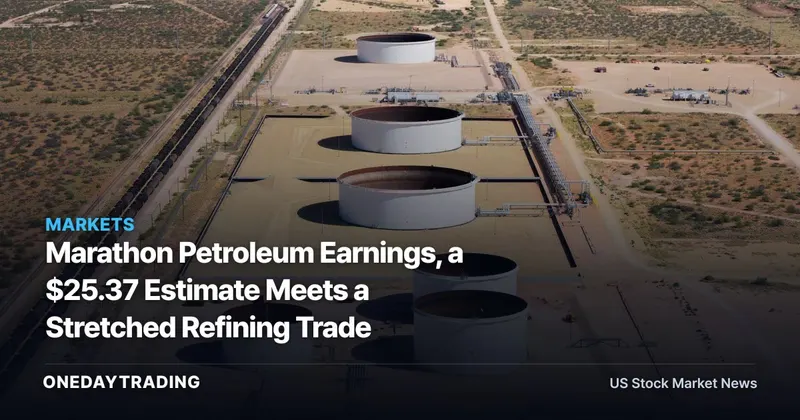
Marathon Petroleum’s Earnings Test
Marathon Petroleum, ExxonMobil, Chevron and ConocoPhillips are preparing to report earnings, with sharp year-on-year increases expected as of CNBC’s 2026-10-29 publication. The strongest numerical setup belongs to Marathon Petroleum, whose upcoming estimate stands at $25.37 per share.
For investors, the tension is straightforward: expected earnings are rising rapidly, while part of the refining trade already carries an unusually strong market move. This reporting cycle therefore tests two different questions—whether the companies deliver the anticipated profit growth and whether those results are strong enough to sustain expectations already reflected in the sector.
An earnings estimate is the market’s pre-report benchmark for earnings per share, not a confirmed company result. The final results, any revisions to capital-spending plans, future oil prices and subsequent stock performance remain unknown.
Why the $25.37 Estimate Raises the Bar
CNBC reported that Marathon Petroleum’s upcoming earnings estimate was $25.37 per share. Three months earlier, Marathon Petroleum produced $17.73 per share against a $14.27 estimate, creating a demanding comparison between the next expected figure and an earlier result that had already exceeded its benchmark.
The longer baseline is more dramatic. Marathon Petroleum earned $4.51 per share one year earlier, while its sales were expected to increase by $13 billion over one year. Those figures establish the scale of the anticipated earnings and sales expansion without confirming how much, if any, will appear in the final report.
The investment significance lies in the expectation gap. A high estimate can support the stock if the reported figure and accompanying outlook validate it; the same benchmark can become a source of pressure if the result or forward commentary fails to clear what investors anticipated. That is a conditional framework, not a forecast, because neither the final result nor the market reaction is known.
ExxonMobil, Chevron and ConocoPhillips were each expected to more than double earnings per share from the prior year. The fact sheet supplies no company-specific estimates for those three businesses, so the quality and magnitude of any eventual surprise cannot be compared with Marathon Petroleum’s $25.37-per-share benchmark before the releases.
The S&P Refining Index Complicates the Earnings Story
The S&P Refining Index was up nearly 160% in 2026, according to CNBC. That advance does not establish where any individual stock will trade next, though it shows that the refining segment entered the earnings period after a substantial move rather than from a position of broad market neglect.
This distinction matters because earnings growth and stock upside are not interchangeable. Earnings describe business performance; market returns also depend on what investors had already anticipated. When an index has advanced nearly 160% during the same period, even a large reported profit may face a demanding standard if expectations have risen alongside the shares.
BTIG chart analyst Jonathan Krinksy argued that caution was warranted in energy and identified concerns in the charts for Valero and Marathon Petroleum. His assessment was technical rather than a reported change in company fundamentals, separating price-pattern risk from the still-unreported earnings outcomes.
Krinksy wrote, “At a minimum we should expect consolidation, but more likely some significant downside reversion.” On Marathon Petroleum specifically, he said the stock “hasn't quite broken its uptrend, but feels like it's coming.” Those comments express an analyst’s view, not confirmation that either consolidation or a decline will occur.
What Investors Are Debating Across Big Oil
- Magnitude versus expectations: ExxonMobil, Chevron and ConocoPhillips are expected to more than double earnings per share from the prior year, yet their final results are unknown. The key test is not the year-on-year direction alone; it is whether the releases validate the level of optimism embedded in those expectations.
- Marathon Petroleum’s comparison: The $25.37-per-share estimate follows earnings of $17.73 three months earlier, when the estimate was $14.27. That sequence raises the benchmark and makes the gap between reported and expected earnings especially important.
- Business momentum versus market positioning: Expected sales growth of $13 billion over one year gives Marathon Petroleum a concrete operating benchmark. The nearly 160% rise in the S&P Refining Index during 2026 provides a separate market benchmark, and the two should not be treated as the same signal.
- Forward investment decisions: Changes to capital-spending plans are unknown. Any disclosed shift would matter because spending decisions indicate how management intends to respond to current earnings conditions, though the fact sheet provides no direction for those plans.
Related Energy Names and the Limits of Comparison
- Marathon Petroleum: It carries the clearest numerical earnings test: $25.37 per share expected, following $17.73 three months earlier and $4.51 one year earlier. Its chart was also among those questioned by BTIG’s Jonathan Krinksy.
- ExxonMobil, Chevron and ConocoPhillips: Each is expected to more than double earnings per share from the prior year. Without final results or company-specific estimates in the supplied facts, no ranking of their earnings strength is supportable.
- Valero: Krinksy expressed concern about its chart alongside Marathon Petroleum’s. No Valero earnings figure is supplied, preventing a fundamental comparison.
- Sinopec: Third-quarter profit increased 57%. This is a separate confirmed energy-sector data point, not sufficient evidence of the results that ExxonMobil, Chevron, Marathon Petroleum or ConocoPhillips will report.
Checkpoints for the Upcoming Earnings Releases
- Final earnings per share: Compare Marathon Petroleum’s reported figure directly with the $25.37-per-share estimate. For ExxonMobil, Chevron and ConocoPhillips, determine whether the expected year-on-year doubling actually occurred.
- Marathon Petroleum sales: Check whether the reported sales trajectory supports the expected $13 billion increase over one year. The expectation alone does not establish the final outcome.
- Capital spending: Review each company’s release and management commentary for any change in spending plans. No change has been confirmed in advance.
- Market response: Separate the earnings result from the stock reaction. The nearly 160% rise in the S&P Refining Index during 2026 and Krinksy’s technical warning make that distinction central to judging whether strong fundamentals were already anticipated.
ExxonMobil, Chevron, Marathon Petroleum and ConocoPhillips Outlook
The constructive case rests on unusually strong expected earnings. ExxonMobil, Chevron and ConocoPhillips are each projected to more than double earnings per share from the prior year, while Marathon Petroleum’s $25.37-per-share estimate sits far above the $4.51 it earned one year earlier.
The risk case comes from the standard those expectations create. Marathon Petroleum’s earlier $17.73 result already surpassed a $14.27 estimate, and the S&P Refining Index’s nearly 160% advance in 2026 suggests that investors have had reason to recognize the sector’s strength before these reports arrive.
The releases must resolve what the estimates cannot: final earnings, sales performance and any shift in capital spending. Until those facts arrive, strong expected growth and elevated technical risk deserve equal weight. The decisive checkpoint is whether reported performance and forward plans justify the expectations surrounding each company, rather than whether the headline numbers look large in isolation.
Market data check: Marathon Petroleum Corporation
Marathon Petroleum Corporation last traded near $423.35 (-3.95%). Our composite signal — blending price momentum and news flow — reads 🟡 neutral. Price momentum scores 18/100 (soft).
Data as of publication. Price via market feeds; for reference only, not investment advice.
📊 Analysis
Signal Neutral
Why Sharp expected earnings growth supports the energy sector, while the S&P Refining Index’s nearly 160% rise in 2026 and BTIG’s chart warning limit the directional case.
This article was independently written by OneDayTrading from public reporting. Read the original (CNBC)