Trump Administration Diesel Waiver: The Investor Read
The Trump administration suspended U.S. sanctions against Russian diesel exports earlier this month, opening a limited supply channel whose relevance for investors lies more in policy optionality than immediate market scale. CNBC reported on 2026-10-27 that the U.S. may permit additional Russian diesel onto the global market depending on Moscow's behavior. The decision directly concerns diesel supply and sanctions policy, but the available figures do not support a company-specific equity call.
The Russian diesel waiver is a suspension of U.S. sanctions that permits covered exports from Russia while leaving further access conditional. Energy Secretary Chris Wright described the measure as “an incentive” for Moscow to end the war in Ukraine. That framing makes policy execution, rather than the announced headline alone, the central variable.
President Donald Trump and President Vladimir Putin Set the Volume
President Donald Trump reached an agreement with President Vladimir Putin for Russia to export 800,000 metric tons of diesel during October and November, followed by another million tons, according to CNBC. Those volumes establish the agreement's intended scale, while the exact timing and shipment sizes within the additional million tons remain unknown.
The first shipment from Russia totals 300,000 tons, equal to about 75,000 barrels per day if distributed over one month, CNBC reported. A second tranche of 500,000 tons is equivalent to about 124,000 bpd. These conversions matter because they translate cargo totals into daily flows that can be compared with the roughly 28 million barrels per day of total global demand cited in the reporting.
Analysts said the agreed diesel volumes would not materially lower prices because the shipments are small beside that 28 million-barrel-per-day demand base. The analytical distinction is important: additional supply can improve availability at the margin without being large enough to reset the broader market balance. The agreement therefore represents a supply increment, not evidence of a durable price outcome.
Russian-Flagged Tanker Talisman Becomes the First Observable Test
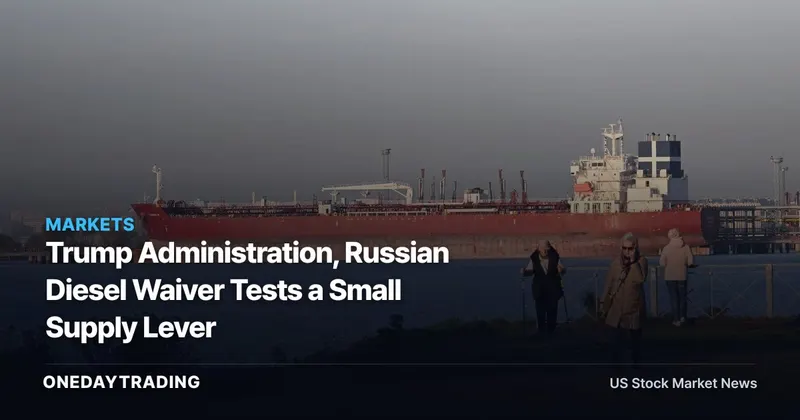
The Russian-flagged tanker Talisman is expected to reach the U.S. East Coast on Nov. 9, according to MarineTraffic. That expected arrival is the clearest near-term checkpoint because it would show the sanctions suspension moving from policy language into a physical cargo flow.
Leruo has also departed Russia for the Atlantic Coast, though it did not explicitly identify the U.S. as its destination. Its final destination is unknown. Energy Secretary Chris Wright said more tankers could “quite possibly” sail under the waiver, but neither the number of additional vessels nor their arrival dates has been established.
For commodity investors, vessel movements separate authorized capacity from delivered supply. The agreement states how much Russia may export across the specified periods; tanker destinations and arrivals show how much of that supply is actually moving through the permitted channel. Until more cargoes are identified, the physical evidence remains narrower than the full volume contemplated by the agreement.
Moscow's Export Ban and the Ukraine Constraint
Kyiv attacked Russian refineries this year, and Moscow implemented a diesel export ban in July. The Kremlin later partially lifted that ban to fulfill the Trump-Putin deal. This sequence creates a practical constraint: the agreement depends not only on U.S. sanctions treatment, but also on Russia maintaining enough export permission to deliver the covered cargoes.
Ukraine's President Volodymyr Zelenskyy sharply criticized the diesel agreement. Several Republican senators and Democratic colleagues also signed a letter condemning it as “a gift to our adversary and a betrayal of our Allies.” The identities of the participating senators were not provided, but the bipartisan opposition establishes political resistance to the policy.
The wider geopolitical setting adds another source of uncertainty. The U.S. and Israel attacked Iran on Feb. 28, while the Russian export arrangement is tied explicitly to Moscow's behavior over the war in Ukraine. These are separate facts in the supply backdrop; the available evidence does not quantify how either will alter future diesel availability.
Commodity-Sector Transmission: Supply Added, Price Effect Limited
- Diesel supply: The waiver permits Russian exports that had faced U.S. sanctions, adding an identifiable source of physical supply to the global market.
- Price sensitivity: Analysts judged the agreed cargoes too small relative to total global demand of around 28 million barrels per day to materially lower prices. That assessment limits the case for treating the waiver as a decisive commodity-price catalyst.
- Shipping visibility: The Talisman offers a dated arrival checkpoint, while Leruo illustrates the uncertainty surrounding destination disclosure. More confirmed sailings would strengthen evidence that the waiver is producing flows beyond the initial cargoes.
- Policy risk: Further access depends on Moscow's behavior, and political opposition spans Republican senators and Democratic colleagues. Either condition can matter before the additional million tons is fully specified.
No listed company is identified in the supplied evidence, and no revenue, cost, margin or exposure data connect the agreement to a particular U.S. stock. Assigning beneficiaries or victims would therefore exceed what the facts support. The defensible market classification is a commodities and policy event with a neutral directional reading: supply rises, while the reported scale is insufficient for a material price conclusion.
Upside and Downside Cases for Russian Diesel Flows
The supply-positive case requires the initial shipments to arrive and additional tankers to sail under the U.S. waiver. If that occurs, the market would receive more Russian diesel, and the additional million tons contemplated by the agreement could become a more concrete flow rather than an unspecified follow-on amount. Even in that case, the analysts' comparison with 28 million barrels per day of global demand argues against assuming a material price reduction from the agreed volumes alone.
The restrictive case centers on conditional policy and incomplete execution. The U.S. has not confirmed whether it will allow further shipments, the waiver depends on Moscow's behavior, and the Kremlin's export ban has been lifted only partially. Political criticism adds pressure without establishing that the agreement will change.
Neither scenario supports certainty. The known cargo totals define the authorized scale, while tanker movements, destinations and Russian export permissions determine realized supply. That gap between agreement and delivery is where the market relevance resides.
Next Checks for the Trump-Putin Diesel Agreement
- Nov. 9: Check whether MarineTraffic continues to show the Talisman arriving on the U.S. East Coast as expected.
- Leruo destination: Look for a declared final destination confirming whether its Atlantic Coast route leads to the U.S.
- Additional sailings: Track whether more tankers depart under the sanctions waiver and whether their cargoes fit within the agreed volumes.
- Policy conditions: Monitor whether the U.S. authorizes more Russian diesel based on Moscow's behavior and whether the Kremlin maintains the partial lifting of its July export ban.
The next meaningful signal is physical, not rhetorical: confirmed arrivals and additional identified cargoes. Until those emerge, the waiver remains a limited supply measure whose strategic significance exceeds the material price effect attributed to its announced volumes.
📊 Analysis
Signal Neutral
Why The waiver adds diesel supply, but analysts said the agreed volumes are too small relative to global demand to materially lower prices.
This article was independently written by OneDayTrading from public reporting. Read the original (CNBC)